


Delaying Iron Therapy until 28 Days after Antimalarial Treatment Is Associated with Greater Iron Incorporation and Equivalent Hematologic Recovery after 56 Days in Children: A Randomized Controlled Trial
- PMID: 27358418
- PMCID: PMC4997284
- DOI: 10.3945/jn.116.233239
Delaying Iron Therapy until 28 Days after Antimalarial Treatment Is Associated with Greater Iron Incorporation and Equivalent Hematologic Recovery after 56 Days in Children: A Randomized Controlled Trial
Erratum in
-
Erratum.J Nutr. 2019 Jul 1;149(7):1294. doi: 10.1093/jn/nxz073. J Nutr. 2019. PMID: 31263880 Free PMC article. No abstract available.
Abstract
Background: Iron therapy begun concurrently with antimalarial treatment may not be well absorbed because of malaria-induced inflammation. Delaying the start of iron therapy may permit better iron absorption and distribution.
Objective: We compared erythrocyte iron incorporation in children who started iron supplementation concurrently with antimalarial treatment or 28 d later. We hypothesized that delayed iron supplementation would be associated with greater incorporation and better hematologic recovery.
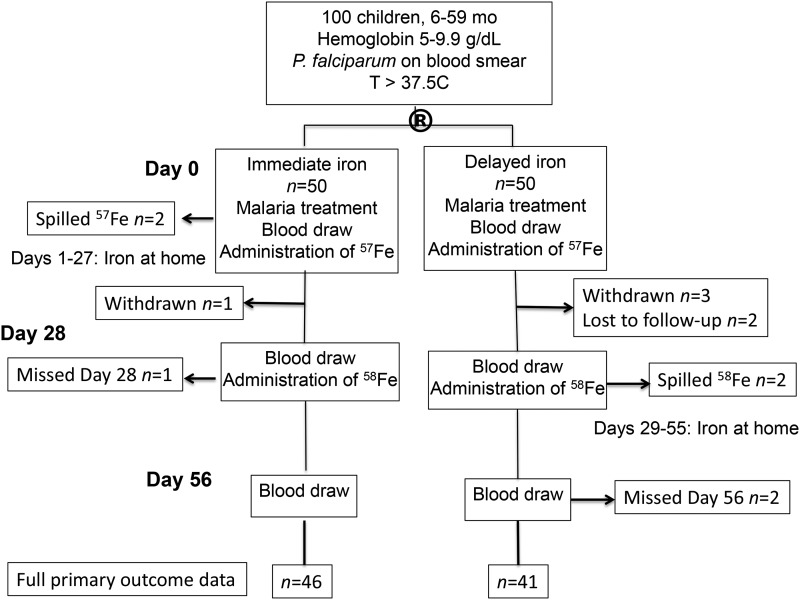
Methods: We enrolled 100 children aged 6-59 mo with malaria and hemoglobin concentrations of 50.0-99.9 g/L who presented to Mulago Hospital, Kampala, into a randomized trial of iron therapy. All children were administered antimalarial treatment. Children with zinc protoporphyrin (ZPP) ≥80 μmol/mol heme were randomly assigned to start iron supplementation concurrently with the antimalarial treatment [immediate iron (I) group] or 28 d later [delayed iron (D) group]. All children were administered iron-stable isotope (57)Fe on day 0 and (58)Fe on day 28. We compared the percentage of iron incorporation at the start of supplementation (I group at day 0 compared with D group at day 28, aim 1) and hematologic recovery at day 56 (aim 2).
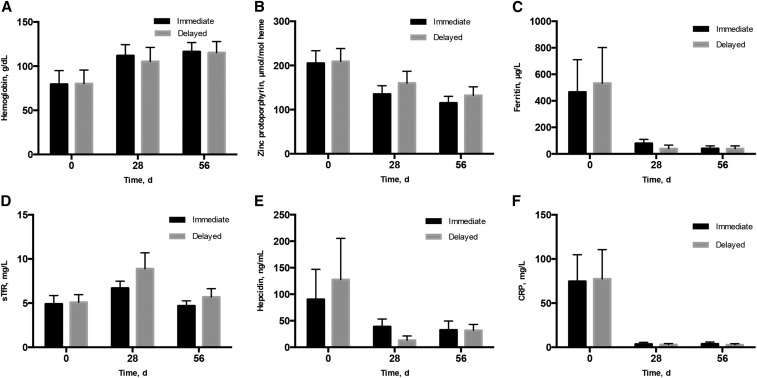
Results: The percentage of iron incorporation (mean ± SE) was greater at day 28 in the D group (16.5% ± 1.7%) than at day 0 in the I group (7.9% ± 0.5%; P < 0.001). On day 56, concentrations of hemoglobin and ZPP and plasma ferritin, soluble transferrin receptor (sTfR), hepcidin, and C-reactive protein did not differ between the groups. On day 28, the hemoglobin (mean ± SD) and plasma iron markers (geometric mean; 95% CI) reflected poorer iron status in the D group than in the I group at this intervening time as follows: hemoglobin (105 ± 15.9 compared with 112 ± 12.4 g/L; P = 0.04), ferritin (39.3 μg/L; 23.5, 65.7 μg/L compared with 79.9 μg/L; 58.3, 110 μg/L; P = 0.02), sTfR (8.9 mg/L; 7.4, 10.7 mg/L compared with 6.7 mg/L; 6.1, 7.5 mg/L; P = 0.01), and hepcidin (13.3 ng/mL; 8.3, 21.2 ng/mL compared with 38.8 ng/mL; 28.3, 53.3 ng/mL; P < 0.001).
Conclusions: Delaying the start of iron improves incorporation but leads to equivalent hematologic recovery at day 56 in Ugandan children with malaria and anemia. These results do not demonstrate a clear, short-term benefit of delaying iron. This trial was registered at clinicaltrials.gov as NCT01754701.
Keywords: Uganda; iron; iron-stable isotopes; malaria; timing of iron therapy.
© 2016 American Society for Nutrition.
Conflict of interest statement
2 Author disclosures: SE Cusick, RO Opoka, SA Abrams, CC John, MK Georgieff, and E Mupere, no conflicts of interest.
Figures
Comment in
-
Iron Supplementation in Children with Malaria: Timing the Treatment.J Nutr. 2016 Sep;146(9):1623-4. doi: 10.3945/jn.116.236463. Epub 2016 Jul 20. J Nutr. 2016. PMID: 27440262 Free PMC article. No abstract available.
References
-
- Sazawal S, Black RE, Ramsan M, Chwaya HM, Dutta A, Dhingra U, Stoltzfus RJ, Othman MK, Kabole FM. Effects of routine prophylactic supplementation with iron and folic acid on admission to hospital and mortality in preschool children in a high malaria transmission setting: community-based, randomised, placebo-controlled trial. Lancet 2006;367:133–43. - PubMed
-
- Nyakeriga AM, Troye-Blomberg M, Dorfman JR, Alexander ND, Bäck R, Kortok M, Chemtai AK, Marsh K, Williams TN. Iron deficiency and malaria among children living on the coast of Kenya. J Infect Dis 2004;190:439–47. - PubMed
-
- Cusick SE, Georgieff MK. Nutrient supplementation and neurodevelopment: timing is the key. Arch Pediatr Adolesc Med 2012;166:481–2. - PubMed
Publication types
MeSH terms
Substances
Associated data
Grants and funding
LinkOut - more resources
Full Text Sources
Other Literature Sources
Medical
Research Materials
