


Cost-Effectiveness of Apixaban versus Warfarin in Chinese Patients with Non-Valvular Atrial Fibrillation: A Real-Life and Modelling Analyses
- PMID: 27362421
- PMCID: PMC4928891
- DOI: 10.1371/journal.pone.0157129
Cost-Effectiveness of Apixaban versus Warfarin in Chinese Patients with Non-Valvular Atrial Fibrillation: A Real-Life and Modelling Analyses
Abstract
Objectives: Many of the cost-effectiveness analyses of apixaban against warfarin focused on Western populations but Asian evidence remains less clear. The present study aims to evaluate the cost-effectiveness of apixaban against warfarin in Chinese patients with non-valvular atrial fibrillation (NVAF) from a public institutional perspective in Hong Kong.
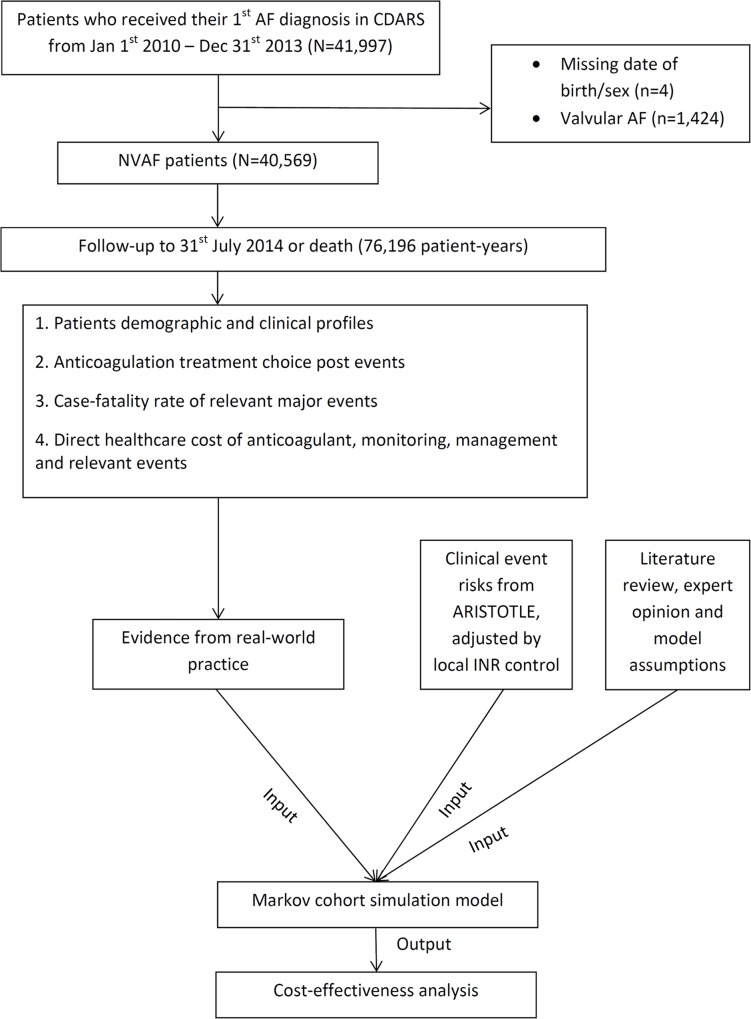
Methods: We used a Markov model incorporating 12 health state transitions, and simulated the disease progression of NVAF in 1,000 hypothetical patients treated with apixaban/warfarin. Risks of clinical events were based on the ARISTOTLE trial and were adjusted with local International Normalized Ratio control, defined as the time in therapeutic range. Real-life input for the model, including patients' demographics and clinical profiles, post-event treatment patterns, and healthcare costs, were determined by a retrospective cohort of 40,569 incident patients retrieved from a Hong Kong-wide electronic medical database. Main outcome measurements included numbers of thromboembolic and bleeding events, life years, quality-adjusted life years (QALYs) and direct healthcare cost. When comparing apixaban and warfarin, treatment with incremental cost-effectiveness ratio (ICER) less than one local GDP per capita (USD 33,534 in 2014) was defined to be cost-effective.
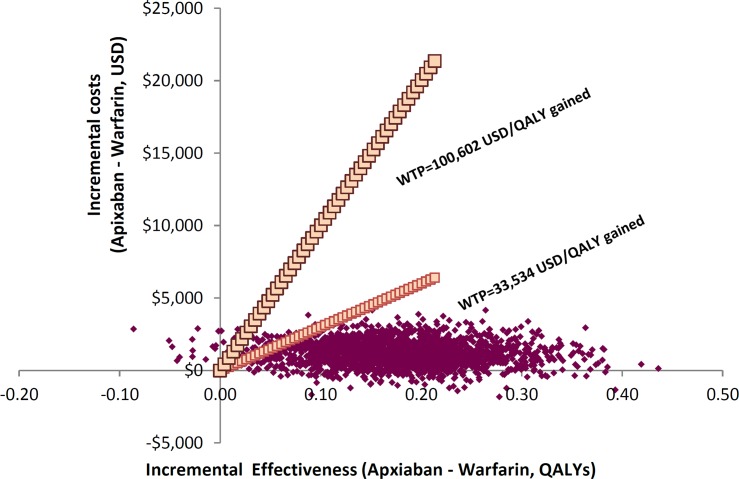
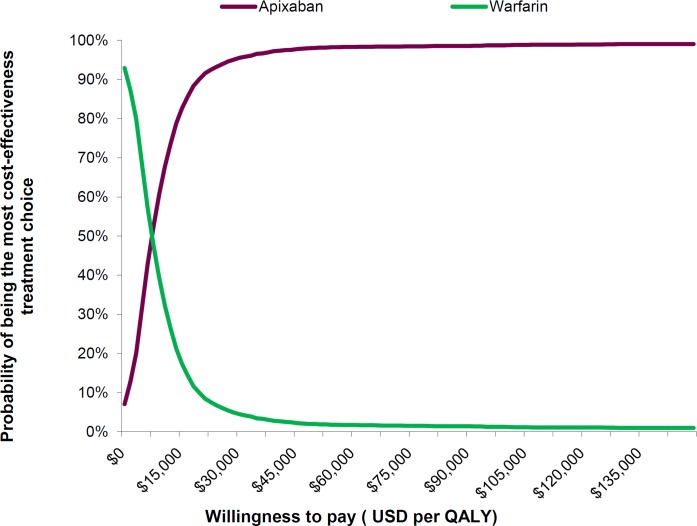
Results: In the lifetime simulation, fewer numbers of events were estimated for the apixaban group, resulting in reduced event-related direct medical costs. The estimated ICER of apixaban was USD 7,057 per QALY at base-case analysis and ranged from USD 1,061 to 14,867 per QALY under the 116 tested scenarios in deterministic sensitivity analysis. While in probabilistic sensitivity analysis, the probability of apixaban being the cost-effective alternative to warfarin was 96% and 98% at a willingness to pay threshold of USD 33,534 and 100,602 per QALY, respectively.
Conclusions: Apixaban is likely to be a cost-effective alternative to warfarin for stroke prophylaxis in Chinese patients with NVAF in Hong Kong.
Conflict of interest statement
Figures

References
-
- Camm AJ, Kirchhof P, Lip GYH, Schotten U, Savelieva I, Ernst S, et al. Guidelines for the management of atrial fibrillation: The Task Force for the Management of Atrial Fibrillation of the European Society of Cardiology (ESC). European Heart Journal. 2010;31(19):2369–429. 10.1093/eurheartj/ehq278 - DOI - PubMed
-
- Tse HF, Wang YJ, Ahmed Ai-Abdullah M, Pizarro-Borromeo AB, Chiang CE, Krittayaphong R, et al. Stroke prevention in atrial fibrillation—an Asian stroke perspective. Heart rhythm: the official journal of the Heart Rhythm Society. 2013;10(7):1082–8. - PubMed
-
- Boccuzzi SJ, Martin J, Stephenson J, Kreilick C, Fernandes J, Beaulieu J, et al. Retrospective study of total healthcare costs associated with chronic nonvalvular atrial fibrillation and the occurrence of a first transient ischemic attack, stroke or major bleed. Current medical research and opinion. 2009;25(12):2853–64. 10.1185/03007990903196422 - DOI - PubMed
-
- De Caterina R, Husted S, Wallentin L, Andreotti F, Arnesen H, Bachmann F, et al. Vitamin K antagonists in heart disease: current status and perspectives (Section III). Position paper of the ESC Working Group on Thrombosis—Task Force on Anticoagulants in Heart Disease. Thrombosis and haemostasis. 2013;110(6):1087–107. 10.1160/TH13-06-0443 - DOI - PubMed
-
- Holbrook AM, Pereira JA, Labiris R, McDonald H, Douketis JD, Crowther M, et al. Systematic overview of warfarin and its drug and food interactions. Archives of internal medicine. 2005;165(10):1095–106. - PubMed
Publication types
MeSH terms
Substances
LinkOut - more resources
Full Text Sources
Other Literature Sources
Medical
