Review
. 2016 Jul;68(3):701-87.
doi: 10.1124/pr.115.012070.

Lipid-Based Drug Delivery Systems in Cancer Therapy: What Is Available and What Is Yet to Come

Affiliations
Review

Lipid-Based Drug Delivery Systems in Cancer Therapy: What Is Available and What Is Yet to Come

Phatsapong Yingchoncharoen et al. Pharmacol Rev. 2016 Jul.

Abstract

Cancer is a leading cause of death in many countries around the world. However, the efficacy of current standard treatments for a variety of cancers is suboptimal. First, most cancer treatments lack specificity, meaning that these treatments affect both cancer cells and their normal counterparts. Second, many anticancer agents are highly toxic, and thus, limit their use in treatment. Third, a number of cytotoxic chemotherapeutics are highly hydrophobic, which limits their utility in cancer therapy. Finally, many chemotherapeutic agents exhibit short half-lives that curtail their efficacy. As a result of these deficiencies, many current treatments lead to side effects, noncompliance, and patient inconvenience due to difficulties in administration. However, the application of nanotechnology has led to the development of effective nanosized drug delivery systems known commonly as nanoparticles. Among these delivery systems, lipid-based nanoparticles, particularly liposomes, have shown to be quite effective at exhibiting the ability to: 1) improve the selectivity of cancer chemotherapeutic agents; 2) lower the cytotoxicity of anticancer drugs to normal tissues, and thus, reduce their toxic side effects; 3) increase the solubility of hydrophobic drugs; and 4) offer a prolonged and controlled release of agents. This review will discuss the current state of lipid-based nanoparticle research, including the development of liposomes for cancer therapy, different strategies for tumor targeting, liposomal formulation of various anticancer drugs that are commercially available, recent progress in liposome technology for the treatment of cancer, and the next generation of lipid-based nanoparticles.


Figures

Fig. 1.
Fig. 1.
(A) Line drawings of the chemical structures of common chemotherapeutic agents and (B) their Log P values and indications, including Cisplatin, Doxorubicin, Paclitaxel, Cytarabine, Vincristine, Docetaxel, Camptothecin, Topotecan, Vinorelbine, Irinotecan, Oxaplatin, Daunorubicin, and Rapamycin (Bolwell et al., 1988; Crom et al., 1994; Wall and Wani, 1995; Clarke and Rivory, 1999; Lobert et al., 2000; Screnci et al., 2000; Hirschfeld et al., 2003; Forrest et al., 2006; Pommier, 2006; Yang et al., 2006; Kelland, 2007; Kreder and Dmochowski, 2007; Cai et al., 2010; Surapaneni et al., 2012; Wilson and Lippard, 2012; Yadav and Khan, 2013; Ferrati et al., 2015; Nirmalanandhan et al., 2015; Saari et al., 2015).
Fig. 2.
Fig. 2.
Types of liposomes classified by size and lamellarity. Based on size and lamellarity, liposomes can be classified into 3 different types. Multilamellar vesicles (MLVs) typically range in the size between 0.05 and 10 μm and consist of multiple phospholipid bilayers. Large unilamellar vesicles (LUVs) are usually in the size >100 nm and consist of a single phospholipid bilayer. The size of LUVs is debatable, as vesicles of size 50–100 nm had been referred to as LUVs. Small unilamellar vesicles (SUVs) are usually in the size range of 25–50 nm and, like LUVs, consist of a single phospholipid bilayer. The SUVs are prepared from MLVs or LUVs by sonication or extrusion. In all types of liposomes, hydrophobic drugs are usually localized within the phospholipid bilayer, whereas hydrophilic drugs are usually encapsulated within the liposome cavity.
Fig. 3.
Fig. 3.
Surface charge and zeta potential of colloidal particles. When a particle develops a net surface charge, oppositely charged ions accumulate around the charged particle surface. This arrangement forms an electrical double layer around the particle consisting of an inner layer called the Stern layer and an outer layer called the diffuse layer. Ions in the Stern layer are strongly bound to the particle, whereas ions in diffuse layer are less strongly associated. A theoretical boundary exists within the diffuse layer in which ions within this boundary form a stable entity with the particle, whereas ions beyond the boundary remain associated with the bulk fluid. Zeta potential is the potential difference between the bulk fluid and the layer of fluid containing oppositely charged ions that is associated with the particle.
Fig. 4.
Fig. 4.
Passive targeting of nanoparticles. Passive targeting uses the properties of the delivery system and the disease anatomy to specifically accumulate the encapsulated substance at a targeted site. Passive targeting of tumors by nanoparticles relies on a phenomenon called the enhanced permeability and retention (EPR) effect. The EPR effect is caused by the enhanced permeability of tumor blood vessels and an ineffective lymphatic system. Highly permeable tumor blood vessels allow nanoparticles ranging between 10 and 500 nm to extravasate and accumulate within the tumor interstitial space, whereas a dysfunctional lymphatic system prevents effective drainage within the tumor tissue. Thus, this further promotes the accumulation of nanoparticles within the tumor.
Fig. 5.
Fig. 5.
Uptake of nanoparticles via receptor-mediated endocytosis. In the process of receptor-mediated endocytosis, one of the ligands on the surface of the nanoparticle binds to its cell surface receptor forming a ligand-receptor complex. Consequently, the plasma membrane forms an invagination surrounding the ligand-receptor complex preparing it for cellular internalization. This process is often assisted by clathrin or caveolin proteins, depending on the type of ligands and receptors, and results in the formation of an endocytic vesicle. The resulting vesicle is coated with either clathrin or caveolin. Once dissociated from the membrane, the coated endocytic vesicle travels through the cytoplasm to fuse with an early endosome, also known as a sorting endosome. As the early endosome matures, vacuolar ATPase pumps are recruited to pump H+ ions into its lumen decreasing the pH to ∼5–6. The decrease in pH facilitates the dissociation of the ligand from its receptor by causing conformational changes to the receptor. The reduced pH also facilitates the release of the encapsulated drug from the nanoparticle by partial degradation. At this point, the receptor and its ligand will either get recycled back to the plasma membrane or continue along the endolysosomal pathway for lysosomal degradation in a late endosome. However, this depends on the receptor and ligand under consideration. If the receptor and its ligand get recycled, they will be sorted to a recycling endosome, which travels to the plasma membrane. Such a receptor and ligand may be of limited use to drugs requiring intracellular accumulation for therapeutic action. If the receptor and its ligand continue along the endolysosomal pathway, it will enter into the multivesicular body, which matures into the late endosome. In the process of maturation from an early endosome into a late endosome, the pH decreases further to ∼5, allowing more encapsulated drug to be released from the nanoparticle. Finally, the late endosome fuses with the lysosome where its content is degraded by the lysosomal enzymes in the acidic pH. This further allows more encapsulated drug to be released from the nanoparticle.
Fig. 6.
Fig. 6.
Active targeting of nanoparticles to cancer tumors. In active targeting, specific ligands recognized only by cells at the disease site are coupled on to the surface of nanoparticles, allowing them to interact specifically with these cells. Active targeting can only occur once passive targeting is completed. This means it can only take place after nanoparticles have accumulated passively at the disease site. For the treatment of cancer, there are two cellular targets in which nanoparticles can be directed to via active targeting, namely, cancer cells and tumoral endothelium. The targeting of cancer cell aims at improving the uptake of nanoparticles by these cells. In contrast, the targeting of tumoral endothelium aims to kill cancer cells indirectly by starving them of oxygen and nutrients.
Fig. 7.
Fig. 7.
Cellular uptake of different types of liposomes. Conventional liposomes (negatively charged and neutral) are taken up by cells via the process of clathrin-coated pit endocytosis. This process generates a clathrin-coated endosome, which undergoes acidification and fusion with lysosomes. In the presence of lysosomal enzymes and low pH, liposomes within the clathrin-coated endosome become destabilized and eventually get degraded by lysosomal enzymes (represented by dashed lines), releasing their contents into the cytoplasm. Additionally, pH-sensitive liposomes follow the same uptake pathway as conventional liposomes. However, these liposomes became destabilized (represented by dashed lines) and degraded once the endosome is acidified releasing their content into the cytoplasm. Positively charged or cationic liposomes can enter cells by two pathways. That is, via either clathrin-coated pit endocytosis or via membrane fusion. However, the primary route of entry for cationic liposomes is via clathrin-coated pit endocytosis similar to conventional liposomes. Although they are able to extravasate through the endothelium layer of small blood vessels, including those of tumors, sterically stabilized liposomes are generally not readily taken up by cells because of steric hindrance and the decreased hydrophobic interaction between the particle and the cell surface. Instead, these liposomes slowly release their contents into the interstitial fluid, which then enter cells via diffusion or pinocytosis.
Fig. 8.
Fig. 8.
Remote loading of DOX into Doxil liposomes using (NH4)2SO4 gradient. The remote loading of DOX into a Doxil liposome uses a transmembrane concentration gradient consisting of a high intraliposomal concentration of (NH4)2SO4 and a low extraliposomal concentration of (NH4)2SO4 as a driving force for DOX loading. In this process, the ammonium salt of DOX (DOX-NH3+) donates H+ to form an amphipathic weak base DOX-NH2, which can diffuse across the phospholipid bilayer of the liposome. Within the liposome, (NH4)2SO4 dissociates to form NH4+ and SO42-. Then NH4+ undergoes a base exchange with DOX-NH2 to form NH3 and DOX-NH3+ within the liposome. Two molecules of DOX-NH3+ quickly precipitate or crystallize with SO42- to form the (DOX-NH3)2SO4 salt inside the liposome cavity, whereas NH3 diffuses across liposome membrane into the external medium.
Fig. 9.
Fig. 9.
Cryotransmission electron microscopy (cryo-TEM) of commercial Doxil liposomes. In a commercial Doxil formulation, remote loading produces doxorubicin sulfate [(DOX-NH3)2SO4] crystals within PEGylated nanoliposomes. These crystals are clearly shown by cryo-TEM as long and fiber-like structures within liposomes. In addition, it can also be seen from cryo-TEM that (DOX-NH3)2SO4 rods come into contact with the liposome membrane, slightly changing the shape of spherical liposomes. Reprinted with permission from Elsevier from Barenholz (2012b).
Fig. 10.
Fig. 10.
Remote loading of DOX into Myocet liposomes using a pH gradient. In contrast to Doxil, Myocet uses a pH gradient as a driving force to actively load DOX into liposomes. In this approach, sodium carbonate buffer creates a neutral pH environment (pH = 7.8) outside the liposome, whereas citrate buffer creates an acidic environment (pH = 4) inside the liposome. Outside the liposome, DOX-H+ is deprotonated to DOX, which can diffuse through liposomal membrane into the liposome cavity. Within the liposome, the acidic pH protonates DOX back to DOX-H+, which interacts with citrate anions to form the DOX-citrate salt that precipitates into a crystal.
Fig. 11.
Fig. 11.
Cryotransmission electron microscopy (cryo-TEM) of Myocet liposomes. The unique complexation of DOX with citrate anions during the remote loading of DOX into Myocet liposomes results in the formation of bundles of DOX fibers within the liposome. (A) The arrow shows the end of a DOX fibrous bundle with each fiber within the bundle being ∼3–3.5 nm apart. (B) The flexibility of these DOX fibers is demonstrated by their ability to exist as fibrous bundles in different geometries, including U-shape, circle, and straight. (C) The arrow shows striated regions in DOX fibrous bundles that repeat approximately every 50 nm. Reprinted with permission from Elsevier from Li et al. (1998).
Fig. 12.
Fig. 12.
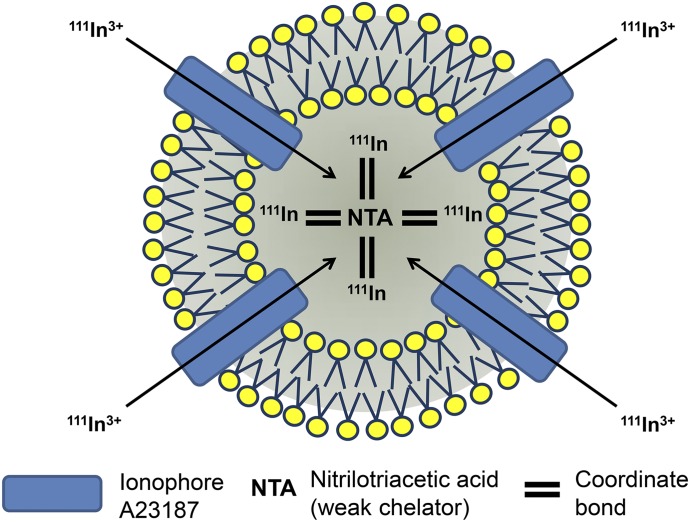
Remote loading of 111In into liposomes. The ionophore A23187 is inserted into the lipid bilayer of liposomes. The incorporation of ionophores into liposomal membrane allows 111In3+ ions to cross the membrane into the liposome cavity. The weak chelator, nitrilotriacetic acid, inside the liposome then traps 111In by forming a weak complex with 111In3+ ions.
Fig. 13.
Fig. 13.
Morphology of DepoCyt liposomes prepared using DepoFoam Technology. The production of DepoCyt uses DepoFoam technology, which generates multivesicular liposomes (MVLs). Each DepoCyt MLV is composed of numerous non-concentric polyhedral aqueous compartments separated by a lipid bilayer membrane. The arrangement of the MVL gives the whole DepoCyt particle a resemblance of aggregated soap bubbles. DepoCyt MLVs are microscopic spherical particles that usually range in size between 3 and 30 μm.
Fig. 14.
Fig. 14.
Structure of solid lipid nanoparticles (SLNs). SLNs are submicron particles that range between 50 and 100 nm in size, which are prepared from lipids that remain solid at room temperature and body temperature. The solid lipid is used as a matrix material in which hydrophobic drugs can be stored. The lipid matrix is then stabilized by biocompatible surfactants, which in this case, are phospholipid and/or lipid-PEG.
Fig. 15.
Fig. 15.
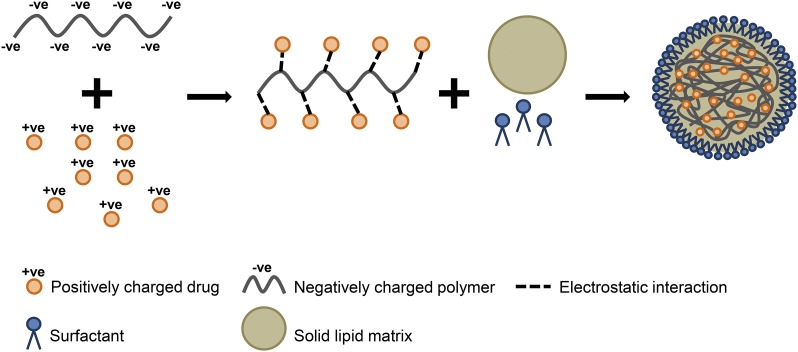
Incorporation of hydrophilic drugs into SLNs using polymers. One of the strategies for incorporating hydrophilic drugs into SLNs is to use charged polymers. In this procedure, the ionic form of the hydrophilic drug is electrostatically neutralized by counterions on the polymer. The drug-polymer complexes are subsequently incorporated into lipids for SLN preparation. This strategy gives rise to polymer-lipid hybrid nanoparticles (PLNs), which are not to be confused with lipid-polymer hybrid nanoparticles (LPNs).
Fig. 16.
Fig. 16.
Morphology of nanostructured lipid carriers (NLCs) and their improvements over SLNs. NLCs are lipid nanoparticles composed of solid lipid matrix immersed in liquid lipid (oil) droplets. The solid lipid is used as a matrix to immobilize the drug and prevent particles from coalescing with one another, whereas the liquid lipid increases the drug loading capacity. The mixture of lipids of different phases also allows an imperfect lipid crystal lattice to be formed within NLCs, in contrast to SLNs, where a solid lipid matrix is almost perfect, forcing encapsulated drugs to the surface of the particle. As a result, more drugs can be encapsulated within NLCs, preventing rapid drug release from the surface of the particles, which is observed with SLNs.
Fig. 17.
Fig. 17.
Morphology of lipid-polymer hybrid nanoparticles (LPNs). LPNs exhibit characteristics of both polymeric nanoparticles and liposomes. They consist of three components: 1) a polymeric core made of polymers, such as PLGA or PLA, in which drugs are encapsulated; 2) a phospholipid layer surrounding the polymeric core, which prevents the encapsulated content from leakage and slows down polymer degradation by limiting inward water diffusion; and 3) an outer lipid-PEG stealth layer, which helps prolong the in vivo circulation time of LPNs and sterically stabilizes the particles.
Fig. 18.
Fig. 18.
Various strategies for combinatorial drug delivery using LPNs. (A) Separate covalent conjugation of different drugs (drug X and Y) to the polymer and phospholipid precursors before LPN preparation. For instance, drug X can be attached to the polymer, whereas drug Y can be attached to phospholipid molecules or vice versa. (B) Separate covalent conjugation of different drugs to polymer precursors prior to preparation. (C) Fusion of preformed polymeric nanoparticles and lipid vesicles via a two-step method of preparation. Different drugs are encapsulated within polymeric nanoparticles and liposomes separately before particle fusion. (D) Conjugation of the second drug (drug Y) to the surface of LPNs postpreparation. The first drug (drug X) is encapsulated within the polymeric core during LPN preparation.

References

    1. Abd El-Rehim DM, Pinder SE, Paish CE, Bell JA, Rampaul RS, Blamey RW, Robertson JF, Nicholson RI, Ellis IO. (2004) Expression and co-expression of the members of the epidermal growth factor receptor (EGFR) family in invasive breast carcinoma. Br J Cancer 91:1532–1542. - PMC - PubMed
    1. Abid MR, Yi X, Yano K, Shih S-C, Aird WC. (2006) Vascular endocan is preferentially expressed in tumor endothelium. Microvasc Res 72:136–145. - PubMed
    1. Abuchowski A, McCoy JR, Palczuk NC, van Es T, Davis FF. (1977) Effect of covalent attachment of polyethylene glycol on immunogenicity and circulating life of bovine liver catalase. J Biol Chem 252:3582–3586. - PubMed
    1. Ahmed SE, Martins AM, Husseini GA. (2015) The use of ultrasound to release chemotherapeutic drugs from micelles and liposomes. J Drug Target 23:16–42. - PubMed
    1. Alkan-Onyuksel H, Ramakrishnan S, Chai H-B, Pezzuto JM. (1994) A mixed micellar formulation suitable for the parenteral administration of taxol. Pharm Res 11:206–212. - PubMed

Publication types

MeSH terms