


Ectopic and Visceral Fat Deposition in Lean and Obese Patients With Type 2 Diabetes
- PMID: 27364051
- PMCID: PMC4925621
- DOI: 10.1016/j.jacc.2016.03.597
Ectopic and Visceral Fat Deposition in Lean and Obese Patients With Type 2 Diabetes
Abstract
Background: Type 2 diabetes (T2D) and obesity are associated with nonalcoholic fatty liver disease, cardiomyopathy, and cardiovascular mortality. Both show stronger links between ectopic and visceral fat deposition, and an increased cardiometabolic risk compared with subcutaneous fat.
Objectives: This study investigated whether lean patients (Ln) with T2D exhibit increased ectopic and visceral fat deposition and whether these are linked to cardiac and hepatic changes.
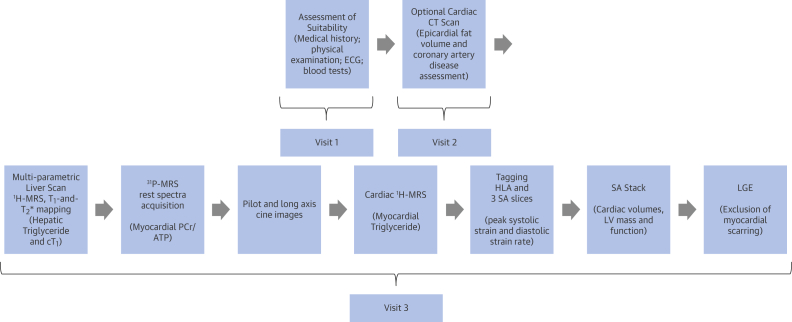
Methods: Twenty-seven obese patients (Ob) with T2D, 15 Ln-T2D, and 12 normal-weight control subjects were studied. Subjects underwent cardiac computed tomography, cardiac magnetic resonance imaging (MRI), proton and phosphorus MR spectroscopy, and multiparametric liver MR, including hepatic proton MRS, T1- and T2*-mapping yielding "iron-corrected T1" [cT1].
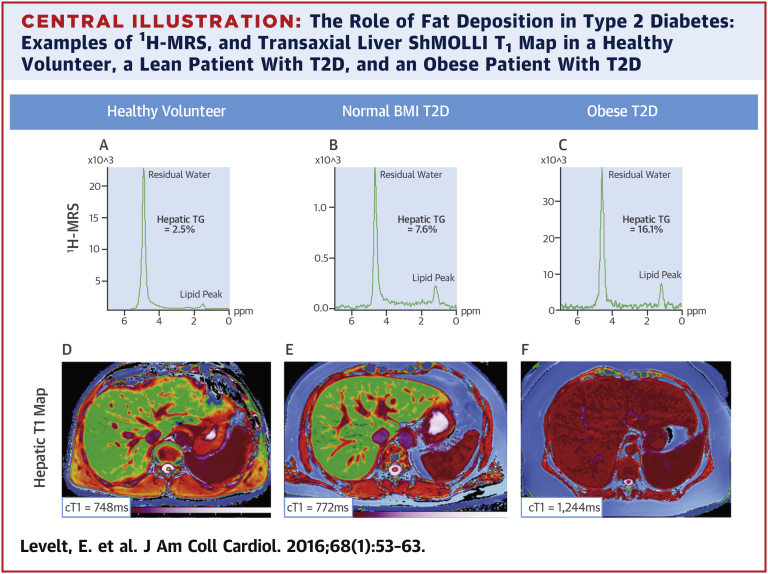
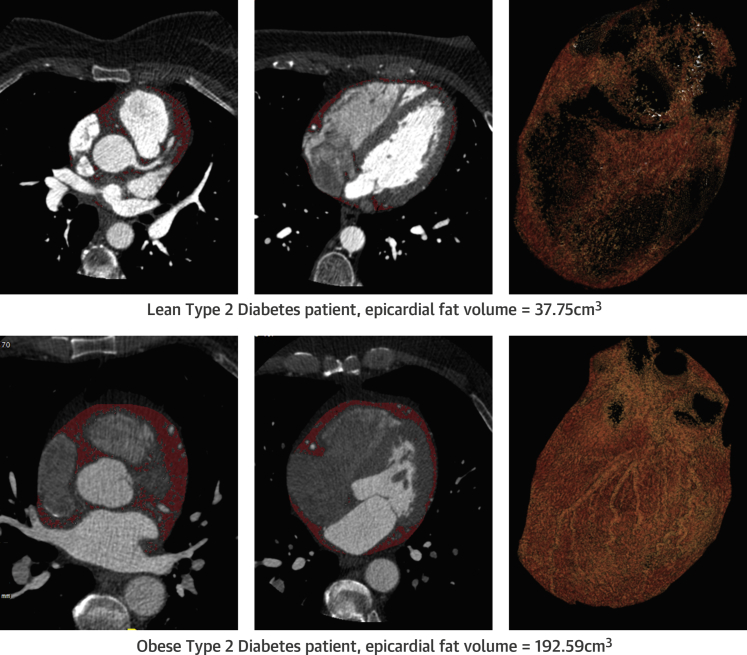
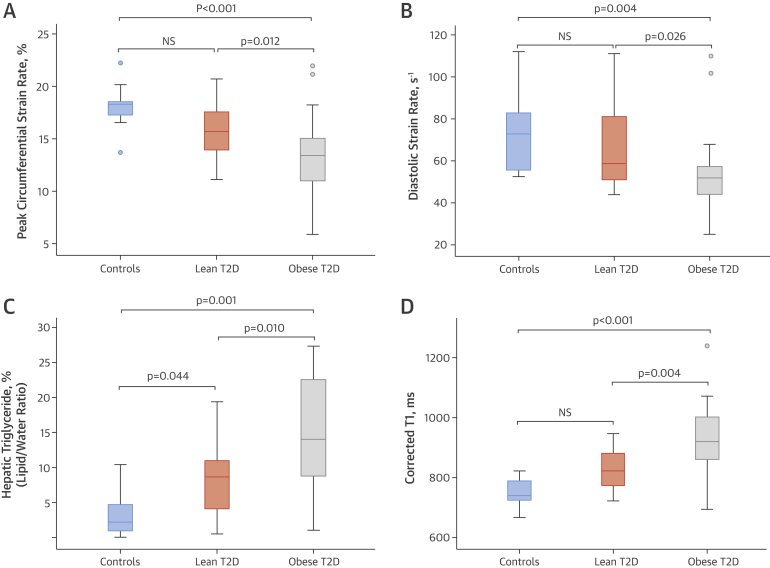
Results: Diabetes, with or without obesity, was associated with increased myocardial triglyceride content (p = 0.01), increased hepatic triglyceride content (p = 0.04), and impaired myocardial energetics (p = 0.04). Although cardiac structural changes, steatosis, and energetics were similar between the T2D groups, epicardial fat (p = 0.04), hepatic triglyceride (p = 0.01), and insulin resistance (p = 0.03) were higher in Ob-T2D. Epicardial fat, hepatic triglyceride, and insulin resistance correlated negatively with systolic strain and diastolic strain rates, which were only significantly impaired in Ob-T2D (p < 0.001 and p = 0.006, respectively). Fibroinflammatory liver disease (elevated cT1) was only evident in Ob-T2D patients. cT1 correlated with hepatic and epicardial fat (p < 0.001 and p = 0.01, respectively).
Conclusions: Irrespective of body mass index, diabetes is related to significant abnormalities in cardiac structure, energetics, and cardiac and hepatic steatosis. Obese patients with T2D show a greater propensity for ectopic and visceral fat deposition.
Keywords: diabetic cardiomyopathy; epicardial fat deposition; fatty liver disease; magnetic resonance imaging; magnetic resonance spectroscopy.
Copyright © 2016 American College of Cardiology Foundation. Published by Elsevier Inc. All rights reserved.
Figures
Comment in
-
An MR Spectroscopy-Based Approach to Lean Versus Obese Diabetic Patients.J Am Coll Cardiol. 2016 Jul 5;68(1):64-6. doi: 10.1016/j.jacc.2016.04.041. J Am Coll Cardiol. 2016. PMID: 27364052 No abstract available.
-
Ectopic Fat Deposition and Diabetes Mellitus.J Am Coll Cardiol. 2016 Dec 13;68(23):2594-2595. doi: 10.1016/j.jacc.2016.07.788. J Am Coll Cardiol. 2016. PMID: 27931623 No abstract available.
-
Reply: Ectopic Fat Deposition and Diabetes Mellitus.J Am Coll Cardiol. 2016 Dec 13;68(23):2595. doi: 10.1016/j.jacc.2016.09.939. J Am Coll Cardiol. 2016. PMID: 27931624 No abstract available.
References
-
- Garcia M.J., McNamara P.M., Gordon T., Kannel W.B. Morbidity and mortality in diabetics in the Framingham population. Sixteen year follow-up study. Diabetes. 1974;23:105–111. - PubMed
-
- Kenchaiah S., Evans J.C., Levy D. Obesity and the risk of heart failure. N Engl J Med. 2002;347:305–313. - PubMed
-
- Kannel W.B., McGee D.L. Diabetes and cardiovascular disease: the Framingham study. JAMA. 1979;241:2035–2038. - PubMed
-
- Rider O.J., Francis J.M., Tyler D. Effects of weight loss on myocardial energetics and diastolic function in obesity. Int J Cardiovasc Imaging. 2013;29:1043–1050. - PubMed
Publication types
MeSH terms
Grants and funding
LinkOut - more resources
Full Text Sources
Other Literature Sources
Medical
Miscellaneous
