


Introduction to biosensors
- PMID: 27365030
- PMCID: PMC4986445
- DOI: 10.1042/EBC20150001
Introduction to biosensors
Abstract
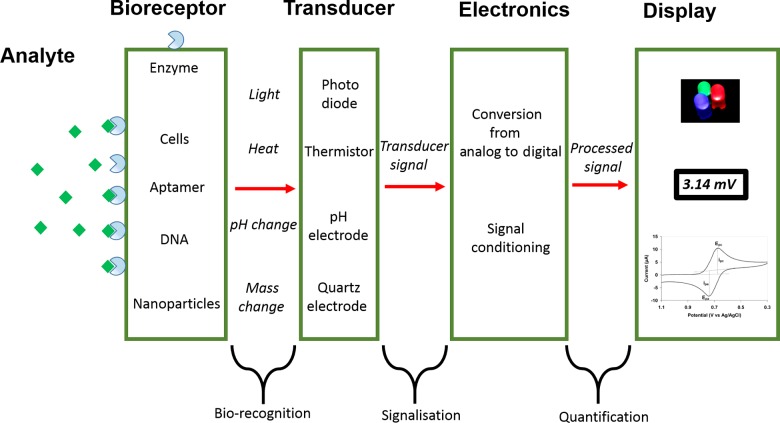
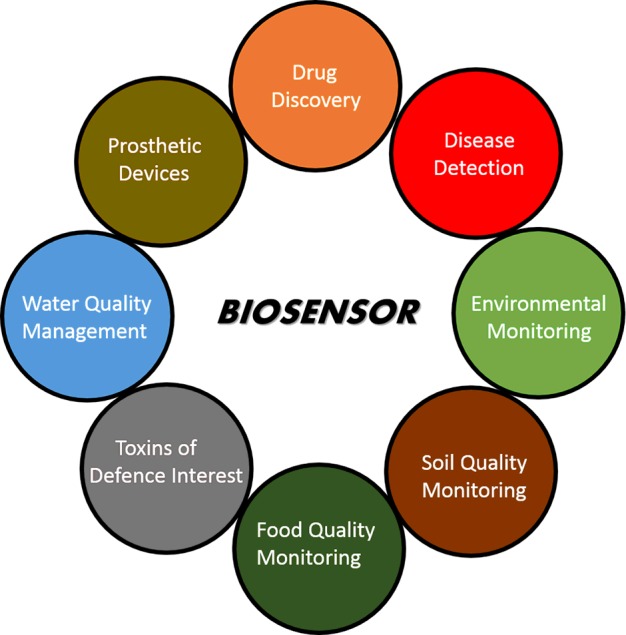
Biosensors are nowadays ubiquitous in biomedical diagnosis as well as a wide range of other areas such as point-of-care monitoring of treatment and disease progression, environmental monitoring, food control, drug discovery, forensics and biomedical research. A wide range of techniques can be used for the development of biosensors. Their coupling with high-affinity biomolecules allows the sensitive and selective detection of a range of analytes. We give a general introduction to biosensors and biosensing technologies, including a brief historical overview, introducing key developments in the field and illustrating the breadth of biomolecular sensing strategies and the expansion of nanotechnological approaches that are now available.
Keywords: affinity reagents; biosensors; glucose sensor; nanomaterials; pregnancy test.
© 2016 The Author(s). Published by Portland Press Limited on behalf of the Biochemical Society.
Figures
References
-
- Cremer M. Über die Ursache der elektromotorischen Eigenschaften der Gewebe, zugleich ein Beitrag zur Lehre von den polyphasischen Elektrolytketten. Z. Biol. 1906;47:562–608.
-
- Hughes W.S. The potential difference between glass and electrolytes in contact with the glass. J. Am. Chem. Soc. 1922;44:2860–2867. doi: 10.1021/ja01433a021. - DOI
-
- Griffin E.G., Nelson J.M. The influence of certain substances on the activity of invertase. J. Am. Chem. Soc. 1916;38:722–730. doi: 10.1021/ja02260a027. - DOI
-
- Nelson J.M., Griffin E.G. Adsorption of invertase. J. Am. Chem. Soc. 1916;38:1109–1115. doi: 10.1021/ja02262a018. - DOI
-
- Heineman W.R., Jensen W.B. Leland C. Clark Jr. (1918–2005) Biosens. Bioelectron. 2006;21:1403–1404. doi: 10.1016/j.bios.2005.12.005. - DOI
Publication types
MeSH terms
Substances
LinkOut - more resources
Full Text Sources
Other Literature Sources
