


Acoustic biosensors
- PMID: 27365040
- PMCID: PMC4986463
- DOI: 10.1042/EBC20150011
Acoustic biosensors
Abstract
Resonant and acoustic wave devices have been researched for several decades for application in the gravimetric sensing of a variety of biological and chemical analytes. These devices operate by coupling the measurand (e.g. analyte adsorption) as a modulation in the physical properties of the acoustic wave (e.g. resonant frequency, acoustic velocity, dissipation) that can then be correlated with the amount of adsorbed analyte. These devices can also be miniaturized with advantages in terms of cost, size and scalability, as well as potential additional features including integration with microfluidics and electronics, scaled sensitivities associated with smaller dimensions and higher operational frequencies, the ability to multiplex detection across arrays of hundreds of devices embedded in a single chip, increased throughput and the ability to interrogate a wider range of modes including within the same device. Additionally, device fabrication is often compatible with semiconductor volume batch manufacturing techniques enabling cost scalability and a high degree of precision and reproducibility in the manufacturing process. Integration with microfluidics handling also enables suitable sample pre-processing/separation/purification/amplification steps that could improve selectivity and the overall signal-to-noise ratio. Three device types are reviewed here: (i) bulk acoustic wave sensors, (ii) surface acoustic wave sensors, and (iii) micro/nano-electromechanical system (MEMS/NEMS) sensors.
Keywords: acoustic biosensors; bulk acoustic waves; microelectromechanical system (MEMS); piezoelectricity; quartz crystal microbalance; surface acoustic waves.
© 2016 The Author(s). Published by Portland Press Limited on behalf of the Biochemical Society.
Figures
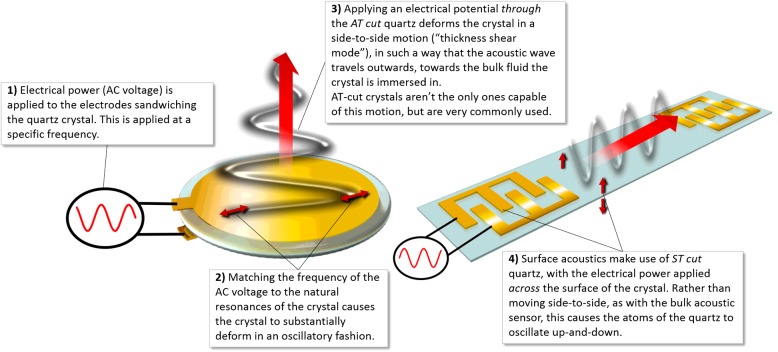
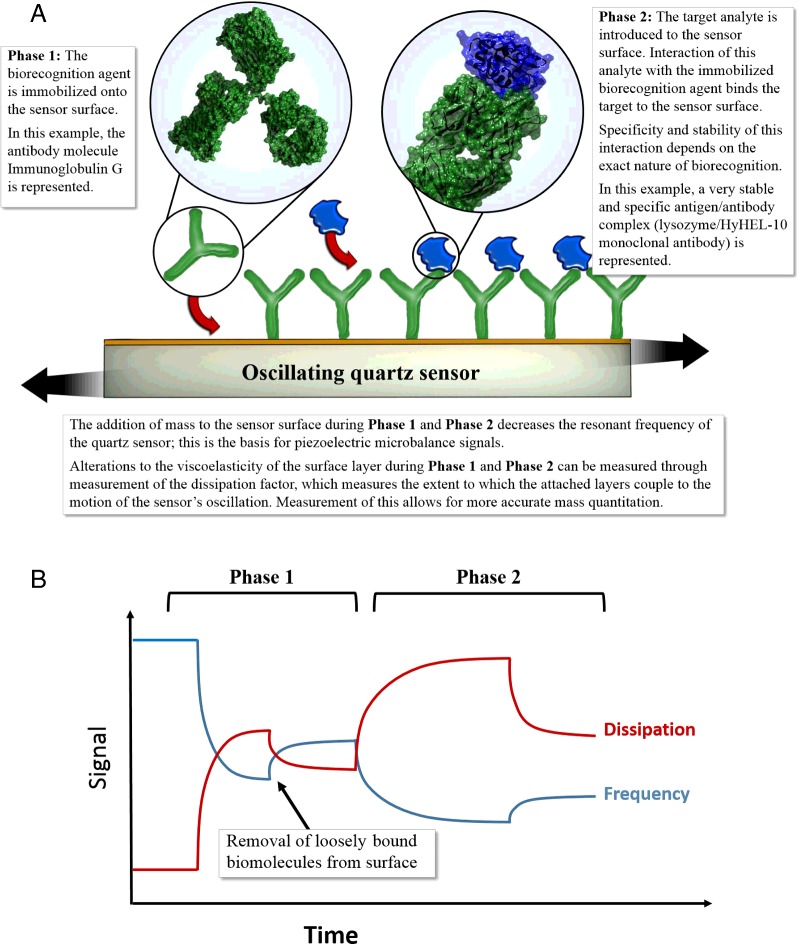
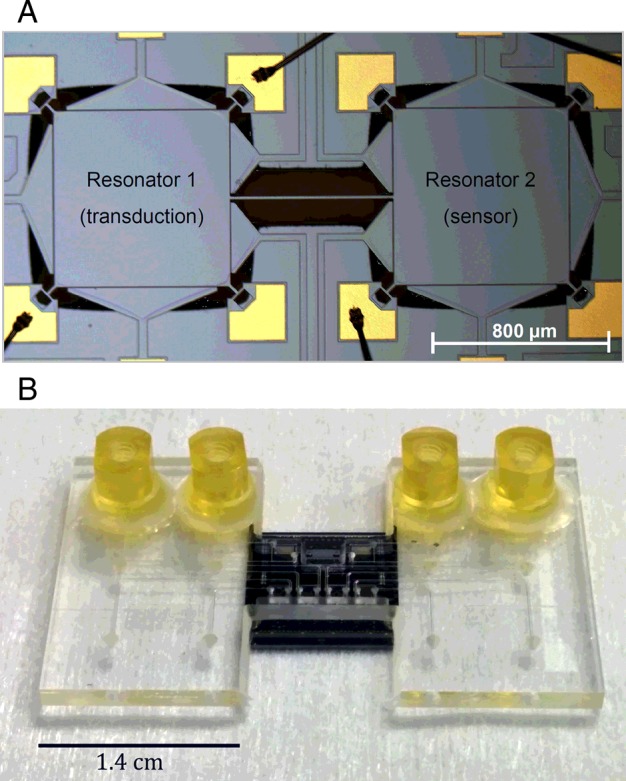
References
-
- Sauerbrey G. Verwendung von Schwingquarzen zur Wägung dünner Schichten und zur Mikrowägung. Z. Physik. 1959;155:206–222. doi: 10.1007/BF01337937. - DOI
-
- Vogt B.D., Lin E.K., Wu W-L., White C.C. Effect of film thickness on the validity of the Sauerbrey equation for hydrated polyelectrolyte films. J. Phys. Chem. B. 2004;108:12685–12690. doi: 10.1021/jp0481005. - DOI
-
- Kanazawa K.K., Gordon J.G. The oscillation frequency of a quartz resonator in contact with a liquid. Anal. Chim. Acta. 1985;175:99–105. doi: 10.1016/S0003-2670(00)82721-X. - DOI
-
- Höök F., Kasemo B. Variations in coupled water, viscoelastic properties, and film thickness of a Mefp-1 protein film during adsorption and cross-linking: a quartz crystal microbalance with dissipation monitoring, ellipsometry, and surface plasmon resonance study. Anal. Chem. 2001;73:5796–5804. doi: 10.1021/ac0106501. - DOI - PubMed
-
- Reimhult E., Larsson C., Kasemo B., Höök F. Simultaneous surface plasmon resonance and quartz crystal microbalance with dissipation monitoring measurements of biomolecular adsorption events involving structural transformations and variations in coupled water. Anal. Chem. 2004;76:7211–7220. doi: 10.1021/ac0492970. - DOI - PubMed
Publication types
MeSH terms
LinkOut - more resources
Full Text Sources
Other Literature Sources
