. 2016 Nov;101(11):1333-1342.
doi: 10.3324/haematol.2016.147496. Epub 2016 Jun 30.

Clinical and pathogenic features of ETV6-related thrombocytopenia with predisposition to acute lymphoblastic leukemia

Affiliations

Clinical and pathogenic features of ETV6-related thrombocytopenia with predisposition to acute lymphoblastic leukemia

Federica Melazzini et al. Haematologica. 2016 Nov.

Abstract

ETV6-related thrombocytopenia is an autosomal dominant thrombocytopenia that has been recently identified in a few families and has been suspected to predispose to hematologic malignancies. To gain further information on this disorder, we searched for ETV6 mutations in the 130 families with inherited thrombocytopenia of unknown origin from our cohort of 274 consecutive pedigrees with familial thrombocytopenia. We identified 20 patients with ETV6-related thrombocytopenia from seven pedigrees. They have five different ETV6 variants, including three novel mutations affecting the highly conserved E26 transformation-specific domain. The relative frequency of ETV6-related thrombocytopenia was 2.6% in the whole case series and 4.6% among the families with known forms of inherited thrombocytopenia. The degree of thrombocytopenia and bleeding tendency of the patients with ETV6-related thrombocytopenia were mild, but four subjects developed B-cell acute lymphoblastic leukemia during childhood, resulting in a significantly higher incidence of this condition compared to that in the general population. Clinical and laboratory findings did not identify any particular defects that could lead to the suspicion of this disorder from the routine diagnostic workup. However, at variance with most inherited thrombocytopenias, platelets were not enlarged. In vitro studies revealed that the maturation of the patients' megakaryocytes was defective and that the patients have impaired proplatelet formation. Moreover, platelets from patients with ETV6-related thrombocytopenia have reduced ability to spread on fibrinogen. Since the dominant thrombocytopenias due to mutations in RUNX1 and ANKRD26 are also characterized by normal platelet size and predispose to hematologic malignancies, we suggest that screening for ETV6, RUNX1 and ANKRD26 mutations should be performed in all subjects with autosomal dominant thrombocytopenia and normal platelet size.


Figures

Figure 1.
Figure 1.
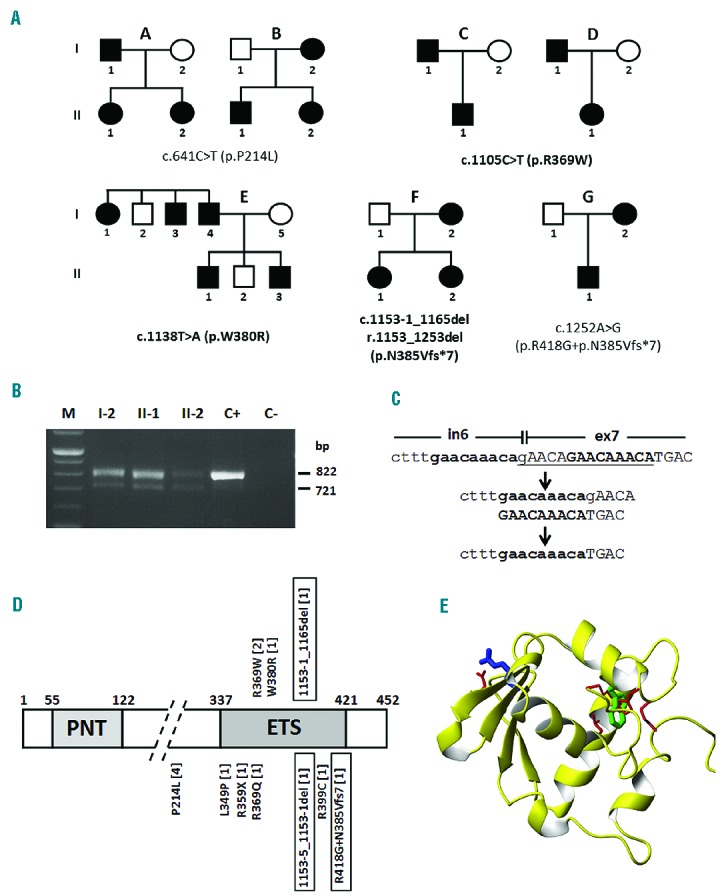
Mutations identified in the ETV6 gene and their effect on protein structure. (A) Pedigrees of families enrolled in this study carrying different mutations as indicated (novel mutations in bold). Nucleotide numbering reflects the ETV6 cDNA with +1 corresponding to the A of the ATG translation initiation codon in the reference sequence (RefSeq NM_001987.4). Therefore, the initiation codon is residue 1 in the amino acid sequence. Families B and G have been previously reported (Noetzli et al.). (B) RT-PCR in affected members (I-2, II-1, and II-2) of family F to determine the consequence of the c.1153-1_1165del mutation on splicing. C+, wild-type control; C−, negative control. The analysis shows two fragments, the wild-type (822 bp) and the exon 7 skipping (721 bp) products. (C) The deletion of the 14 bp (gAACAGAACAAACA) of c.1153-1_1165del is likely due to non-allelic homologous recombination between the two GAACAAACA repeats located at the intron 6 and exon 7 boundary. (D) Domain structure of ETV6 (XP_011518909.1) based on Pfam annotation at http://www.ncbi.nlm.nih.gov/gene/2120 (PNT, pointed N-terminal domain; ETS, C-terminal DNA binding domain), with mutations identified in ETV6, already reported or identified in this study (top). The numbers of families carrying each mutation are in brackets. Mutations leading to skipping of exon 7 are boxed. (E) Structural modeling of the ETS domain with residues R369 (blue) and W380 (green) affected by the p.R369W and p.W380R mutations.
Figure 2.
Figure 2.
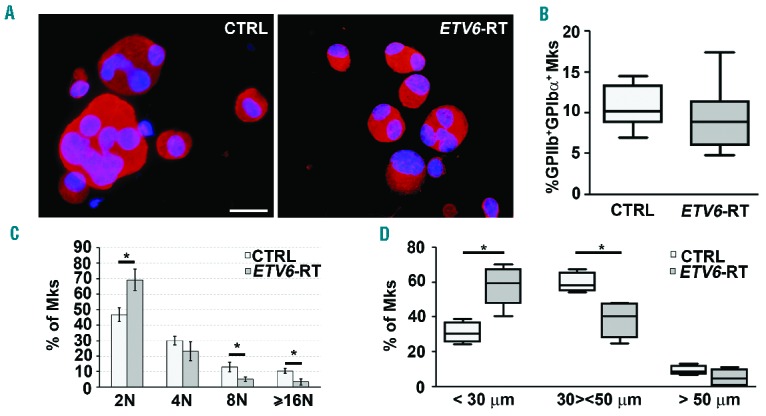
Normal differentiation but decreased ploidy of ETV6-RT megakaryocytes. Hematopoietic progenitors from peripheral blood samples of healthy controls (CTRL) and patients (ETV6-RT) were differentiated in vitro into megakaryocytes in the presence of thrombopoietin, interleukin-6 and interleukin-11. (A) Representative immunofluorescence staining of plasma membrane GPIIIa in CTRL and ETV6-RT megakaryocytes (red=GPIIIa; blue=nuclei; scale bar=20 μm). (B) Flow cytometry analysis of GPIIb and GPIbα expression revealed comparable percentages of double-stained populations in CTRL and ETV6-RT at the end of the culture. (C) Ploidy of megakaryocytes at the end of the culture was significantly reduced in cells from ETV6-RT patients (*P<0.05). (D) Diameters of megakaryocytes were also significantly lower in ETV6-RT patients (total number of cells analyzed: 1,100, *P<0.01).
Figure 3.
Figure 3.
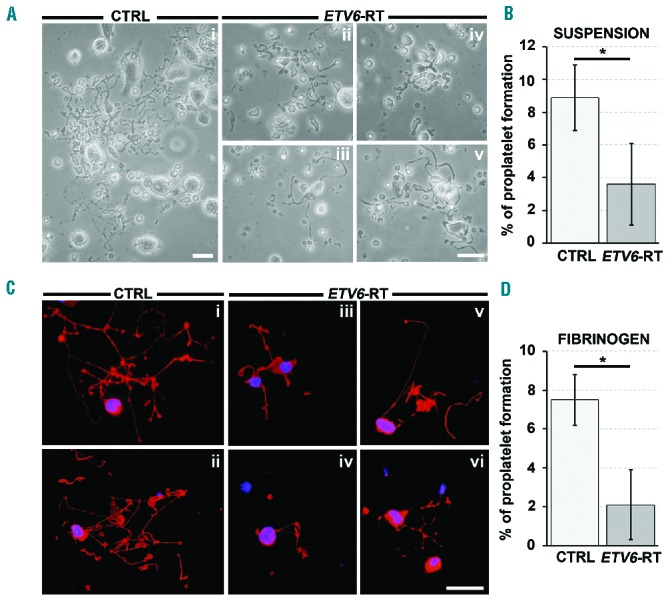
Aberrant proplatelet formation by ETV6-RT megakaryocytes. (A) Representative light microscopy analysis of proplatelet formation and structure from control (CTRL, i) and patient (ETV6-RT, ii–v) megakaryocytes cultured for 16 h in suspension (scale bar=50 μm). (B) The percentage of proplatelet-forming megakaryocytes was calculated as the number of megakaryocytes displaying at least one filamentous pseudopod with respect to total number of round megakaryocytes per analyzed field (*P<0.01). (C) Representative fluorescence microscopy analysis of proplatelet formation and structure from CTRL (i–ii) and ETV6-RT (iii–vi) megakaryocytes cultured for 16 h with adhesion on fibrinogen. The pictures clearly show defective proplatelet elongation in ETV6-RT (red=β1-tubulin; blue=nuclei; scale bar=30 μm). (D) The percentage of proplatelet-forming megakaryocytes was calculated as the number of β1-tubulin-positive cells displaying at least one pseudopod with respect to total number of round megakaryocytes per analyzed field (*P<0.01).

References

    1. Pecci A. Diagnosis and treatment of inherited thrombocytopenias. Clin Genet. 2016;89(2):141–153. - PubMed
    1. Savoia A. Molecular basis of inherited thrombocytopenias. Clin Genet. 2016:89(2): 154–162. - PubMed
    1. Moriyama T, Metzger ML, Wu G, et al. Germline genetic variation in ETV6 and risk of childhood acute lymphoblastic leukaemia: a systematic genetic study. Lancet Oncol. 2015;16(16):1659–1666. - PMC - PubMed
    1. Noetzli L, Lo RW, Lee-Sherick AB, et al. Germline mutations in ETV6 are associated with thrombocytopenia, red cell macrocytosis and predisposition to lymphoblastic leukemia. Nat Genet. 2015;47(5):535–538. - PMC - PubMed
    1. Topka S, Vijai J, Walsh MF, et al. Germline ETV6 mutations confer susceptibility to acute lymphoblastic leukemia and thrombocytopenia. PLoS Genet. 2015;11(6): e1005262. - PMC - PubMed

MeSH terms

Substances

LinkOut - more resources