


Economic analysis of empiric versus diagnostic-driven strategies for immunocompromised patients with suspected fungal infections in the People's Republic of China
- PMID: 27366099
- PMCID: PMC4913884
- DOI: 10.2147/CEOR.S101015
Economic analysis of empiric versus diagnostic-driven strategies for immunocompromised patients with suspected fungal infections in the People's Republic of China
Abstract
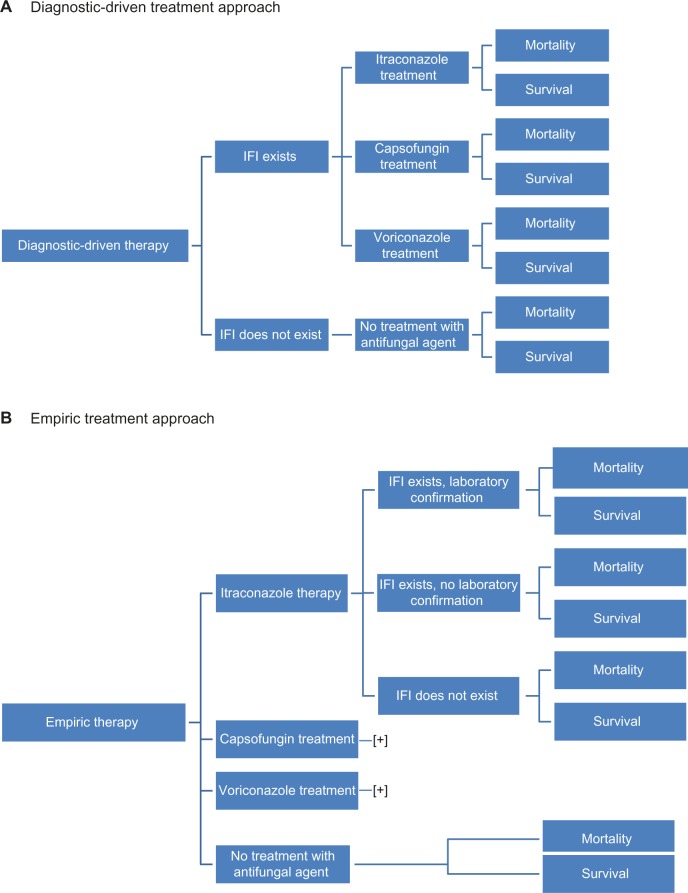
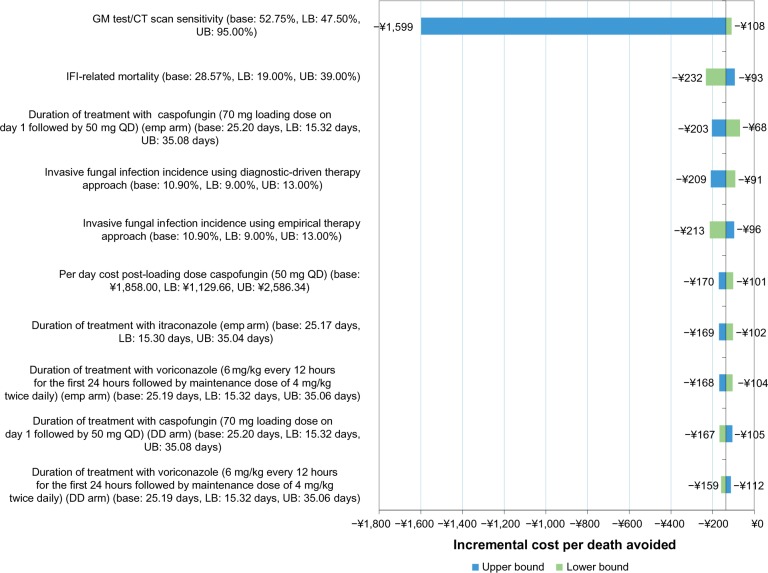
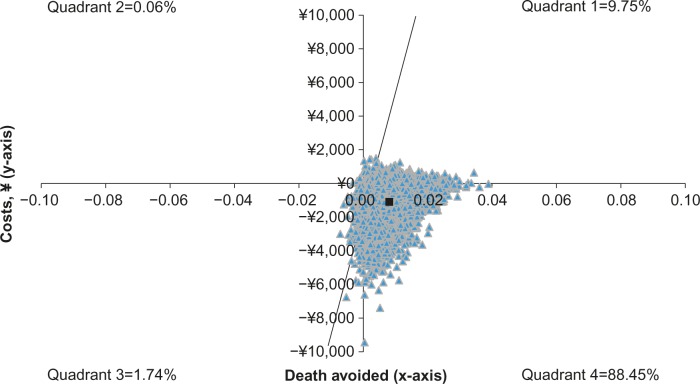
Invasive fungal infections (IFIs) require rapid diagnosis and treatment. A decision-analytic model was used to estimate total costs and survival associated with a diagnostic-driven (DD) or an empiric treatment approach in neutropenic patients with hematological malignancies receiving chemotherapy or autologous/allogeneic stem cell transplants in Shanghai, Beijing, Chengdu, and Guangzhou, the People's Republic of China. Treatment initiation for the empiric approach occurred after clinical suspicion of an IFI; treatment initiation for the DD approach occurred after clinical suspicion and a positive IFI diagnostic test result. Model inputs were obtained from the literature; treatment patterns and resource use were based on clinical opinion. Total costs were lower for the DD versus the empiric approach in Shanghai (¥3,232 vs ¥4,331), Beijing (¥3,894 vs ¥4,864), Chengdu, (¥4,632 vs ¥5,795), and Guangzhou (¥8,489 vs ¥9,795). Antifungal administration was lower using the DD (5.7%) than empiric (9.8%) approach, with similar survival rates. Results from one-way and probabilistic sensitivity analyses were most sensitive to changes in diagnostic test sensitivity and IFI incidence; the DD approach dominated the empiric approach in 88% of scenarios. These results suggest that a DD compared to an empiric treatment approach in the People's Republic of China may be cost saving, with similar overall survival in immunocompromised patients with suspected IFIs.
Keywords: aspergillosis; caspofungin; cost-effectiveness analysis; itraconazole; voriconazole.
Figures
References
-
- Liao Y, Chen M, Hartmann T, Yang RY, Liao WQ. Epidemiology of opportunistic invasive fungal infections in China: review of literature. Chin Med J (Engl) 2013;126(2):361–368. - PubMed
-
- Warnock DW. Trends in the epidemiology of invasive fungal infections. Nippon Ishinkin Gakkai Zasshi. 2007;48(1):1–12. - PubMed
-
- Cordonnier C, Pautas C, Maury S, et al. Empirical versus preemptive antifungal therapy for high-risk, febrile, neutropenic patients: a randomized, controlled trial. Clin Infect Dis. 2009;48(8):1042–1051. - PubMed
-
- Girmenia C, Micozzi A, Gentile G, et al. Clinically driven diagnostic antifungal approach in neutropenic patients: a prospective feasibility study. J Clin Oncol. 2010;28(4):667–674. - PubMed
-
- Hebart H, Klingspor L, Klingebiel T, et al. A prospective randomized controlled trial comparing PCR-based and empirical treatment with liposomal amphotericin B in patients after allo-SCT. Bone Marrow Transplant. 2009;43(7):553–561. - PubMed
LinkOut - more resources
Full Text Sources
Other Literature Sources
