. 2016 Jun 29:13:28.
doi: 10.1186/s12983-016-0161-1. eCollection 2016.

Dietary specialization drives multiple independent losses and gains in the bitter taste gene repertoire of Laurasiatherian Mammals

Affiliations

Dietary specialization drives multiple independent losses and gains in the bitter taste gene repertoire of Laurasiatherian Mammals

Zhijin Liu et al. Front Zool. .

Abstract

Background: Bitter taste perception is essential for species with selective food intake, enabling them to avoid unpalatable or toxic items. Previous studies noted a marked variation in the number of TAS2R genes among various vertebrate species, but the underlying causes are not well understood. Laurasiatherian mammals have highly diversified dietary niche, showing repeated evolution of specialized feeding preferences in multiple lineages and offering a unique chance to investigate how various feeding niches are associated with copy number variation for bitter taste receptor genes.

Results: Here we investigated the evolutionary trajectories of TAS2Rs and their implications on bitter taste perception in whole-genome assemblies of 41 Laurasiatherian species. The number of intact TAS2Rs copies varied considerably, ranging from 0 to 52. As an extreme example of a narrow dietary niche, the Chinese pangolin possessed the lowest number of intact TAS2Rs (n = 2) among studied terrestrial vertebrates. Marine mammals (cetacea and pinnipedia), which swallow prey whole, presented a reduced copy number of TAS2Rs (n = 0-5). In contrast, independent insectivorous lineages, such as the shrew and insectivorous bats possessed a higher TAS2R diversity (n = 52 and n = 20-32, respectively), exceeding that in herbivores (n = 9-22) and omnivores (n = 18-22).

Conclusions: Besides herbivores, insectivores in Laurasiatheria tend to have more functional TAS2Rs in comparison to carnivores and omnivores. Furthermore, animals swallowing food whole (cetacean, pinnipedia and pangolin) have lost most functional TAS2Rs. These findings provide the most comprehensive view of the bitter taste gene repertoire in Laurasiatherian mammals to date, casting new light on the relationship between losses and gains of TAS2Rs and dietary specialization in mammals.

Keywords: Bitter taste receptor; Dietary specialization; Gene gain and loss; Laurasiatheria; Mammal; TAS2R.


Figures
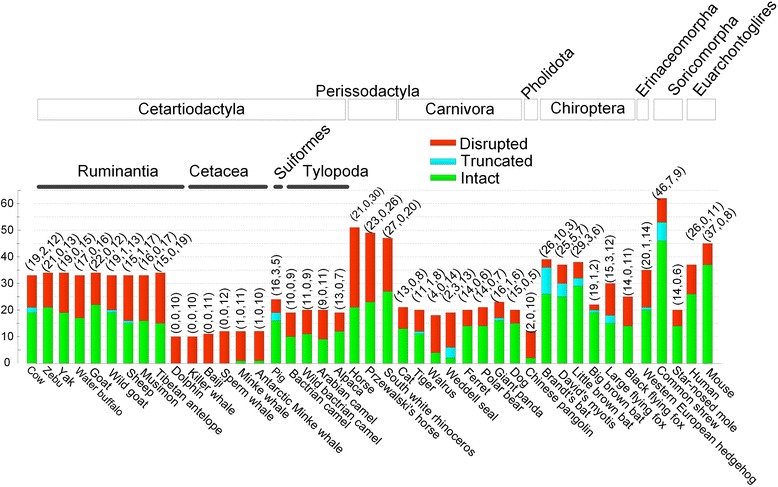
Fig. 1
Fig. 1
Numbers of complete, partial and disrupted TAS2Rs in 41 Laurasiatherian mammals
Fig. 2
Fig. 2
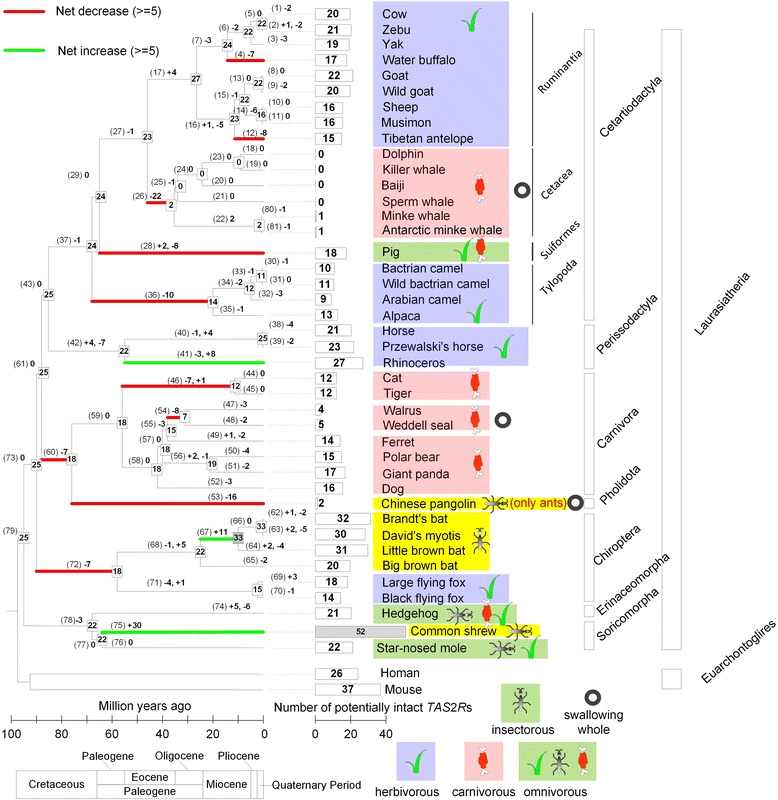
Evolutionary trajectories of TAS2Rs in Laurasiatheria. Numbers next to nodes denote the number of intact TAS2Rs (complete and partial ones). Numbers on branches denote the number of increases (caused by duplication of genes) and decreases (caused by pseudogenisation and whole-gene deletion). The bracketed ordinal numbers in this figure are used in electric supplementary material table S4, to describe the details of the birth-and-death evolution. To assess the phylogenetic relationships and divergence times of these species, we referred to TimeTree v3.0 [6] and Zhou et al. [39]
Fig. 3
Fig. 3
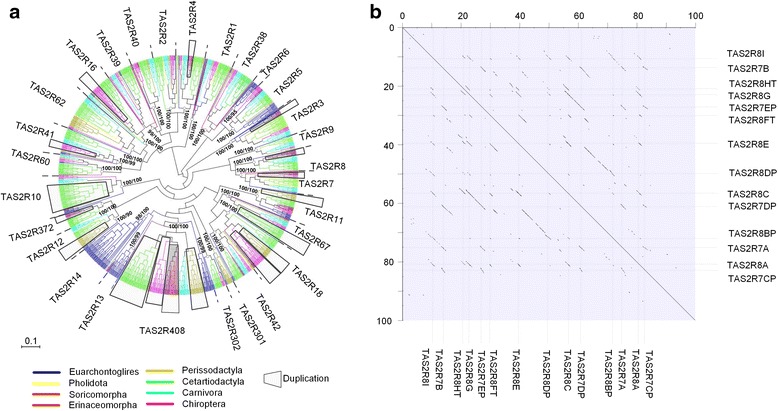
a A Neighbour-joining tree based on an alignment of annotated Laurasiatherian TAS2Rs (with orthologs representing all the 28 clades of Euarchontoglires TAS2Rs as outgroups) is shown. The clades not found (TAS2R6 and TAS2R13) and the pseudogenized clade TAS2R301 are underlined. The massive duplication events in different orders are marked by shadow blocks. b The dotplots showing that the duplication in the genomic region NW_004545902.1 of the common shrew resulted in increased gene copy numbers of clades TAS2R7 and TAS2R8
Fig. 4
Fig. 4
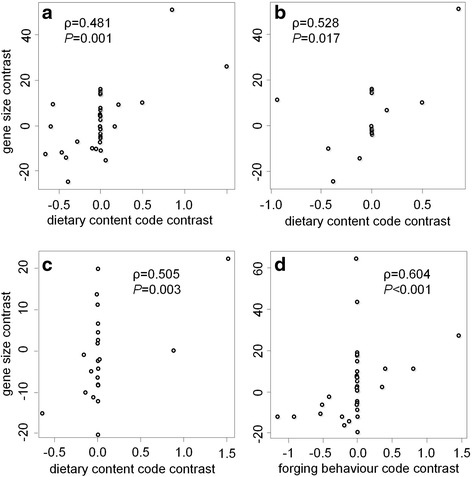
The impact of dietary content and behaviour on the intact TAS2R genes repertoire, as revealed by a PIC analysis. a significant positive correlation of PICs in total number of intact genes with PICs in diet content code (herbivores and/or insectivores:1, omnivores: 0.5, carnivores: 0). b the first sub-dataset (insectivores:1, omnivores: 0.5, carnivores: 0): a significantly positive correlation of PICs in total number of intact genes with PICs in diet content code. c the second sub-dataset (herbivores:1, omnivores: 0.5, carnivores: 0; not including tylopods): a significantly positive correlation of PICs in total number of intact genes with PICs in diet content. d significant positive correlation of PICs in total number of intact genes with PICs in foraging behaviour code (swallowing food whole: 0, chewing food: 1). The Spearman’s rank correlation coefficient (ρ) with a one-tailed P value was used to evaluate the association

References

    1. Bachmanov AA, Beauchamp GK. Taste receptor genes. Annu Rev Nutr. 2007;27:389–414. doi: 10.1146/annurev.nutr.26.061505.111329. - DOI - PMC - PubMed
    1. Dong D, Jones G, Zhang S. Dynamic evolution of bitter taste receptor genes in vertebrates. BMC Evol Biol. 2009;9:12. doi: 10.1186/1471-2148-9-12. - DOI - PMC - PubMed
    1. Shi P, Zhang J. Contrasting modes of evolution between vertebrate sweet/umami receptor genes and bitter receptor genes. Mol Biol Evol. 2006;23:292–300. doi: 10.1093/molbev/msj028. - DOI - PubMed
    1. Li D, Zhang J. Diet shapes the evolution of the vertebrate bitter taste receptor gene repertoire. Mol Biol Evol. 2014;31:303–309. doi: 10.1093/molbev/mst219. - DOI - PMC - PubMed
    1. Hu LL, Shi P. Smallest bitter taste receptor (T2Rs) gene repertoire in carnivores. Zool Res. 2013;34:E75–81. - PubMed

LinkOut - more resources