


The Effect of Different End-tidal Desflurane Concentrations on Bispectral Index Values in Normal Children and Children with Cerebral Palsy
- PMID: 27366372
- PMCID: PMC4894209
- DOI: 10.5152/TJAR.2013.33
The Effect of Different End-tidal Desflurane Concentrations on Bispectral Index Values in Normal Children and Children with Cerebral Palsy
Abstract
Objective: In this study, we aimed to compare the effects of different intraoperative end-tidal desflurane concentrations on bispectral index (BIS) values in normal children and children with cerebral palsy.
Methods: Twenty normal children (Group N) and 20 children with non-communicative/nonverbal cerebral palsy (Group CP), between 2 and 15 years of age, undergoing elective orthopaedic surgery were included in the study. Following premedication with midazolam, anaesthesia was induced by infusing 1% propofol at a rate of 200 mL hr(-1) until BIS reached 50. Heart rate, blood pressure and BIS values were recorded before and after the induction of anaesthesia, at steady-state end-tidal concentrations of 4% and 6% desflurane, and after emergence from anaesthesia. A p value <0.05 was considered significant in the statistical analyses, including Kolmogorov-Smirnov, t-test, paired samples t-test and chi-square test.
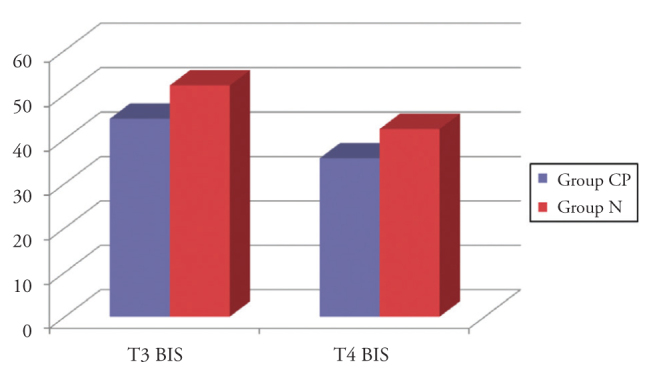
Results: The time to extubation and eye opening after discontinuation of anaesthesia was longer in Group CP. BIS values before the induction of anaesthesia, at a steady-state end-tidal desflurane concentration of 4% and after emergence from the anaesthetic were significantly lower in Group CP. At a steady-state end-tidal desflurane concentration of 6%, BIS values were slightly lower in Group CP but this difference was not statistically significant.
Conclusion: Based on the data obtained, we concluded that BIS monitoring in children with cerebral palsy can be useful in terms of decreasing adverse effects and drug interactions due to multiple drug usage by reducing the use of anaesthetic agents and improving emergence from the anaesthetic.
Keywords: Cerebral palsy; bispectral index; desflurane; paediatric anaesthesia.
Figures

References
-
- Nolan J, Chalkiadis GA, Low J, Olesch CA, Brown TC. Anaesthesia and pain management in cerebral palsy. Anaesthesia. 2000;55:32–41. http://dx.doi.org/10.1046/j.1365-2044.2000.01065.x. - DOI - PubMed
-
- Nelson KB, Emery ES., 3rd Birth asphyxia and the neonatal brain: what do we know and when do we know it? Clin Perinatol. 1993;20:327–44. - PubMed
-
- Dolk H, Parkes J, Hill N. Trends in the prevalence of cerebral palsy in Northern Ireland, 1981–1997. Dev Med Child Neurol. 2006;48:406–12. http://dx.doi.org/10.1111/j.1469-8749.2006.tb01287.x. - DOI - PubMed
-
- Theroux MC, Akins RE. Surgery and anesthesia for children who have cerebral palsy. Anesthesiol Clin North America. 2005;23:733–43. http://dx.doi.org/10.1016/j.atc.2005.08.001. - DOI - PubMed
-
- Denman WT, Swanson EL, Rosow D, Ezbicki K, Connors PD, Rosow CE. Pediatric evaluation of the bispectral index (BIS) monitor and correlation of BIS with end-tidal sevoflurane concentration in infants and children. Anesth Analg. 2000;90:872–7. http://dx.doi.org/10.1213/00000539-200004000-00018. - DOI - PubMed
LinkOut - more resources
Full Text Sources
Other Literature Sources
Miscellaneous