


Cardioprotective Effects of Remifentanil in a Sympathetic Hyperactivity Model in Rabbits
- PMID: 27366503
- PMCID: PMC4917134
- DOI: 10.5152/TJAR.2015.88319
Cardioprotective Effects of Remifentanil in a Sympathetic Hyperactivity Model in Rabbits
Abstract
Objective: In this study, the antiarrhythmic and anti-ischemic effects of a 6 μg kg(-1) min(-1) infusion dose of remifentanil are investigated in a central sympathetic hyperactivity model in rabbits.
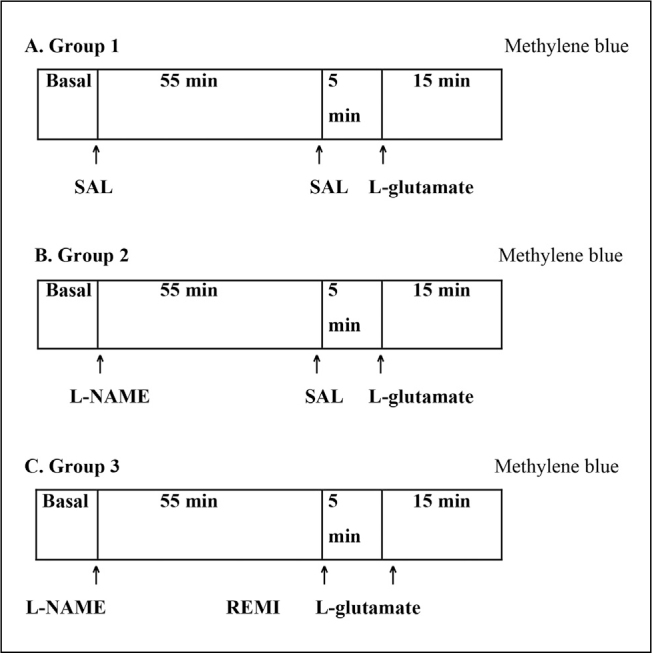
Methods: In this study, 18 New Zealand rabbits were used. The subjects were randomly divided into three groups (n=6) and received 10 μmol L(-1) glutamate intracerebroventricularly to provide the central sympathetic hyperactivity. In group 1, 10 μmol L(-1) glutamate was used; in group 2, 1 h before L-glutamate injection, 40 mg kg(-1) N (omega)-nitro-L-arginine methyl ester was intravenously (iv) administered; and in group 3, also 1 h before L-glutamate injection, 40 mg kg(-1) N (omega)-nitro-L-arginine methyl ester was iv administered. A 6 μg kg(-1) min(-1) dose of remifentanil infusion was administered 5 min before L-glutamate injection. Heart rate, systolic arterial pressure and mean arterial pressure were measured and recorded. Within 15 min of the intracerebroventricular L-glutamate injection, premature ventricular complexes, bigeminy ventricular arrhythmia, ventricular tachycardia, ST-segment shift and T-wave inversions were recorded.
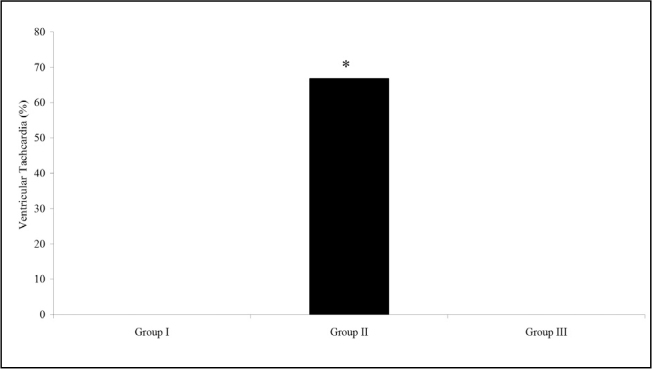
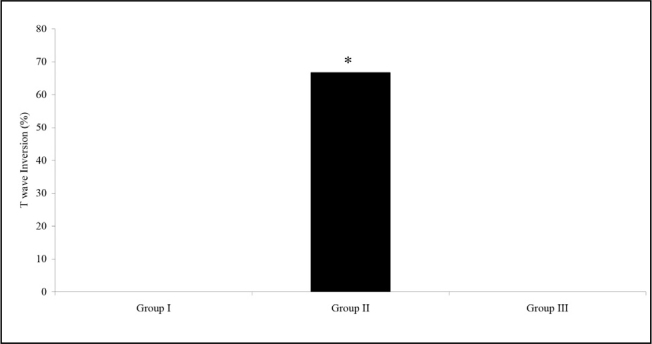
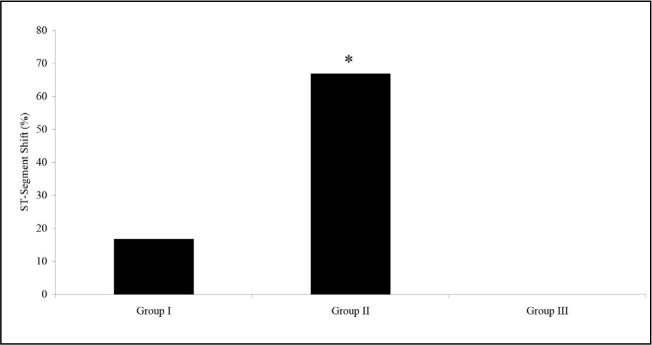
Results: When incidences of heart rate, rate pressure product, premature ventricular complexes and bigeminy ventricular arrhythmia were compared between groups, significant differences were not determined. Mean arterial pressure was more significantly increased in group 2 than in the other groups (p<0.05). Ventricular tachycardia, ST-segment shift and T-wave inversions were significantly lower in group 3 than in groups 1 and 2 (p<0.05).
Conclusion: Remifentanil (6 μg kg(-1) min(-1) for 5 min of infusion) prevented life-threatening ventricular tachycardia and electrocardiographic signs of myocardial ischemia in a model of arrhythmia resulting from the association of central sympathetic overactivity.
Keywords: Central sympathetic hyperactivity; myocardial ischemia; opioids; ventricular arrhythmia.
Figures
References
-
- Lessa MA, Rodrigues E, Tibiriça E. Cardioprotective action of fentanyl in a model of central sympathetic overactivity in rabbits: antiarrhythmic and anti-ischemic effects. Acta Anaesthesiol Scand. 2004;48:1115–22. http://dx.doi.org/10.1111/j.1399-6576.2004.00472.x. - DOI - PubMed
-
- Lessa MA, Tibirica E. Pharmacologic evidence for the involvement of central and peripheral opioid receptors in the cardioprotective effects of fentanyl. Anesth Analg. 2006;103:815–21. http://dx.doi.org/10.1213/01.ane.0000237284.30817.f6. - DOI - PubMed
-
- Zimlichman R, Gefel D, Eliahou H, Matas Z, Rosen B, Gass S, et al. Expression of opioid receptors during heart ontogeny in normotensive and hypertensive rats. Circulation. 1996;93:1020–5. http://dx.doi.org/10.1161/01.CIR.93.5.1020. - DOI - PubMed
-
- Schultz JJ, Hsu AK, Gross GJ. Ischemic preconditioning and morphine-induced cardioprotection involve the delta (delta)- opioid receptor in the intact rat heart. J Mol Cell Cardiol. 1997;29:2187–95. http://dx.doi.org/10.1006/jmcc.1996.0369. - DOI - PubMed
-
- Schultz JE, Hsu AK, Gross GJ. Ischemic preconditioning in the intact rat heart is mediated by delta1- but not mu- or kappa- opioid receptors. Circulation. 1998;97:1282–9. http://dx.doi.org/10.1161/01.CIR.97.13.1282. - DOI - PubMed
LinkOut - more resources
Full Text Sources
Miscellaneous