Growth status of small for gestational age Indian children from two socioeconomic strata
- PMID: 27366721
- PMCID: PMC4911844
- DOI: 10.4103/2230-8210.183473
Growth status of small for gestational age Indian children from two socioeconomic strata
Abstract
Aims: To assess growth and factors associated with growth in children born small for gestational age (SGA) from two socioeconomic strata in comparison to age- and sex-matched healthy controls.
Methods: Retrospective study conducted at two hospitals in Pune, 0.5-5 years, 618 children: 189-SGA from upper socioeconomic strata (USS), 217-SGA from lower socioeconomic strata (LSS), and 212 appropriate for gestational age healthy controls were randomly selected. Birth and maternal history, socioeconomic status, length/height, and weight of children were recorded. Anthropometric data were converted to Z scores (height for age Z-score [HAZ], weight for age Z-score [WAZ]) using WHO AnthroPlus software.
Results: The HAZ and WAZ of the SGA group were significantly lower as compared to the controls and that of the LSS SGAs were lower than USS SGAs (P < 0.05). Thirty two percent children were stunted (HAZ <-2.0) in USS and 49% in LSS (P < 0.05). Twenty nine percent children in the USS SGA group were stunted at 2 years and 17% at 5 years. In the LSS SGA group, 54% children were stunted at 2 years and 46% at 5 years. Generalized linear model revealed normal vaginal delivery (β = 0.625) and mother's age (β =0.072) were positively associated and high SES (β = -0.830), absence of major illness (β = -1.01), higher birth weight (β = -1.34) were negatively associated for risk of stunting (P < 0.05).
Conclusion: Children born SGA showed poor growth as compared to controls. Special attention to growth is necessary in children from LSS, very low birth weight babies, and those with major illnesses during early years of life.
Keywords: Children; growth; small for gestational age.
Figures

 normal height (>−2.0 height for age Z-score)
  Stunted (≤−2.0 height for age Z-score)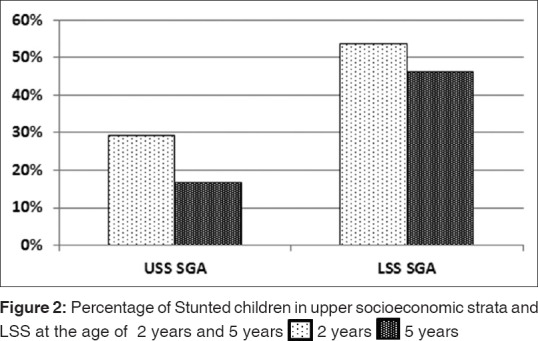
 2 years
  5 years
References
-
- Bhargava SK, Ramji S, Srivastava U, Sachdev HP, Kapani V, Datta V, et al. Growth and sexual maturation of low birth weight children: A 14 year follow up. Indian Pediatr. 1995;32:963–70. - PubMed
-
- Bernstein PS, Divon MY. Etiologies of fetal growth restriction. Clin Obstet Gynecol. 1997;40:723–9. - PubMed
-
- de Zegher F, Francois I, van Helvoirt M, Van den Berghe G. Clinical review 89: Small as fetus and short as child: From endogenous to exogenous growth hormone. J Clin Endocrinol Metab. 1997;82:2021–6. - PubMed
-
- Kean V. Assessment of growth. In: Kliegman R, Bhrman R, Jenson HB, Stanson BF, editors. Nelson Textbook of Pediatrics. 18th ed. Philadelphia, Pa, USA: Saunders Elsevier; 2007. p. 72. Ch. 14.
LinkOut - more resources
Full Text Sources
Other Literature Sources