Multiple Citation Indicators and Their Composite across Scientific Disciplines
- PMID: 27367269
- PMCID: PMC4930269
- DOI: 10.1371/journal.pbio.1002501
Multiple Citation Indicators and Their Composite across Scientific Disciplines
Erratum in
-
Correction: Multiple Citation Indicators and Their Composite across Scientific Disciplines.PLoS Biol. 2016 Aug 22;14(8):e1002548. doi: 10.1371/journal.pbio.1002548. eCollection 2016 Aug. PLoS Biol. 2016. PMID: 27548059 Free PMC article.
Abstract
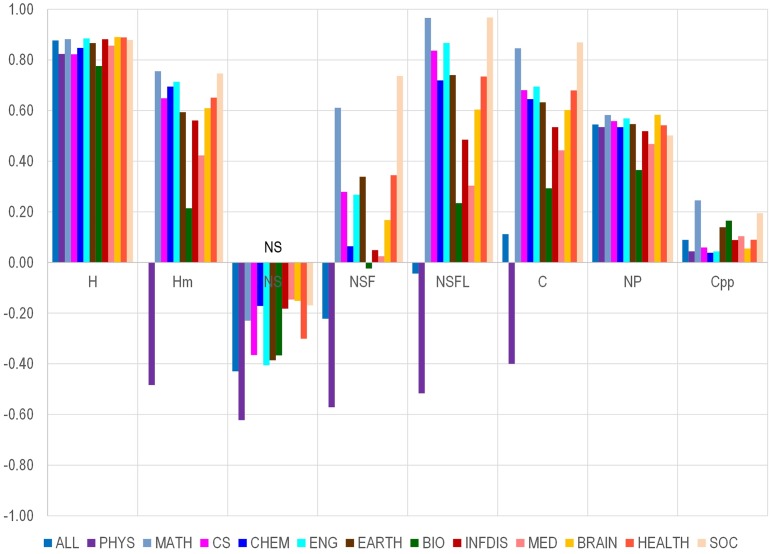
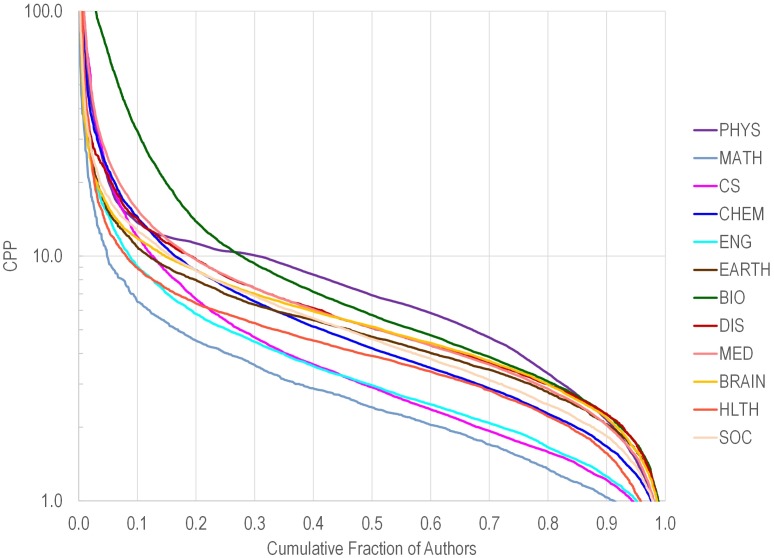
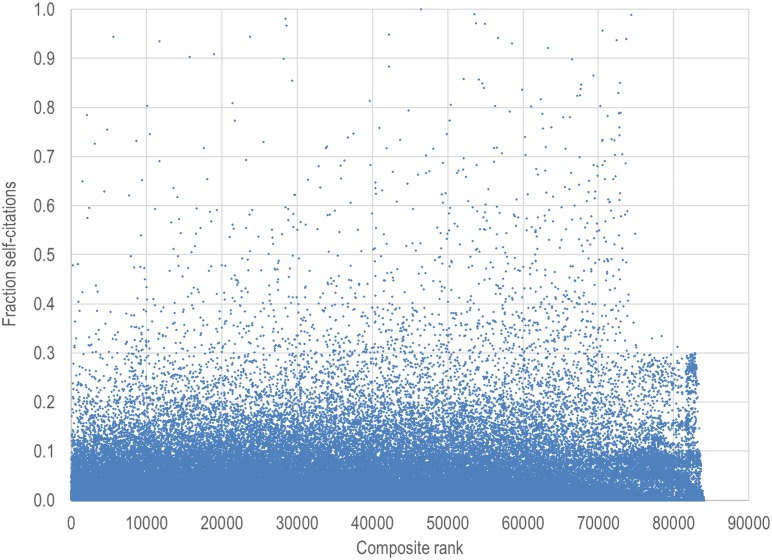
Many fields face an increasing prevalence of multi-authorship, and this poses challenges in assessing citation metrics. Here, we explore multiple citation indicators that address total impact (number of citations, Hirsch H index [H]), co-authorship adjustment (Schreiber Hm index [Hm]), and author order (total citations to papers as single; single or first; or single, first, or last author). We demonstrate the correlation patterns between these indicators across 84,116 scientists (those among the top 30,000 for impact in a single year [2013] in at least one of these indicators) and separately across 12 scientific fields. Correlation patterns vary across these 12 fields. In physics, total citations are highly negatively correlated with indicators of co-authorship adjustment and of author order, while in other sciences the negative correlation is seen only for total citation impact and citations to papers as single author. We propose a composite score that sums standardized values of these six log-transformed indicators. Of the 1,000 top-ranked scientists with the composite score, only 322 are in the top 1,000 based on total citations. Many Nobel laureates and other extremely influential scientists rank among the top-1,000 with the composite indicator, but would rank much lower based on total citations. Conversely, many of the top 1,000 authors on total citations have had no single/first/last-authored cited paper. More Nobel laureates of 2011-2015 are among the top authors when authors are ranked by the composite score than by total citations, H index, or Hm index; 40/47 of these laureates are among the top 30,000 by at least one of the six indicators. We also explore the sensitivity of indicators to self-citation and alphabetic ordering of authors in papers across different scientific fields. Multiple indicators and their composite may give a more comprehensive picture of impact, although no citation indicator, single or composite, can be expected to select all the best scientists.
Conflict of interest statement
The authors have declared that no competing interests exist.
Figures
References
-
- Kelly CD, Jennions MD. The h index and career assessment by numbers. Trends Ecol Evol 2006;21:167–170. - PubMed
Publication types
MeSH terms
LinkOut - more resources
Full Text Sources
Other Literature Sources
Research Materials