


Comment
doi: 10.1016/j.cell.2016.06.021.
Evidence of G.O.D.'s Miracle: Unearthing a RAG Transposon
Affiliations
- PMID: 27368095
- PMCID: PMC5428540
- DOI: 10.1016/j.cell.2016.06.021
Item in Clipboard
Comment
Evidence of G.O.D.'s Miracle: Unearthing a RAG Transposon
Cell.
.
Abstract
Diversity of antibodies and T cell receptors is generated by gene rearrangement dependent on RAG1 and RAG2, enzymes predicted to have been derived from a transposable element (TE) that invaded an immunoglobulin superfamily gene early in the evolution of jawed vertebrates. Now, Huang et al. report the discovery of ProtoRAG in the lower chordate Amphioxus, the long-anticipated TE related to the RAG transposon.
Copyright © 2016 Elsevier Inc. All rights reserved.
Figures
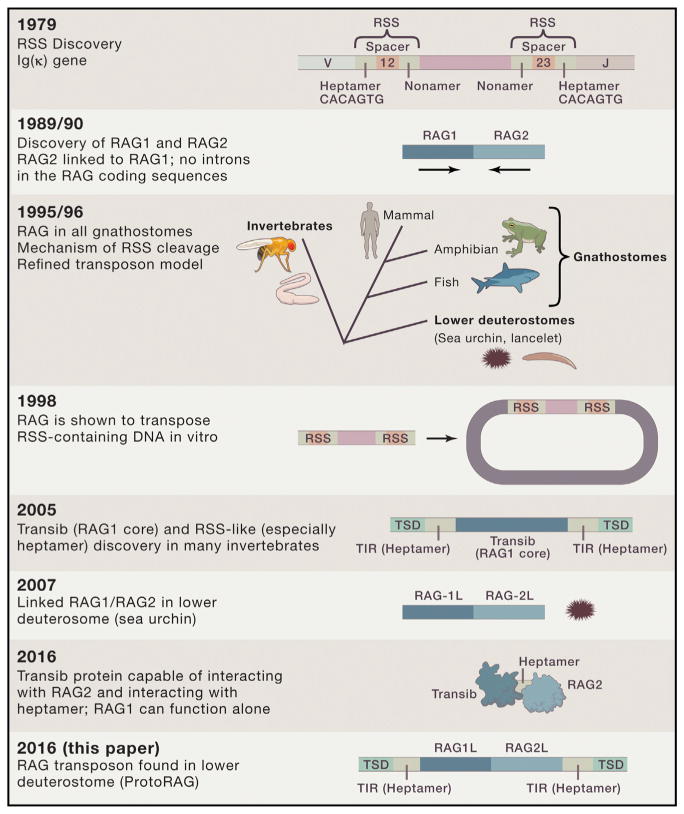
The discoveries of RSS (by Tonegawa and colleagues), the RAG proteins (by
Baltimore and colleagues), and the mechanism of RSS cleavage (by
Oettinger/Gellert and colleagues) resulted in the theory that a TE invaded an
IgSF gene, eventually leading to Ig/TCR gene rearrangement (by Thompson).
Experiments showing that the RAGs are capable of DNA transposition (by
Schatz/Gellert and colleagues), the presence of RAG in all gnathostomes (by
Marchalonis and colleagues), and the presence of a RAG1 core and TIR in the
invertebrates (by Kaptinov and Jurka) were consistent with the model. Discovery
of linked RAG1L and RAG2L in lower deuterostomes (by Fugmann/Rast and
colleagues), including a complete and active RAG transposon in Amphioxus (Huang et al., 2016), are consistent with the
hypothesis.
Comment on
-
Discovery of an Active RAG Transposon Illuminates the Origins of V(D)J Recombination.Cell. 2016 Jun 30;166(1):102-14. doi: 10.1016/j.cell.2016.05.032. Epub 2016 Jun 9. Cell. 2016. PMID: 27293192 Free PMC article.
References
Publication types
MeSH terms
Substances
Grants and funding
LinkOut - more resources
Full Text Sources
Other Literature Sources
