


Clinical parameters for predicting radiation-induced liver disease after intrahepatic reirradiation for hepatocellular carcinoma
- PMID: 27369241
- PMCID: PMC4930588
- DOI: 10.1186/s13014-016-0663-1
Clinical parameters for predicting radiation-induced liver disease after intrahepatic reirradiation for hepatocellular carcinoma
Abstract
Background: Few data are available on the tolerance of reirradiation in patients with hepatocellular carcinoma (HCC). This study determined the clinical parameters contributing to the development of radiation-induced liver disease (RILD).
Methods: We included 36 patients with HCC who received 2 courses of radiotherapy (RT) to the liver. Using α/β = 15 for tumor and α/β =8 for normal liver tissue for biologically equivalent doses in 2 Gy fractions, mean cumulative to the hepatic tumor and normal liver were 87.7 Gy15 and 31.1 Gy8, respectively. Hepatic toxicities were classified according to the Common Terminology Criteria for Adverse Events, Version 4.0. Clinical data, including liver function test results, radiological study findings, and RT parameters before and after both courses of RT were retrieved for analysis. Using multivariate analysis, logistic regression was used to identify the predictors of RILD, and Cox regression was performed to explore the prognostic factors for overall survival (OS).
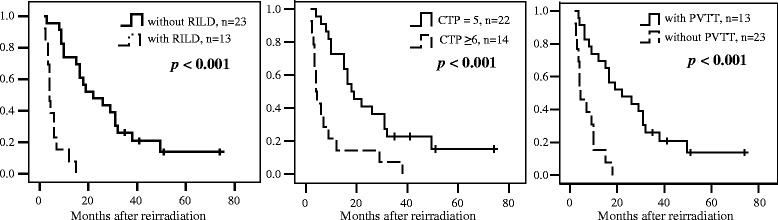
Results: Thirteen patients (36 %) developed RILD after reirradiation. Nine of them died because of progressive liver failure without evidence of tumor progression and were categorized to have lethal RILD. A pretreatment Child-Turcotte-Pugh (CTP) score ≥6 was the only predictor of RILD [odds ratio (OR): 15.83, p = 0.001] and lethal RILD [OR: 72.56, p = 0.005]. In addition, a CTP score ≥6 and the presence of portal vein tumor thrombosis before reirradiation were 2 prognostic factors for OS.
Conclusion: Despite a limited sample size, residual liver function using a preirradiation CTP score ≥6 is a clinical parameter associated with an increased risk of RILD in patients requiring hepatic reirradiation.
Keywords: Hepatocellular carcinoma; Irradiation; Prognostic factor; Radiation-induced liver disease.
Figures
References
MeSH terms
LinkOut - more resources
Full Text Sources
Other Literature Sources
Medical
