. 2016 Dec;7(5-6):327-335.
doi: 10.1007/s12672-016-0267-0. Epub 2016 Jul 1.

Different Types of Urinary Steroid Profiling Obtained by High-Performance Liquid Chromatography and Gas Chromatography-Mass Spectrometry in Patients with Adrenocortical Carcinoma

Affiliations

Different Types of Urinary Steroid Profiling Obtained by High-Performance Liquid Chromatography and Gas Chromatography-Mass Spectrometry in Patients with Adrenocortical Carcinoma

L I Velikanova et al. Horm Cancer. 2016 Dec.

Abstract

Urinary steroid profiling (USP) was studied using high-performance liquid chromatography (HPLC) and gas chromatography-mass spectrometry (GC-MS) methods in 108 patients with adrenocortical adenoma (ACA) and in 31 patients with adrenocortical carcinoma (ACC). Thirteen ACC and Cushing's syndrome (ACC-CS) patients had two types of USP as well as 18 ACC patients without hypercortisolism. These four types differed by androgen and glucocorticoid secretion of the adrenal cortex. Fifteen main ACC features were observed by GC-MS. Urinary excretion of dehydroepiandrosterone (DHEA) was increased in 67.7 % of ACC patients and tetrahydro-11-deoxycortisol (THS) in 74.2 %. By combination of the following parameters: THS >900 μg/24 h and/or DHEA >1500 μg/24 h with ratios of 3α,16,20-pregnentriol/3β,16,20-pregnentriol (3α,16,20dP3/3β,16,20dP3) less than 6.0 and 3α,17,20dP3/3β,17,20dP3 less than 9.0 and the detection of "non-classical" 5-en-pregnens, not found in ACA and healthy persons, 100 % sensitivity and specificity of ACC and ACA differential diagnosis were achieved. Features of 21-hydroxylase and 11β-hydroxylase deficiency were observed by GC-MS in 32.2 and 61.3 % of the ACC patients, respectively. Additional features for ACC-CS diagnostic were increased urinary excretion of 6β-hydroxycortisol, 18-hydroxycorticosterone, the sum (UFF + UFE) obtained by HPLC, tetrahydrocorticosterone, and the sum (THF + THE + allo-THF) obtained by GC-MS.


Conflict of interest statement

The authors declare that they have no conflict of interest.

Figures
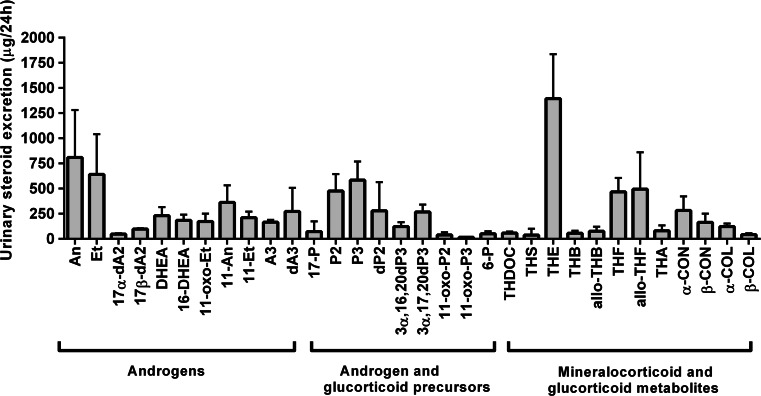
Fig. 1
Fig. 1
Excretion of urinary steroids in healthy persons. Androgens: An androsterone, Et etiocholanolone, 17α-dA2 17α-androstendiol, DHEA dehydroepiandrosterone, 16-DHEA 16-hydroxy-DHEA, 11oxo-Et 11-oxo-etiocholanolone, 11-An 11-hydroxy-androsteron, 11-Et 11-hydroxy-etiocholanolone, A3 3,11,17-androstantriol, dA3 androstenetriol. Androgen and glucocorticoid precursors: 17-P 17-hydroxy-pregnanolone, P pregnanolone, P2 pregnanediol, P3 pregnanetriol, dP2 pregnenediol, 3α,17,20dP3 3α,17,20-pregnenetriol, 3α,16,20dP3 3α,16,20-pregnenetriol, 11-oxo-P2 11-oxo-pregnandiol, 11-oxo-P3 11-oxo-pregnantriol, 6-P 6-hydroxy-pregnanolone. Mineralocorticoid and glucocorticoid metabolites: THDOC tetrahydro-11-deoxycorticosterone, THS tetrahydro-11-deoxycortisol, THE tetrahydrocortisone, THB tetrahydrocorticosterone, THF tetrahydrocortisol, THA tetrahydro-11-dehydrocorticosterone, α-CON α-cortolon, α-COL α-cortol
Fig. 2
Fig. 2
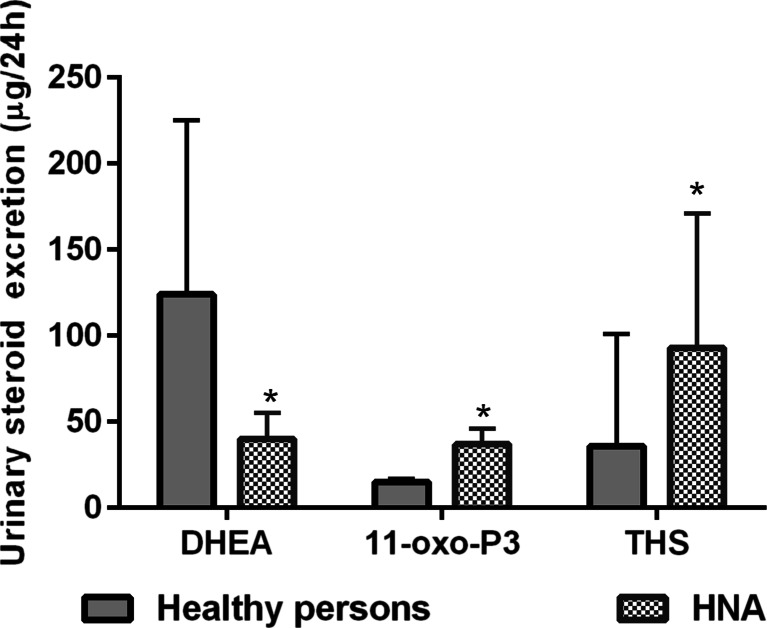
Urinary excretion of dehydroepiandrosterone (DHEA), 11-oxo-pregnanetriol (11-oxo-P3), and tetrahydro-11-deoxycortisol (THS) in healthy persons and patients with hormonally non-active adenomas (HNA). *p < 0.05—comparison with healthy persons
Fig. 3
Fig. 3
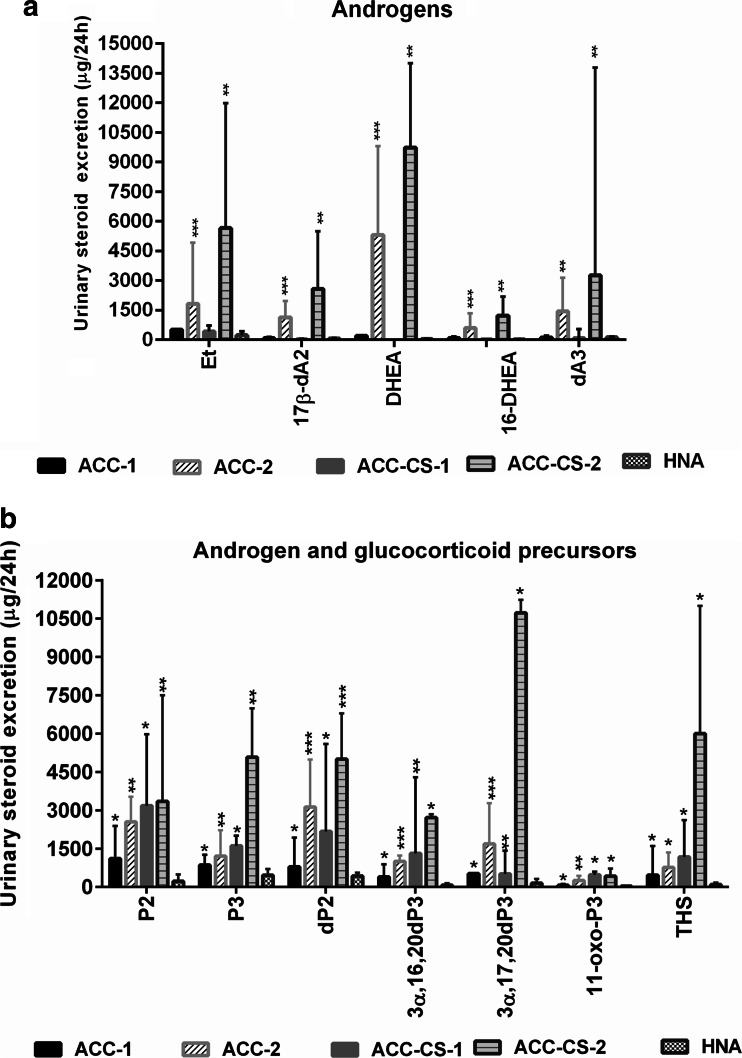
Urinary steroid excretion in patients with adrenocortical carcinoma without cortisol hypersecretion (ACC), in patients with adrenocortical carcinoma and Cushing’s syndrome (ACC-CS), and in patients with hormonally non-active adenomas (HNA). ACC-1—patients with ACC without cortisol and androgen hypersecretion (n = 5); ACC-2—patients with ACC and androgen hypersecretion (n = 13); ACC-CS-1—patients with ACC-CS and without androgen hypersecretion (n = 5); ACC-CS-2—patients with ACC-CS and androgen hypersecretion (n = 8). a Urinary androgen excretion: Et etiocholanolone, 17β-dA2 17β-androstendiol, DHEA dehydroepiandrosterone, 16-DHEA 16-OH-dehydroepiandrosterone, dA3 androstenetriol. b Urinary androgen and glucocorticoid precursor excretion (common ACC signs found in all four ACC patient groups): P2 pregnanediol, P3 pregnanetriol, dP2 pregnenediol, 3α,17,20dP3 3α,17,20-pregnenetriol, 3α,16,20dP3 3α,16,20-pregnenetriol, 11-oxo-P3 11-oxo-pregnanetriol, THS tetrahydro-11-deoxycortisol. *p < 0.05, **p < 0.01, ***p < 0.001—comparison with hormonally non-active adenomas
Fig. 4
Fig. 4
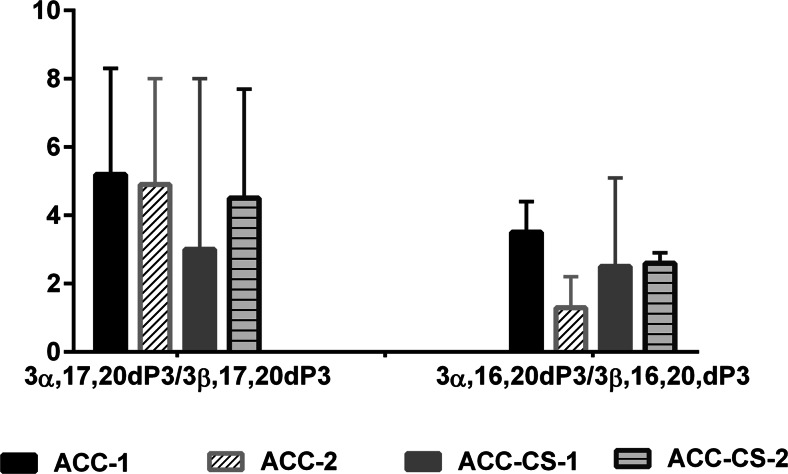
The ratios of 3α,16,20-pregnenetriol/3β,16,20-pregnenetriol and 3α,17,20-pregnenetriol/3β,17,20-pregnenetriol in adrenocortical carcinoma patients without cortisol hypersecretion (ACC) and in adrenocortical carcinoma with Cushing’s syndrome (ACC-CS) patients. ACC-1—patients with ACC without cortisol and androgen hypersecretion; ACC-2—patients with ACC and androgen hypersecretion; ACC-CS-1—patients with ACC-CS and without androgen hypersecretion; ACC-CS-2—patients with ACC-CS and androgen hypersecretion

References

    1. Fassnacht M, Kroiss M, Allolio B. Update in adrenocortical carcinoma. J Clin Endocrinol Metab. 2013;98(12):4551–4564. doi: 10.1210/jc.2013-3020. - DOI - PubMed
    1. Else T, Kim AC, Sabolch A, Raymond VM, Kandathil A, Caoili EM, Jolly S, Miller BS, Giordano TJ, Hammer GD. Adrenocortical carcinoma. Endocr Rev. 2014;35(2):282–326. doi: 10.1210/er.2013-1029. - DOI - PMC - PubMed
    1. Reibetanz J, Kroiss M, Deutschbein T, Fenske W, Gasser M, Jurowich C, Germer CT, Allolio B, Fassnacht M. German adrenocortical carcinoma registry. Surgical therapy results and follow-up treatment. Chirurg. 2012;83(6):528–535. doi: 10.1007/s00104-011-2193-6. - DOI - PubMed
    1. Arlt W, Biehl M, Taylor AE, Hahner S, Libé R, Hughes BA, Schneider P, Smith DJ, Stiekema H, Krone N, Porfiri E, Opocher G, Bertherat J, Mantero F, Allolio B, Terzolo M, Nightingale P, Shackleton CH, Bertagna X, Fassnacht M, Stewart PM. Urine steroid metabolomics as a biomarker tool for detecting malignancy in adrenal tumors. J Clin Endocrinol Metab. 2011;96(12):3775–3784. doi: 10.1210/jc.2011-1565. - DOI - PMC - PubMed
    1. Grumbach MM, Biller BM, Braunstein GD, Campbell KK, Carney JA, Godley PA, Harris EL, Lee JK, Oertel YC, Posner MC, Schlechte JA, Wieand HS. Management of the clinically inapparent adrenal mass (“incidentaloma”) Ann Intern Med. 2003;138:424–429. doi: 10.7326/0003-4819-138-5-200303040-00013. - DOI - PubMed

MeSH terms

LinkOut - more resources