


Transmission-blocking activity is determined by transmission-reducing activity and number of control oocysts in Plasmodium falciparum standard membrane-feeding assay
- PMID: 27372156
- PMCID: PMC4958521
- DOI: 10.1016/j.vaccine.2016.06.066
Transmission-blocking activity is determined by transmission-reducing activity and number of control oocysts in Plasmodium falciparum standard membrane-feeding assay
Abstract
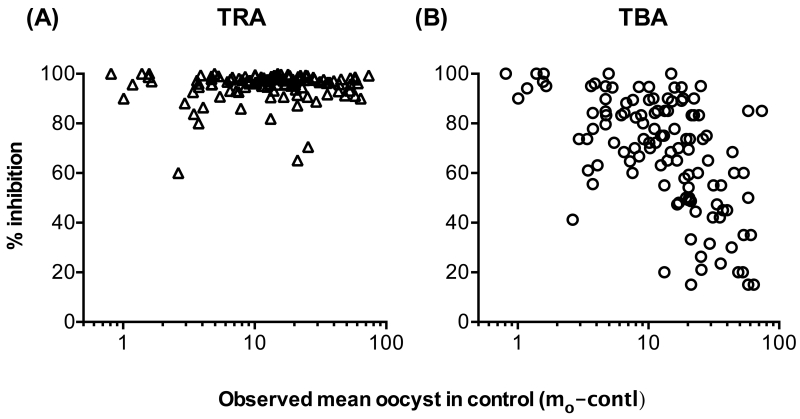
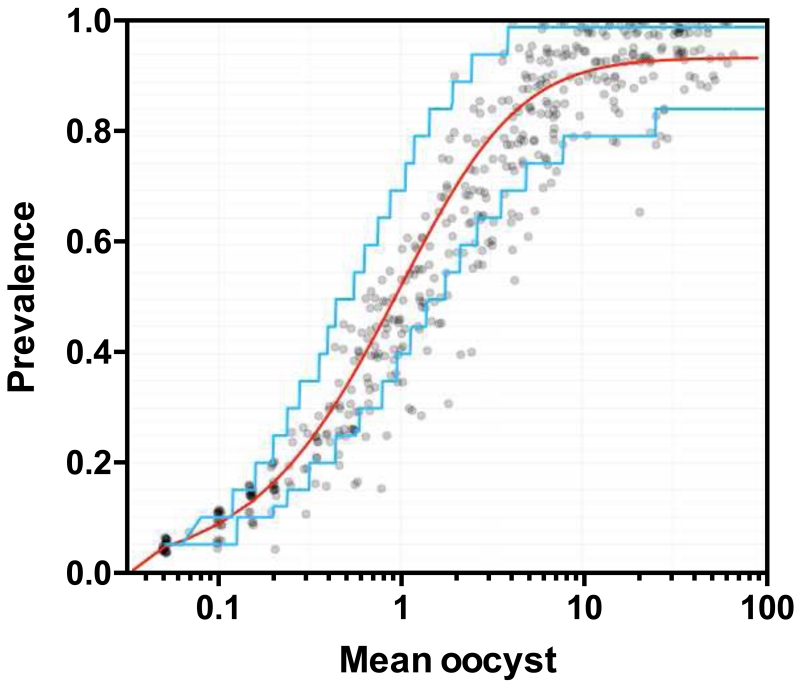
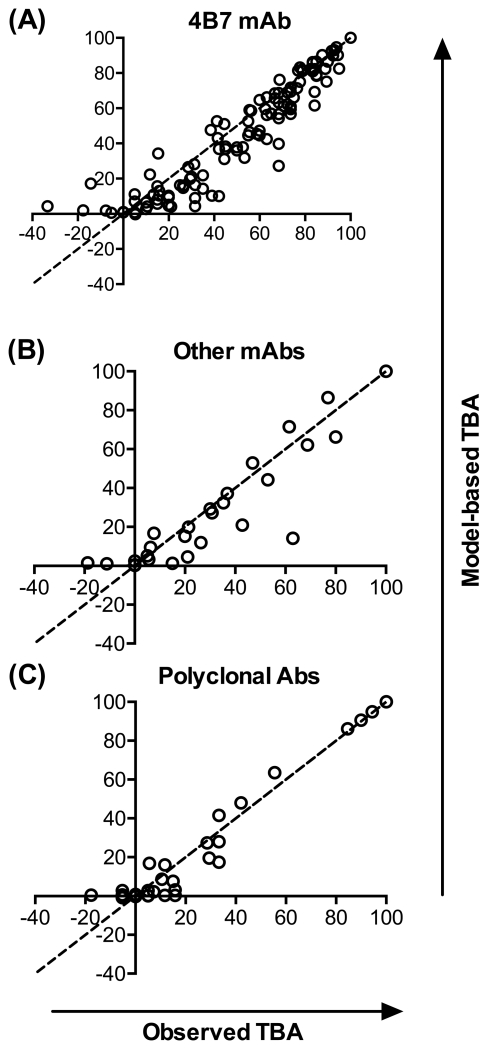
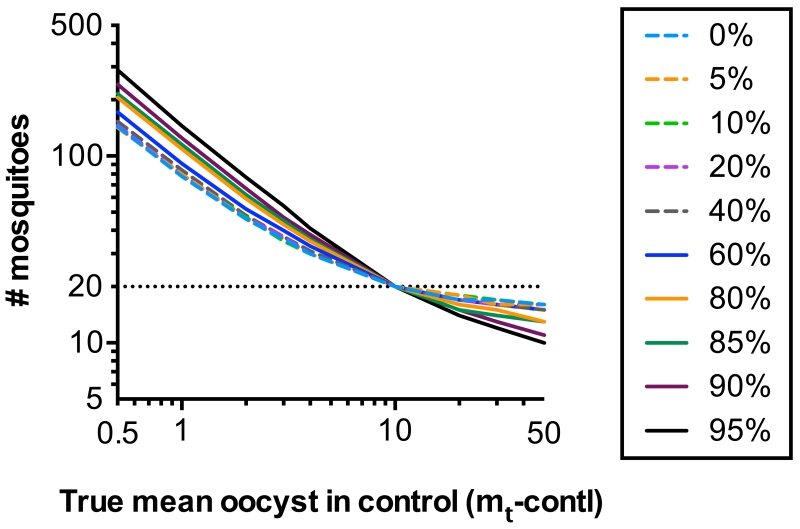
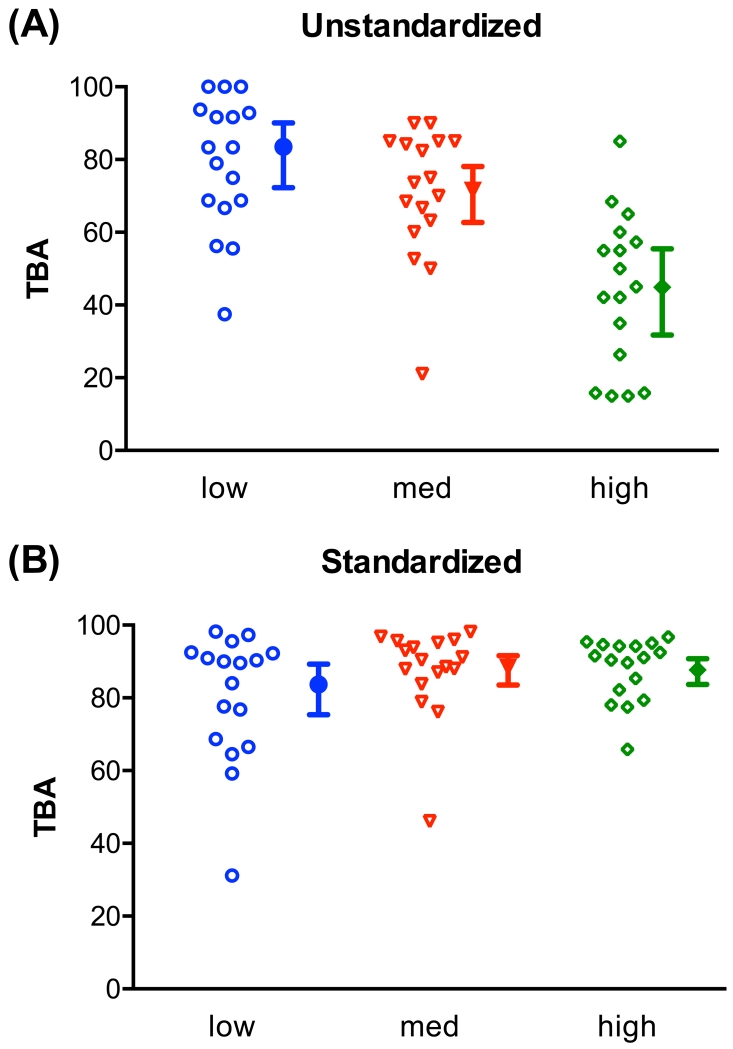
Malaria transmission-blocking vaccines (TBVs) are potentially helpful tools for malaria eradication. The standard membrane-feeding assay (SMFA) is considered one of the "gold standard" assays for TBV development. However, lack of consensus in reporting results from SMFA has made it very challenging to compare results from different studies. Two main readouts, % inhibition in mean oocyst count per mosquito (TRA) and % inhibition in prevalence of infected mosquitoes (TBA), have been used widely. In this study, we statistically modeled the oocyst data in SMFA using data from 105 independent feeding experiments including 9804 mosquitoes. The model was validated using an independent data set that included 10,790 mosquitoes from 110 feeding studies. The model delineates a relationship between TRA, the mean oocyst count in the control mosquitoes (mo-contl), and TBA. While TRA was independent from mo-contl, TBA values changed depending on mo-contl. Regardless of monoclonal or polyclonal antibodies tested, there were strong concordances between observed TBA and predicted TBA based on the model using mo-contl and observed TRA. Simulations showed that SMFA with lower true control means had increased uncertainty in TRA estimates. The strong linkage between TBA, TRA and mo-contl inspired creation of a standardized TBA, a model-based TBA standardized to a target control mean, which allows comparison across multiple feeds regardless of mo-contl. This is the first study showing that the observed TBA can be reasonably predicted by mo-contl and the TRA of the test antibody using independent experimental data. This study indicates that TRA should be used to compare results from multiple feeds with different levels of mo-contl. If a measure of TBA is desired, it is better to report standardized TBA rather than observed TBA. These recommendations support rational comparisons of results from different studies, thus benefiting future TBV development.
Keywords: Malaria; Standard membrane-feeding assay; Transmission-blocking vaccine.
Published by Elsevier Ltd.
Figures
References
-
- [accessed 24 February 2016];World Malaria Report. 2015 http://www.who.int/malaria/publications/world-malaria-report-2015/report...
-
- Nunes JK, Woods C, Carter T, Raphael T, Morin MJ, Diallo D, et al. Development of a transmission-blocking malaria vaccine: progress, challenges, and the path forward. Vaccine. 2014;32:5531–5539. - PubMed
-
- Wu Y, Sinden RE, Churcher TS, Tsuboi T, Yusibov V. Development of malaria transmission-blocking vaccines: from concept to product. Adv Parasitol. 2015;89:109–152. - PubMed
-
- Nikolaeva D, Draper SJ, Biswas S. Toward the development of effective transmission-blocking vaccines for malaria. Expert Rev Vaccines. 2015:1–28. - PubMed
Publication types
MeSH terms
Substances
Grants and funding
LinkOut - more resources
Full Text Sources
Other Literature Sources
Medical
Molecular Biology Databases
Research Materials
