Review
. 2016 Nov;263(11):2339-2354.
doi: 10.1007/s00415-016-8208-y. Epub 2016 Jul 2.

Hearing and dementia

Affiliations
Review

Hearing and dementia

Chris J D Hardy et al. J Neurol. 2016 Nov.

Abstract

Hearing deficits associated with cognitive impairment have attracted much recent interest, motivated by emerging evidence that impaired hearing is a risk factor for cognitive decline. However, dementia and hearing impairment present immense challenges in their own right, and their intersection in the auditory brain remains poorly understood and difficult to assess. Here, we outline a clinically oriented, symptom-based approach to the assessment of hearing in dementias, informed by recent progress in the clinical auditory neuroscience of these diseases. We consider the significance and interpretation of hearing loss and symptoms that point to a disorder of auditory cognition in patients with dementia. We identify key auditory characteristics of some important dementias and conclude with a bedside approach to assessing and managing auditory dysfunction in dementia.

Keywords: Alzheimer’s disease; Auditory; Dementia; Frontotemporal dementia; Hearing; Lewy body disease; Progressive aphasia.


Conflict of interest statement

Compliance with ethical standards Conflicts of interest The Dementia Research Centre is supported by Alzheimer’s Research UK, the Brain Research Trust and the Wolfson Foundation. CJDH holds an MRC PhD Studentship. CRM is funded by a Clinical Research Fellowship from the Leonard Wolfson Experimental Neurology Centre. HLG was supported by an Alzheimer Research UK PhD Fellowship. CNC is supported by The National Brain Appeal—Frontotemporal Dementia Research Fund. JDW received salary support from the Wellcome Trust (Wellcome Trust Senior Clinical Fellowship (091673/Z/10/Z). The authors report no conflicts of interest. Study funding This work was funded by the Wellcome Trust, the UK Medical Research Council and the NIHR Queen Square Dementia Biomedical Research Unit.

Figures
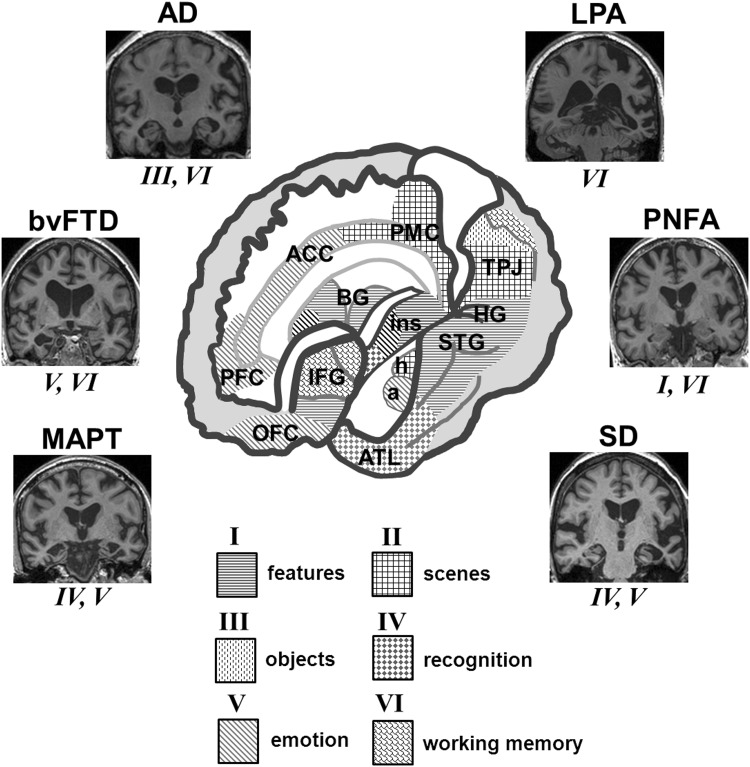
Fig. 1
Fig. 1
Neuroanatomical signatures of disordered auditory cognition in dementias. The cutaway brain schematic (centre) shows cerebral networks that mediate key components of auditory cognition, coded I to VI (below) and based on clinical and normal functional neuroanatomical evidence (see Tables 1, 2); ‘features’ here subsumes acoustic feature detection and analysis, ‘objects’ corresponds to auditory apperceptive processing and ‘recognition’ corresponds to auditory semantic processing. The left cerebral hemisphere is projected forward in the schematic; however, neuroanatomical correlates of auditory cognition are bi-hemispherically distributed, principally, including: a amygdala, ACC anterior cingulate cortex, ATL anterior temporal lobe, BG basal ganglia, h hippocampus, HG Heschl’s gyrus (containing primary auditory cortex), IFG inferior frontal gyrus/frontal operculum, ins insula, OFC orbitofrontal cortex, PFC prefrontal cortex, PMC posterior medial cortex (posterior cingulate, precuneus), STG superior temporal gyrus/superior temporal sulcus/planum temporale, TPJ temporo–parietal junction. Side panels show characteristic profiles of regional cerebral atrophy (coronal MRI sections) and auditory cognitive functions chiefly affected in selected dementias (see also Table 2): typical Alzheimer’s disease (AD), bilateral symmetrical mesial temporal and parietal lobe atrophy; behavioural variant frontotemporal dementia (bvFTD), asymmetric (predominantly right-sided) frontal and temporal lobe atrophy; logopenic aphasia (LPA) variant of Alzheimer’s disease, predominantly left-sided temporo-parietal atrophy; microtubule-associated protein tau (MAPT) gene mutations, bilateral (predominantly antero-mesial) temporal lobe atrophy; progressive nonfluent aphasia (PNFA), predominantly left-sided peri-Sylvian atrophy; and semantic dementia (SD), asymmetric (predominantly left-sided) anterior temporal lobe atrophy
Fig. 2
Fig. 2
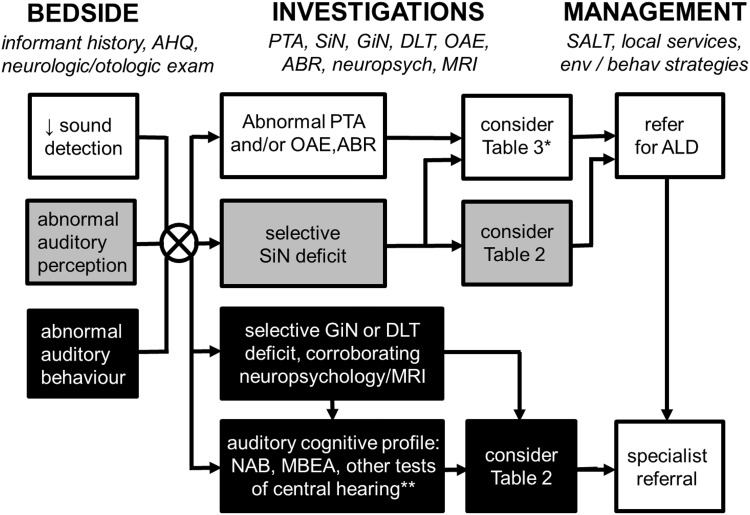
A clinical approach to the patient presenting with cognitive decline and altered hearing. Our approach is based on initial thorough bedside history taking and examination to identify key auditory symptoms (see also Table 4) supplemented by investigations to characterise the nature of the patient’s hearing and cognitive deficits. As clinical symptoms are rarely specific and disorders at different levels of the auditory processing hierarchy frequently coexist, we recommend a core hearing assessment battery in all cases, corroborated by general neuropsychological assessment and brain MRI. Together, these assessments often allow the patient’s hearing deficit to be localised predominantly to the cochlea or ascending auditory pathways (unfilled oblongs) or to cerebral circuitry (black filled oblongs) and direct further more specific assessment for the diagnoses listed in Tables 2, 3. Other patients will have auditory deficits that are more difficult to localise or may have mixed deficits (grey oblongs); speech-in-noise perception is a useful index of real world hearing impairment but needs care in interpretation as this can be affected by pathology at different levels of the auditory system. Management in all cases should involve consideration of environmental and behavioural modification strategies that optimise the patient’s residual hearing function (see text) and involvement of multidisciplinary services to assess their needs and plan appropriate care delivery; we have a low threshold for a trial of hearing aids or other assistive listening devices if there is the possibility of a contributing peripheral hearing loss and in patients with more complex or central auditory deficits, onward referral to a specialist cognitive or auditory clinic may be helpful. Asterisk particularly in younger patients or where there are associated neurological or systemic features; double asterisk more specialised tests of central hearing functions if available may be useful in defining the phenotype of an auditory cortical disorder, particularly where all standard tests of hearing are unremarkable; ABR auditory brainstem evoked responses, AHQ auditory handicap questionnaire, ALD assistive listening device, behav behavioural, env environmental, DLT dichotic listening test, GiN gap-in-noise perception, HA hearing aid, MBEA Montreal Battery for Evaluation of Amusia, MRI brain magnetic resonance imaging, NAB Newcastle Auditory Battery, neuropsych neuropsychology, OAE otoacoustic emissions, PTA pure tone audiometry, SiN speech-in-noise perception

References

    1. Lin FR, Ferrucci L, Metter EJ, et al. Hearing loss and cognition in the Baltimore Longitudinal Study of aging. Neuropsychology. 2011;25:763–770. doi: 10.1037/a0024238. - DOI - PMC - PubMed
    1. Lin FR, Metter EJ, O’Brien RJ, et al. Hearing loss and incident dementia. Arch Neurol. 2011;68:214–220. - PMC - PubMed
    1. Lin F, Ferrucci L, An Y, et al. Association of hearing impairment with brain volume changes in older adults. Neuroimage. 2014;90:84–92. doi: 10.1016/j.neuroimage.2013.12.059. - DOI - PMC - PubMed
    1. Johnson J, Chow M. Hearing and music in dementia. Handb Clin Neurol. 2015 - PMC - PubMed
    1. Mahoney CJ, Rohrer JD, Goll JC, et al. Structural neuroanatomy of tinnitus and hyperacusis in semantic dementia. J Neurol Neurosurg Psychiatry. 2011;82:1274–1278. doi: 10.1136/jnnp.2010.235473. - DOI - PMC - PubMed

LinkOut - more resources