Review
. 2016 Oct:166:30-9.
doi: 10.1016/j.pharmthera.2016.06.010. Epub 2016 Jun 29.

Chimeric antigen receptor-modified T cells for the treatment of solid tumors: Defining the challenges and next steps

Affiliations
Review

Chimeric antigen receptor-modified T cells for the treatment of solid tumors: Defining the challenges and next steps

Gregory L Beatty et al. Pharmacol Ther. 2016 Oct.

Abstract

Chimeric antigen receptor (CAR) T cell therapy has shown promise in CD19 expressing hematologic malignancies, but how to translate this success to solid malignancies remains elusive. Effective translation of CAR T cells to solid tumors will require an understanding of potential therapeutic barriers, including factors that regulate CAR T cells expansion, persistence, trafficking, and fate within tumors. Herein, we describe the current state of CAR T cells in solid tumors; define key barriers to CAR T cell efficacy and mechanisms underlying these barriers, outline potential avenues for overcoming these therapeutic obstacles, and discuss the future of translating CAR T cells for the treatment of patients with solid malignancies.

Keywords: CAR T cells; Cellular immunity; Chimeric antigen receptor; Solid malignancies; Tumor microenvironment.


Conflict of interest statement

statement G.L.B. has received research funding from Novartis, Incyte, and Biothera. The authors declare no other conflicts of interest.

Figures
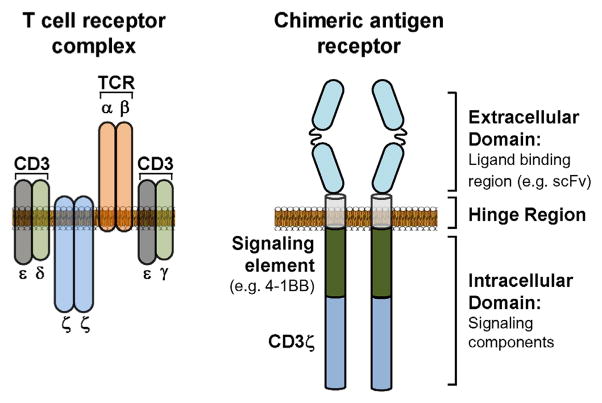
Fig. 1
Fig. 1. Schematic comparing the structure of T cell receptors (TCRs) and chimeric antigen receptors (CARs)
The TCR complex is composed of TCR-α and -β chains that are assembled together with invariant CD3 molecules. In contrast, a CAR is a modular protein that comprises an extracellular domain (ligand binding region), a hinge region, and an intracellular domain (signaling components). TCR: T cell receptor; CD3: cluster of differentiation 3; scFv: single-chain variable fragment.
Fig. 2
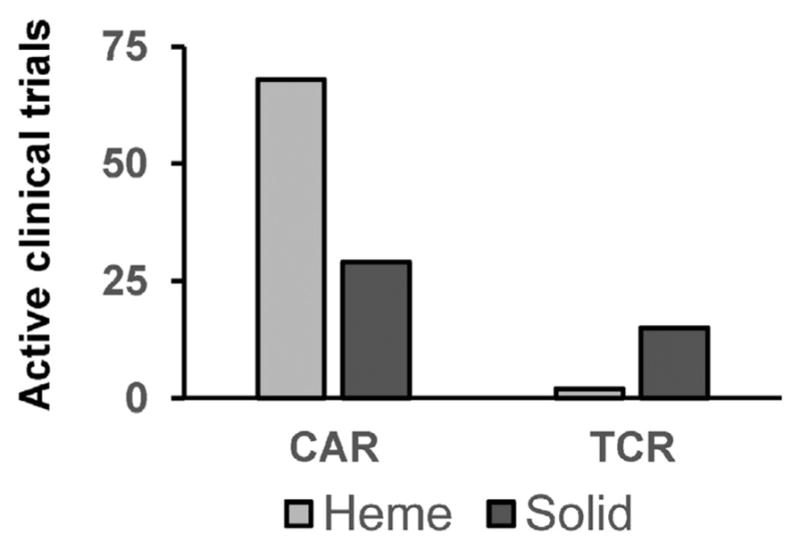
Fig. 2. Clinical trials using TCR and CAR therapy in cancer
Both CAR- and TCR-based T cell immunotherapies are being investigated in solid and hematologic malignancies. Shown are active clinical trials using CAR and TCR adoptive cell therapy in solid and hematologic malignancies. Active studies were identified on clinicaltrials.gov as of March 31, 2016, using keywords “CAR,” “chimeric antigen,” and “TCR”.
Fig. 3
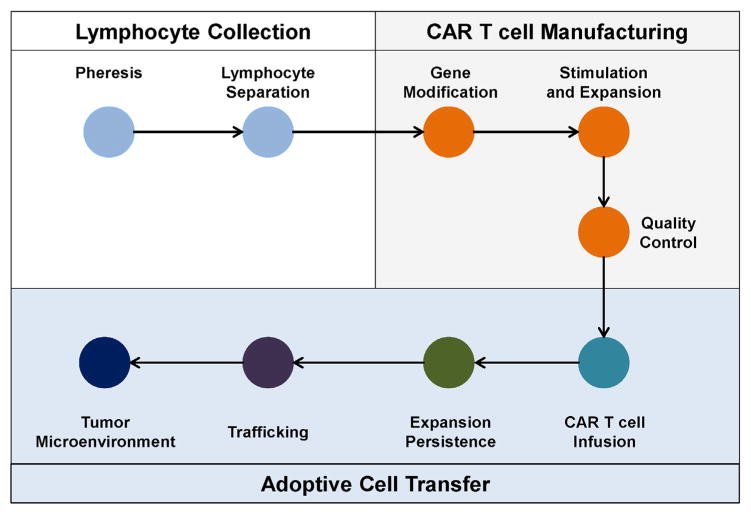
Fig. 3. CAR T cell efficacy in solid malignancies is dependent on multiple steps
CAR T cell therapy is a multi-step process involving (i) pheresis to collect peripheral blood leukocytes (i.e. leukapheresis) and elutriation to isolate lymphocytes from the peripheral blood of patients (Lymphocyte Collection); (ii) manufacturing of CAR T cells including gene modification of T cells to express the CAR, stimulation/expansion of gene-modified T cells in vitro, and quality control measures to evaluate CAR expression levels, T cell quality, and infectious contamination (CAR T cell Manufacturing); and (iii) the adoptive transfer of T cells to patients which then must expand, persist, traffick to tumors, and mediate effector anti-tumor activity within the tumor microenvironment (Adoptive Cell Transfer). Each of these steps is critical to the efficacy of CAR T cell therapy in solid malignancies.

References

    1. Ahmed N, Brawley VS, Hegde M, Robertson C, Ghazi A, Gerken C, et al. Human epidermal growth factor receptor 2 (HER2)-specific chimeric antigen receptor-modified T cells for the immunotherapy of HER2-positive sarcoma. J Clin Oncol. 2015;33(15):1688–1696. - PMC - PubMed
    1. Ali K, Soond DR, Pineiro R, Hagemann T, Pearce W, Lim EL, et al. Inactivation of PI(3)K p110delta breaks regulatory T-cell-mediated immune tolerance to cancer. Nature. 2014;510(7505):407–411. - PMC - PubMed
    1. Barrett DM, Liu X, Jiang S, June CH, Grupp SA, Zhao Y. Regimen-specific effects of RNA-modified chimeric antigen receptor T cells in mice with advanced leukemia. Hum Gene Ther. 2013;24(8):717–727. - PMC - PubMed
    1. Bayne LJ, Beatty GL, Jhala N, Clark CE, Rhim AD, Stanger BZ, et al. Tumor-derived granulocyte-macrophage colony-stimulating factor regulates myeloid inflammation and T cell immunity in pancreatic cancer. Cancer Cell. 2012;21(6):822–835. - PMC - PubMed
    1. Beatty GL. Engineered chimeric antigen receptor-expressing T cells for the treatment of pancreatic ductal adenocarcinoma. Oncoimmunology. 2014b;3:e28327. - PMC - PubMed

MeSH terms