


Acute kidney injury following cardiac surgery: current understanding and future directions
- PMID: 27373799
- PMCID: PMC4931708
- DOI: 10.1186/s13054-016-1352-z
Acute kidney injury following cardiac surgery: current understanding and future directions
Abstract
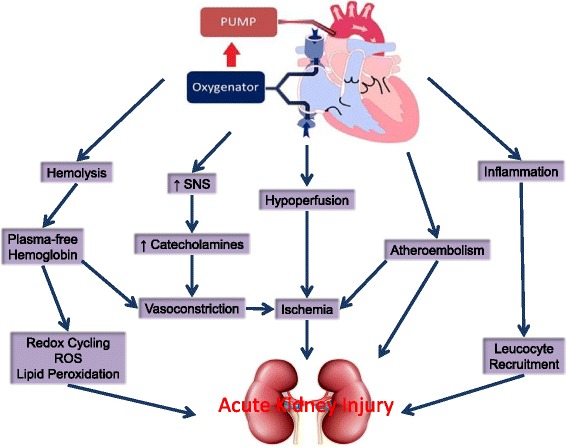
Acute kidney injury (AKI) complicates recovery from cardiac surgery in up to 30 % of patients, injures and impairs the function of the brain, lungs, and gut, and places patients at a 5-fold increased risk of death during hospitalization. Renal ischemia, reperfusion, inflammation, hemolysis, oxidative stress, cholesterol emboli, and toxins contribute to the development and progression of AKI. Preventive strategies are limited, but current evidence supports maintenance of renal perfusion and intravascular volume while avoiding venous congestion, administration of balanced salt as opposed to high-chloride intravenous fluids, and the avoidance or limitation of cardiopulmonary bypass exposure. AKI that requires renal replacement therapy occurs in 2-5 % of patients following cardiac surgery and is associated with 50 % mortality. For those who recover from renal replacement therapy or even mild AKI, progression to chronic kidney disease in the ensuing months and years is more likely than for those who do not develop AKI. Cardiac surgery continues to be a popular clinical model to evaluate novel therapeutics, off-label use of existing medications, and nonpharmacologic treatments for AKI, since cardiac surgery is fairly common, typically elective, provides a relatively standardized insult, and patients remain hospitalized and monitored following surgery. More efficient and time-sensitive methods to diagnose AKI are imperative to reduce this negative outcome. The discovery and validation of renal damage biomarkers should in time supplant creatinine-based criteria for the clinical diagnosis of AKI.
Keywords: Acute kidney injury; Cardiac surgery; Cardiopulmonary bypass; Extracorporeal circulation; Hypoperfusion; Inflammation; Intravenous fluid management; Pigment nephropathy; Renal failure.
Figures
References
-
- Lopez-Delgado JC EF, Torrado H, Rodríguez-Castro D, Carrio ML, Farrero E, Javierre C, et al. Influence of acute kidney injury on short- and long-term outcomes in patients undergoing cardiac surgery: risk factors and prognostic value of a modified RIFLE classification. Crit Care. 2013;17(16):R293. doi:210.1186/cc13159 - PMC - PubMed
-
- Gomez H, Ince C, De Backer D, Pickkers P, Payen D, Hotchkiss J, et al. A unified theory of sepsis-induced acute kidney injury: inflammation, microcirculatory dysfunction, bioenergetics, and the tubular cell adaptation to injury. Shock. 2014;41(41):3–11. doi: 10.1097/SHK.0000000000000052. - DOI - PMC - PubMed
Publication types
MeSH terms
Substances
Grants and funding
LinkOut - more resources
Full Text Sources
Other Literature Sources
Medical
Miscellaneous
