. 2016 Oct 1;23(5):427-439.
doi: 10.1093/dnares/dsw026.

The draft genome of MD-2 pineapple using hybrid error correction of long reads

Affiliations

The draft genome of MD-2 pineapple using hybrid error correction of long reads

Raimi M Redwan et al. DNA Res. .

Abstract

The introduction of the elite pineapple variety, MD-2, has caused a significant market shift in the pineapple industry. Better productivity, overall increased in fruit quality and taste, resilience to chilled storage and resistance to internal browning are among the key advantages of the MD-2 as compared with its previous predecessor, the Smooth Cayenne. Here, we present the genome sequence of the MD-2 pineapple (Ananas comosus (L.) Merr.) by using the hybrid sequencing technology from two highly reputable platforms, i.e. the PacBio long sequencing reads and the accurate Illumina short reads. Our draft genome achieved 99.6% genome coverage with 27,017 predicted protein-coding genes while 45.21% of the genome was identified as repetitive elements. Furthermore, differential expression of ripening RNASeq library of pineapple fruits revealed ethylene-related transcripts, believed to be involved in regulating the process of non-climacteric pineapple fruit ripening. The MD-2 pineapple draft genome serves as an example of how a complex heterozygous genome is amenable to whole genome sequencing by using a hybrid technology that is both economical and accurate. The genome will make genomic applications more feasible as a medium to understand complex biological processes specific to pineapple.

Keywords: fruit ripening; hybrid assembly; pineapple; plant genome.


Figures

Figure 1.
Figure 1.
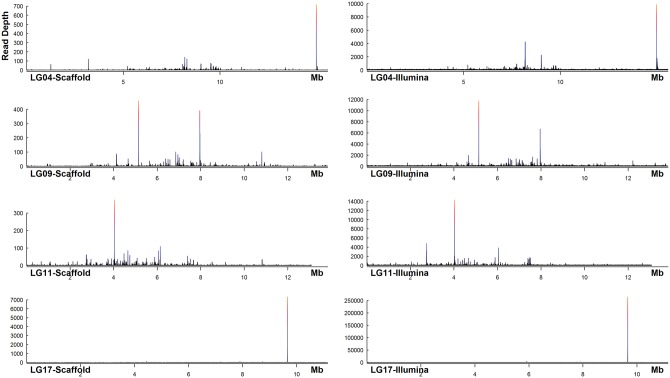
The plot showed the distribution of coverage of Illumina short reads and the MD-2 scaffolds mapping to the F153 pineapple genome assembly. These were the ‘linkage’ constructed that have high mapping coverage of short reads that match the same region where multiple scaffolds from MD-2 assembly mapped. The regions highlighted the high ‘multiplicity’ as shown in the COMPASS metrics. Different rows are for the different linkage of the F153 assembly and on the left are the mapping from the Illumina short reads and on the right are the respective mapping of the MD-2 scaffolds on the same linkage. For all of the linkages, the mapping covered throughout the genome, but may not be visible in the plot as the mapping value was undersized by the high coverage value.
Figure 2.
Figure 2.
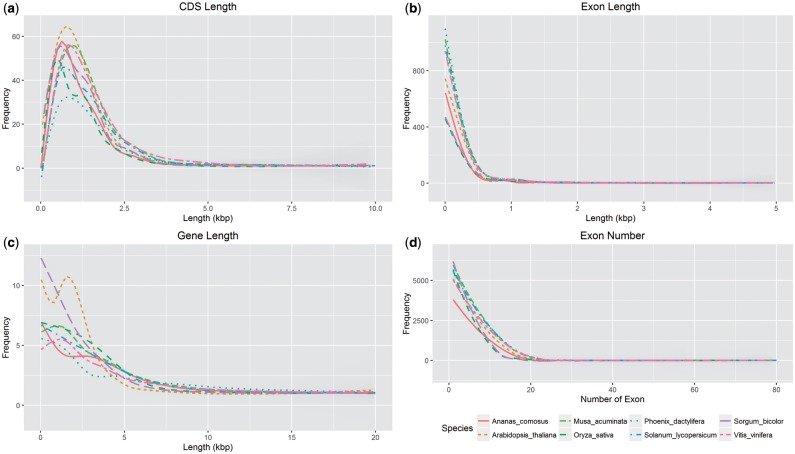
Comparison of the gene features among eight sequenced plant genomes including the pineapple. From top left is length distribution of (a) CDS, (b) exon and (c) gene, followed by (d) the exon number. There was no obvious difference observed for all features, except for gene length of S. bicolor and A. thaliana.
Figure 3.
Figure 3.
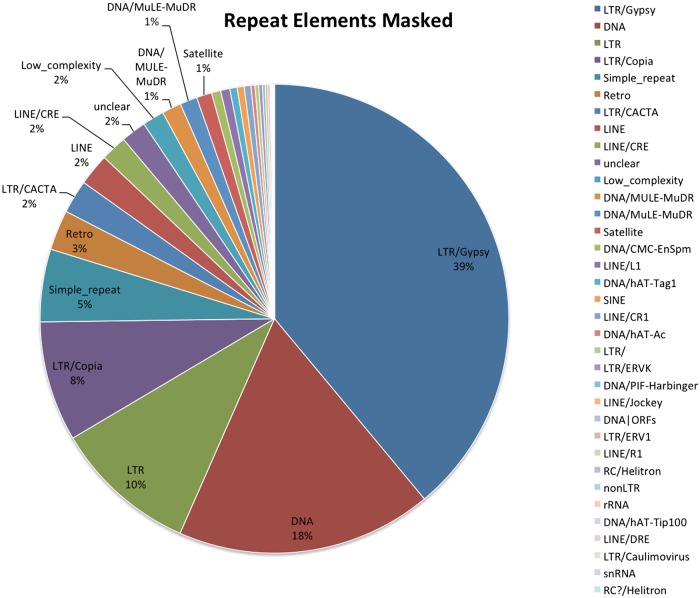
Pie charts show the percentage of different repeated elements identified in MD-2 pineapple genome. The most abundant components identified were LTR/Gypsys, DNA Class II transposons and followed by unidentified LTR and LTR/Copia.
Figure 4.
Figure 4.
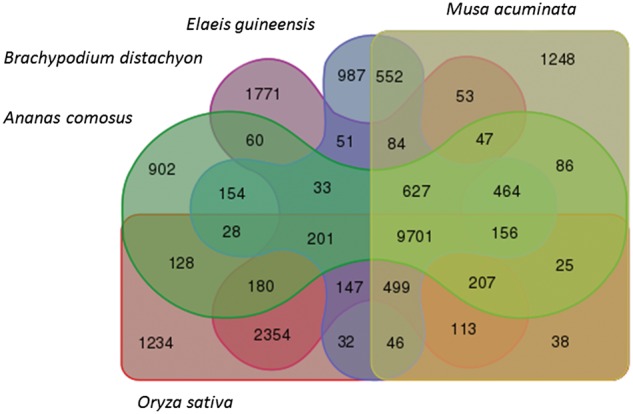
Venn diagram illustrates the shared orthologous gene cluster among pineapple and four other sequenced grass genomes, namely M. acuminata, E. guineensis, B. distachyon and O. sativa. Orthology analysis was performed using OrthoMCL.
Figure 5.
Figure 5.
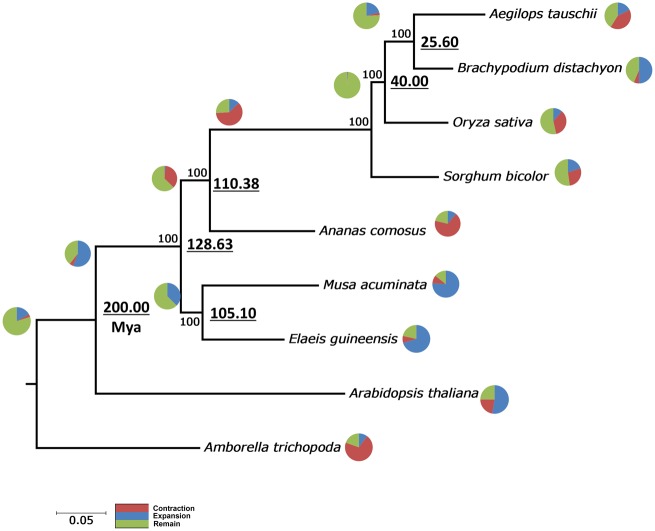
Phylogenetic tree, gene family contraction and expansion and time line divergence of pineapple among the subclass Commelinidae. The phylogenetic tree was constructed using 409 single-copy-genes shared by pineapple and six other Commelinidae and A. thaliana and Am. trichopoda were included as the out-group. Pie charts at each node depict the gene family expansion and contraction and underlined number at each node represents the divergence of pineapple from other commelinids in millions of years ago (MYA). Divergent time was calculated using RelTime using the same matrix used to construct the phylogenetic tree.
Figure 6.
Figure 6.
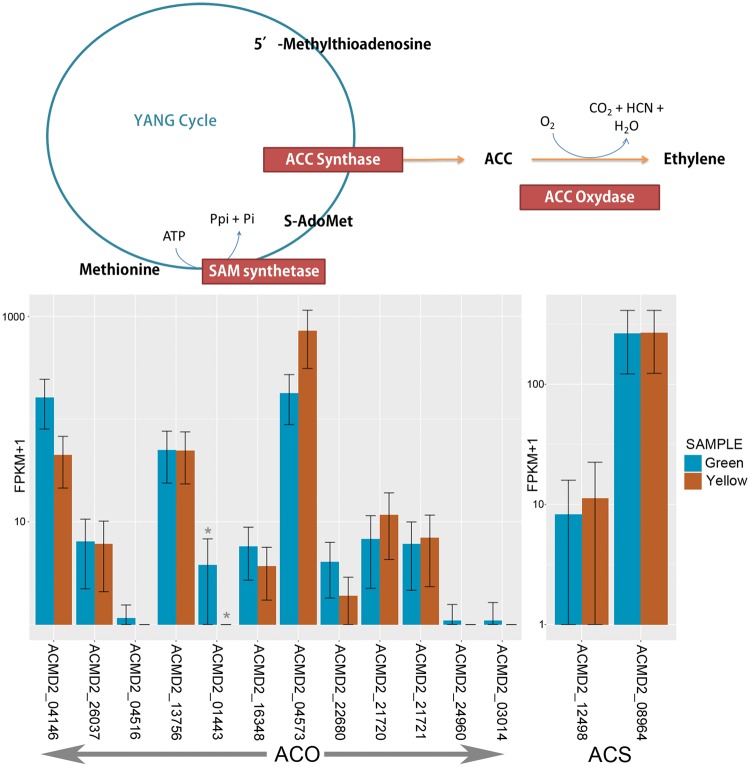
Biosynthesis of ethylene and expression of its two rate-limiting enzymes, ACC Synthase (ACS) and ACC Oxydase (ACO). This figure depicts the biosynthetic pathway of ethylene, which is integral to the YANG cycle. Seven and 13 transcripts were identified in the genome with a putative function to ACS and ACO, respectively, and only one ACO transcript (i.e. ACMD2_01443) was differentially regulated during ripening of pineapple fruit. Asterisk marks the significantly differentially regulated transcript.
Figure 7.
Figure 7.
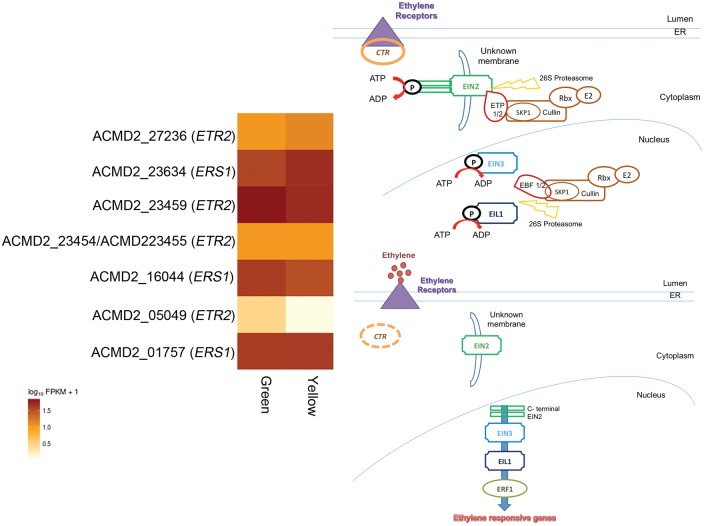
Regulation of ethylene production, from left is class I, auto-inhibition and class II auto-catalytic and level of expression of ethylene receptors during ripening of pineapple fruit. In class I, during the basal level of ethylene production, ethylene response pathway does not occur as the negative regulator (CTR) is bound and activated by the ethylene receptors, which lead to subsequent degradation of EIN2, EIN3 and EIL1 through ubiquitination by SCP complex and 26 proteosome. In class II, the presence of the hormone will further induce its production, leading to ethylene spike observed during floral senescence and fruit ripening process. Most importantly, the binding of ethylene at its receptors will release and inactivate the CTR, promoting cleavage of carboxyl end of EIN2 to the nucleus and activate the nuclear transcription factor EIN3/EIL1 and ERF1, which induce the ethylene responsive genes. Two types of ethylene receptors have been identified at the ER lumen. It is hypothesized that non-climacteric fruits rely on type-II ethylene receptor, which binds to CTR more loosely compared with type-I. Thus, only minimal amount of ethylene required to release the negative regulator, CTR. On the left is the heatmap of the transcripts with homology to ethylene receptors. None of the ethylene receptors were differentially expressed, but one transcript with homology to ETR2, type II ethylene receptors was the highest expression in green mature fruit.

References

    1. Zanella C.M., Janke A., Palma-Silva C., et al. 2012, Genetics, evolution and conservation of Bromeliaceae, Genet. Mol. Biol., 35, 1020–6. - PMC - PubMed
    1. Arumuganathan K., Earle E.D. 1991, Nuclear DNA content of some important plant species, Plant Mol. Biol. Report., 9, 415.
    1. Moore S. 2002, Use of genomics tools to isolate key ripening genes and analyse fruit maturation in tomato, J. Exp. Bot., 53, 2023–30. - PubMed
    1. Cherian S., Figueroa C.R., Nair H. 2014, ‘ Movers and shakers’ in the regulation of fruit ripening: a cross-dissection of climacteric versus non-climacteric fruit, J. Exp. Bot., 65, 4705–22. - PubMed
    1. Golding J.B., Shearer D., Wyllie S.G., McGlasson W. 1998, Application of 1-MCP and propylene to identify ethylene-dependent ripening processes in mature banana fruit, Postharvest Biol. Technol., 14, 87–98.