


Bladder Cancer Molecular Taxonomy: Summary from a Consensus Meeting
- PMID: 27376123
- PMCID: PMC4927916
- DOI: 10.3233/BLC-150037
Bladder Cancer Molecular Taxonomy: Summary from a Consensus Meeting
Abstract
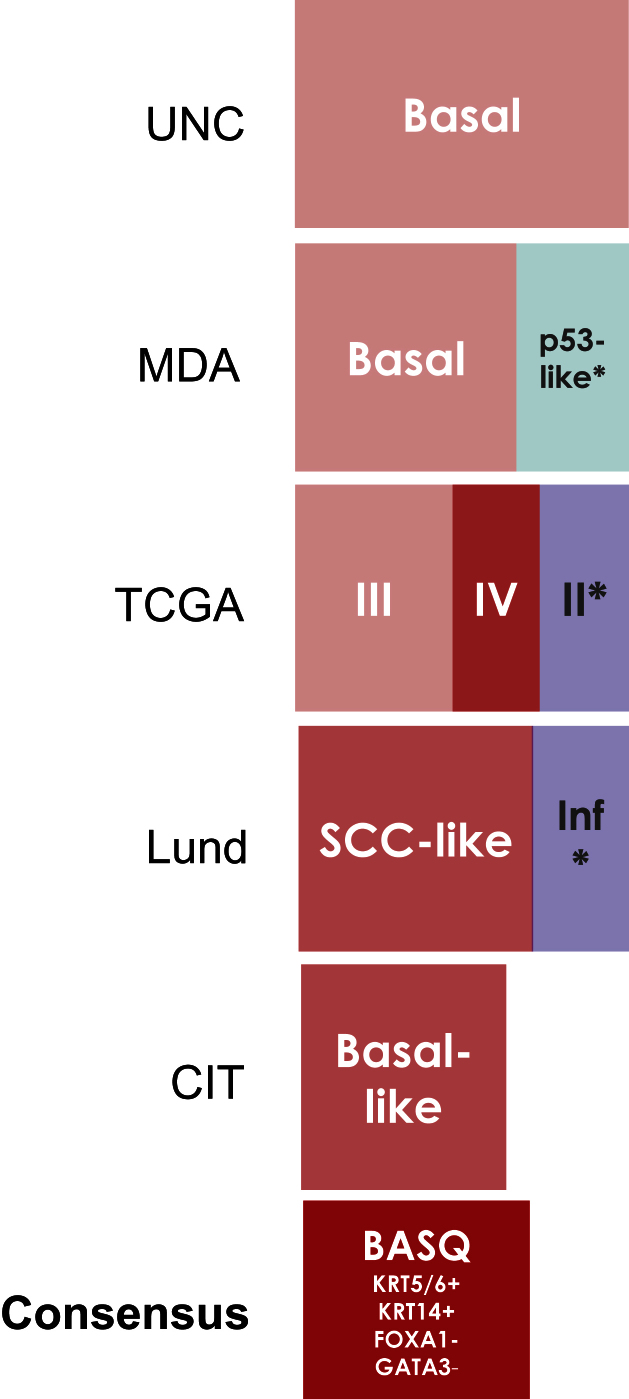
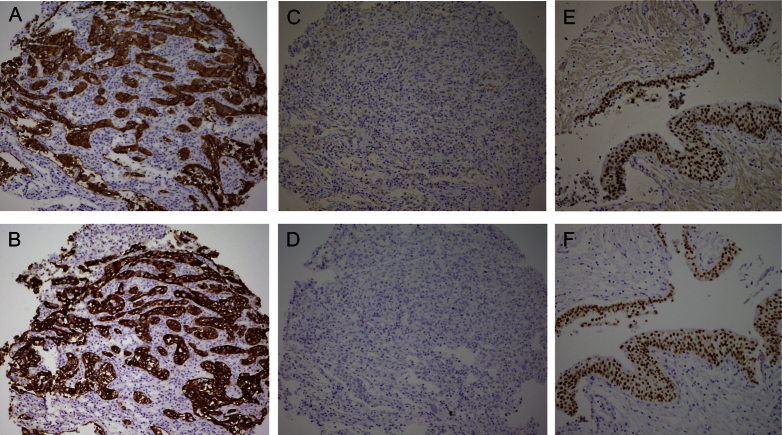
The advent of Omics technologies has been key to the molecular subclassification of urothelial bladder cancer. Several groups have used different strategies to this aim, with partially overlapping findings. The meeting at the Spanish National Cancer Research Center-CNIO was held to discuss such classifications and reach consensus where appropriate. After updated presentations on the work performed by the teams attending the meeting, a consensus was reached regarding the existence of a group of Basal-Squamous-like tumors - designated BASQ - charaterized the high expression of KRT5/6 and KRT14 and low/undetectable expression of FOXA1 and GATA3. An additional tumor subgroup with urothelial differentiation features was recognized whose optimal molecular definition is required. For other subtypes described, more work is needed to determine how robust they are and how to best define them at the molecular level.
Keywords: Bladder cancer; genomics; molecular classification; taxonomy.
Figures
References
-
- Volkmer JP, Sahoo D, Chin RK, Ho PL, Tang C, Kurtova AV, Willingham SB, Pazhanisamy SK, Contreras-Trujillo H, Storm TA, Lotan Y, Beck AH, Chung BI, Alizadeh AA, Godoy G, Lerner SP, van de Rijn M, Shortliffe LD, Weissman IL, Chan KS. Three differentiation states risk-stratify bladder cancer into distinct subtypes. Proc Natl Acad Sci USA 2012;109(6):2078–2083. - PMC - PubMed
-
- Sjödahl G, Lauss M, Lovgren K, Chebil G, Gudjonsson S, Veerla S, Patschan O, Aine M, Fernö M, Ringnér M, Månsson W, Liedberg F, Lindgren D, Höglund M. A molecular taxonomy for urothelial carcinoma. Clin Cancer Res 2012;18(12):3377–3386. - PubMed
-
- Hoadley KA, Yau C, Wolf DM, Cherniack AD, Tamborero D, Ng S, Leiserson MD, Niu B, McLellan MD, Uzunangelov V, Zhang J, Kandoth C, Akbani R, Shen H, Omberg L, Chu A, Margolin AA, Van’t Veer LJ, Lopez-Bigas N, Laird PW, Raphael BJ, Ding L, Robertson AG, Byers LA, Mills GB, Weinstein JN, Van Waes C, Chen Z, Collisson EA; Cancer Genome Atlas Research Network, Benz CC, Perou CM, Stuart JM. Multiplatform analysis of 12 cancer types reveals molecular classification within and across tissues of origin. Cell 2014;158(4):929–944. - PMC - PubMed
Grants and funding
LinkOut - more resources
Full Text Sources
Other Literature Sources
Research Materials
Miscellaneous
