. 2016 Dec;18(12):1176-1190.
doi: 10.1111/dom.12735. Epub 2016 Aug 15.

Robust anti-obesity and metabolic effects of a dual GLP-1/glucagon receptor peptide agonist in rodents and non-human primates

Affiliations

Robust anti-obesity and metabolic effects of a dual GLP-1/glucagon receptor peptide agonist in rodents and non-human primates

S J Henderson et al. Diabetes Obes Metab. 2016 Dec.

Abstract

Aims: To characterize the pharmacology of MEDI0382, a peptide dual agonist of glucagon-like peptide-1 (GLP-1) and glucagon receptors.

Materials and methods: MEDI0382 was evaluated in vitro for its ability to stimulate cAMP accumulation in cell lines expressing transfected recombinant or endogenous GLP-1 or glucagon receptors, to potentiate glucose-stimulated insulin secretion (GSIS) in pancreatic β-cell lines and stimulate hepatic glucose output (HGO) by primary hepatocytes. The ability of MEDI0382 to reduce body weight and improve energy balance (i.e. food intake and energy expenditure), as well as control blood glucose, was evaluated in mouse models of obesity and healthy cynomolgus monkeys following single and repeated daily subcutaneous administration for up to 2 months.

Results: MEDI0382 potently activated rodent, cynomolgus and human GLP-1 and glucagon receptors and exhibited a fivefold bias for activation of GLP-1 receptor versus the glucagon receptor. MEDI0382 produced superior weight loss and comparable glucose lowering to the GLP-1 peptide analogue liraglutide when administered daily at comparable doses in DIO mice. The additional fat mass reduction elicited by MEDI0382 probably results from a glucagon receptor-mediated increase in energy expenditure, whereas food intake suppression results from activation of the GLP-1 receptor. Notably, the significant weight loss elicited by MEDI0382 in DIO mice was recapitulated in cynomolgus monkeys.

Conclusions: Repeated administration of MEDI0382 elicits profound weight loss in DIO mice and non-human primates, produces robust glucose control and reduces hepatic fat content and fasting insulin and glucose levels. The balance of activities at the GLP-1 and glucagon receptors is considered to be optimal for achieving weight and glucose control in overweight or obese Type 2 diabetic patients.

Keywords: GLP-1 receptor knock-out mice; bodyweight; cynomolgus monkeys; diet-induced obese mice; dual agonist; glucagon; glucagon-like peptide-1; glucose tolerance; liraglutide; obesity; type 2 diabetes.


Figures

Figure 1
Figure 1
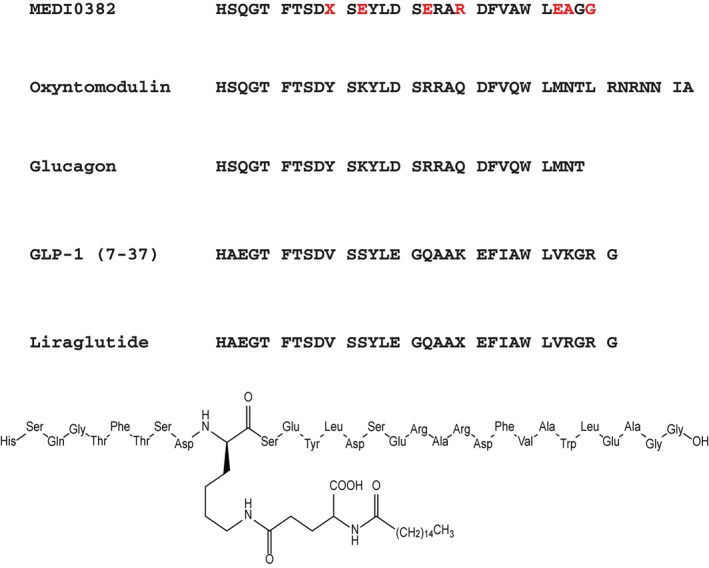
Amino acid sequence and chemical structure of MEDI0382. Sequences of the related peptides oxyntomodulin, glucagon, GLP‐1 (amino acids 7‐37) and liraglutide are also shown. Differences in amino acids from native glucagon and GLP‐1 are denoted in red. X represents lysine linked through gamma glutamate to palmitic acid.
Figure 2
Figure 2
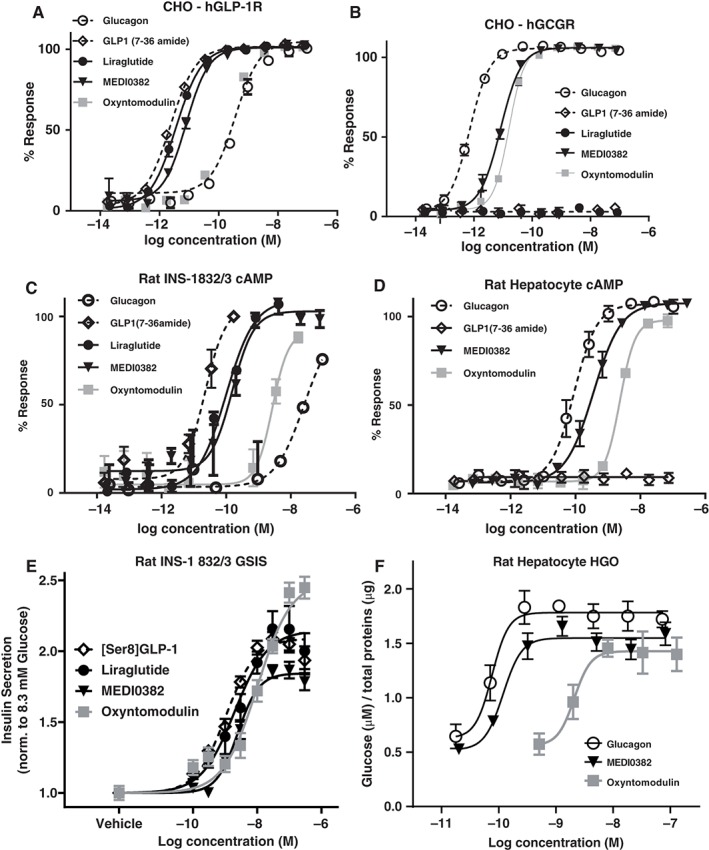
Potency of MEDI0382 in transfected and physiologically relevant endogenous receptor systems. Representative concentration‐response curves for MEDI0382, GLP‐1, glucagon (GCG), oxyntomodulin (OXM) and liraglutide in cAMP accumulation assays in CHO cell lines expressing human GLP‐1 receptors (A), human GCG receptors (B), rat INS‐1 832/3 β–cell line (C) and rat hepatocytes (D) all in the presence of 0.1% BSA. Concentration‐response curve for MEDI0382, GLP‐1, liraglutide and OXM in rat INS‐1 832/3 glucose‐stimulated insulin secretion assay (GSIS) in the presence of 0.2% BSA (E). Concentration‐response curve for MEDI0382, GCG and OXM in rat hepatocyte glucose output (HGO) assay in the presence of 0.1% BSA (F). Values are mean (±SEM) from duplicate analysis fitted with 4‐parameter logistic fit to determine EC50. Data shown representative of n ≥ 3 experiments.
Figure 3
Figure 3
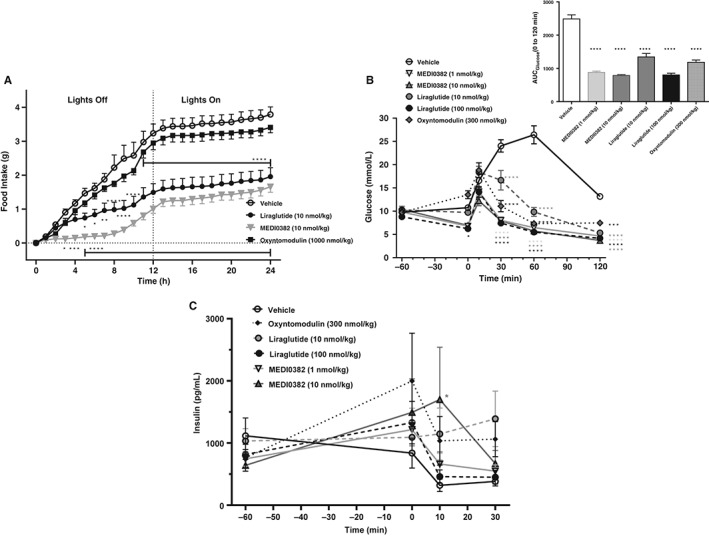
Acute effects of MEDI0382, liragutide or oxyntomodulin on food intake and glucose tolerance in male DIO mice. Cumulative food intake during 0‐24 hours after s.c. administration of vehicle, MEDI0382 (10 nmol/kg), liraglutide (10 nmol/kg) or oxyntomodulin (1000 nmol/kg) in DIO mice (A; n = 8 mice/group). Concentrations of blood glucose (B) and plasma insulin (C) after single s.c. administration of vehicle, MEDI0382 (1 and 10 nmol/kg), liraglutide (10 and 100 nmol/kg) or oxyntomodulin (300 nmol/kg) prior to administration of glucose (1.5 g/kg) by i.p. administration (n = 4‐7 mice/group). Time 0 is immediately prior to glucose challenge. Values are presented as mean (± SEM). *p < .05; **p < .01; ***p < .001; ****p < .0001 compared to vehicle.
Figure 4
Figure 4
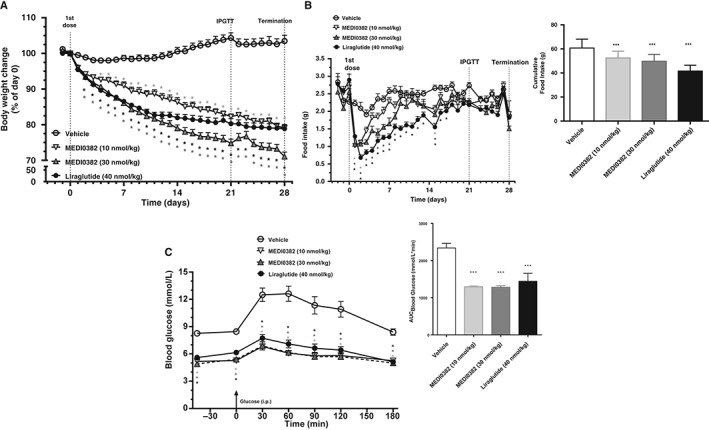
Effects of MEDI0382 on body weight (A), food intake (B) and glucose tolerance (C) in male DIO mice after repeated daily s.c. administration of vehicle, MEDI0382 (10 or 30 nmol/kg) or liraglutide (40 nmol/kg) for 28 days. Glucose tolerance (IPGTT) was conducted by i.p. administration of glucose (1 g/kg) on day 21. Time 0 is immediately prior to glucose challenge. Insets show overall area under the curve (AUC) values for food intake (B) and blood glucose (C). Values are presented as mean (± SEM); n = 11‐12 mice/group. *p < .05; ***p < .001 compared to vehicle.
Figure 5
Figure 5
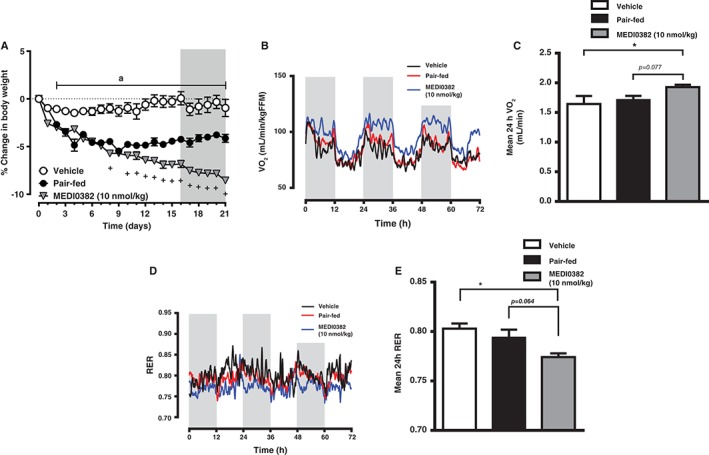
Body weight and energy expenditure parameters in male DIO mice after repeated daily s.c. administration of vehicle (ad libitum or pair‐fed) or MEDI0382 (10 nmol/kg). Change in body weight of mice expressed as percent change from baseline (A). Shaded area from day 16‐21 indicates period when mice were subjected to indirect calorimetry measurement. Diurnal (B) and 24 hours (C) mean rate of oxygen consumption (VO2) normalized to fat‐free mass over 3‐day recording period. Diurnal (D) and mean 24 hours (E) respiratory exchange ratio (RER). Data in (B) and (D) are smoothed to more clearly show circadian patterns. Shaded areas in (B) and (D) represent lights off period. ap < .05 for vehicle compared to both pair‐fed and MEDI0382 groups, +p < .05 MEDI0382 compared to pair‐fed, *p < .05 compared to vehicle.
Figure 6
Figure 6
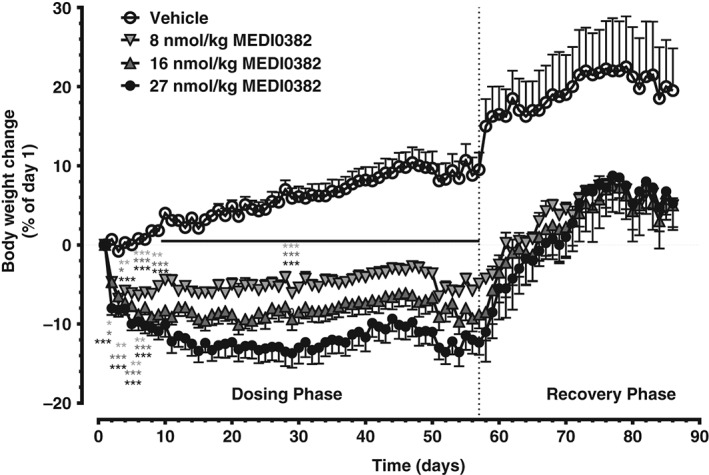
Effect of MEDI0382 on body weight in cynomolgus monkeys after repeated daily administration of vehicle or MEDI0382 (8, 16 or 27 nmol/kg/d; 30, 60 or 100 µg/kg/d, s.c.) for 57 days. Values are mean (± SD); n = 5 male and 5 female animals/group during dosing phase; n = 2 male and 2 female animals/group during recovery phase. *p < .05; **p < .01; ***p < .001 compared to vehicle.

References

    1. Campbell JE, Drucker DJ. Pharmacology, physiology, and mechanisms of incretin hormone action. Cell Metab. 2013;17:819–837. - PubMed
    1. Uccellatore A, Genovese S, Dicembrini I, Mannucci E, Ceriello A. Comparison review of short‐acting and long‐acting glucagon‐like peptide‐1 receptor agonists. Diabetes Ther. 2015;6:239–256. - PMC - PubMed
    1. Wadden TA, Hollander P, Klein S, et al. Weight maintenance and additional weight loss with liraglutide after low‐calorie‐diet‐induced weight loss: the SCALE maintenance randomized study. Int J Obes. 2013;37:1443–1451. - PubMed
    1. Potts JE, Gray LJ, Brady EM, Khunti K, Davies MJ, Bodicoat DH. The effect of glucagon‐like peptide 1 receptor agonists on weight loss in type 2 diabetes: a systematic review and mixed treatment comparison meta‐analysis. PLoS One. 2015;10:e0126769. - PMC - PubMed
    1. Pi‐Sunyer X, Astrup A, Fujioka K, et al. SCALE obesity and prediabetes NN8022‐1839 study group. A randomized, controlled trial of 3.0 mg of liraglutide in weight management. N Engl J Med. 2015;373:11–22. - PubMed

MeSH terms