Review
. 2017 Jan;14(1):57-66.
doi: 10.1038/nrclinonc.2016.96. Epub 2016 Jul 5.

Combine and conquer: challenges for targeted therapy combinations in early phase trials

Affiliations
Review

Combine and conquer: challenges for targeted therapy combinations in early phase trials

Juanita S Lopez et al. Nat Rev Clin Oncol. 2017 Jan.

Abstract

Our increasing understanding of cancer biology has led to the development of molecularly targeted anticancer drugs. The full potential of these agents has not, however, been realised, owing to the presence of de novo (intrinsic) resistance, often resulting from compensatory signalling pathways, or the development of acquired resistance in cancer cells via clonal evolution under the selective pressures of treatment. Combinations of targeted treatments can circumvent some mechanisms of resistance to yield a clinical benefit. We explore the challenges in identifying the best drug combinations and the best combination strategies, as well as the complexities of delivering these treatments to patients. Recognizing treatment-induced toxicity and the inability to use continuous pharmacodynamically effective doses of many targeted treatments necessitates creative intermittent scheduling. Serial tumour profiling and the use of parallel co-clinical trials can contribute to understanding mechanisms of resistance, and will guide the development of adaptive clinical trial designs that can accommodate hypothesis testing, in order to realize the full potential of combination therapies.


Conflict of interest statement

Declaration of competing financial interests

The authors declare no competing interests.

Figures
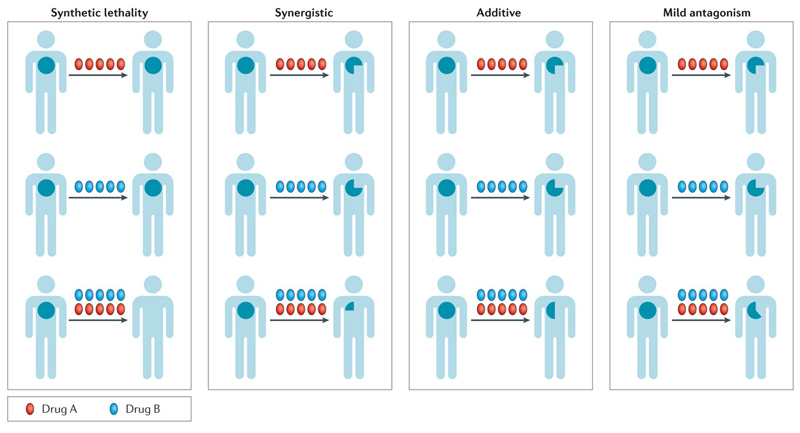
Figure 1
Figure 1. Clinical impact of drug combinations on the tumour
The size of the patient tumour is demarcated within the illustrated human cartoon. Drugs A and B are colour-coded as shown. While drugs in a given combination will have common effects on a proportion of clones of tumour cells, they can have differential effects on other clones thus influencing clonal evolution owing to selective pressure. The ultimate common readout is the size of the tumour and its rate of growth that eventually translates to progression-free survival and overall survival. The effects of clinically used combinations can be broadly classified as synthetically lethal, synergistic, additive, or mildly antagonistic.
Figure 2
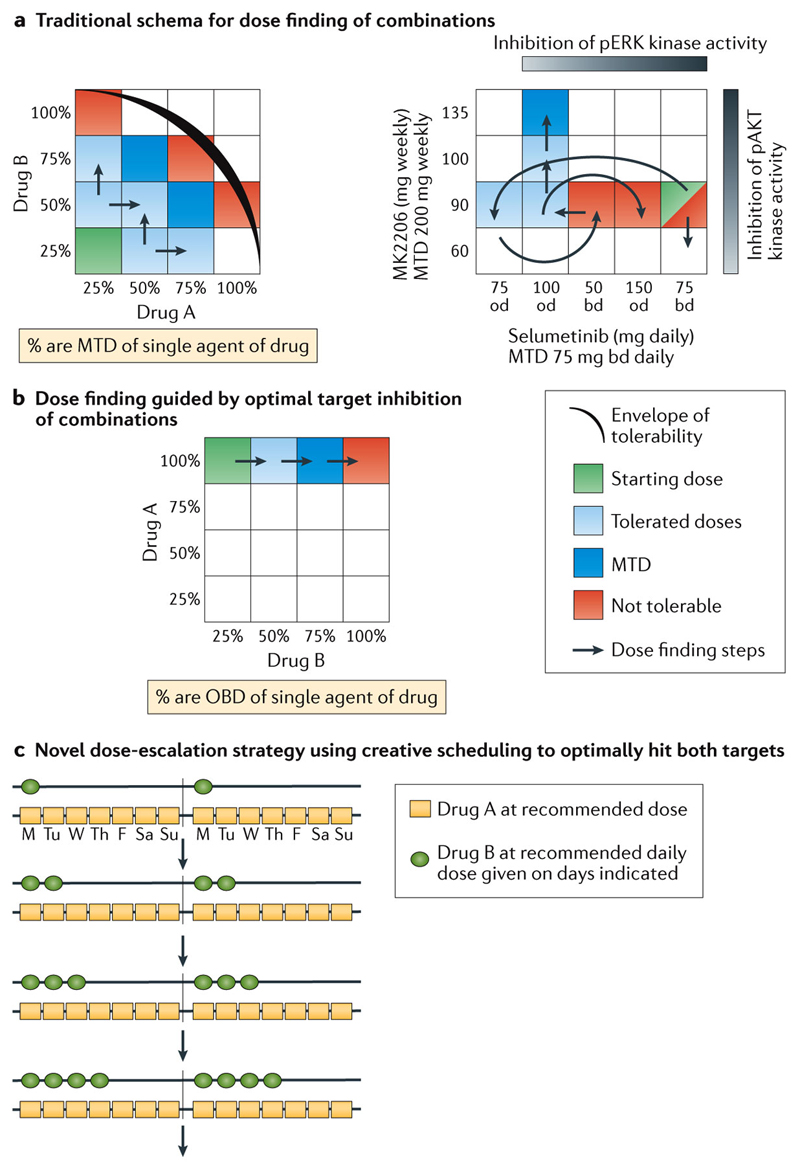
Figure 2. The challenge of optimising drugs dosed in combinations
A) Left panel shows the traditional rule-based dose-escalation strategy for combinations based on toxicity. A starting dose is selected utilising a combination of a fraction of the maximum tolerated dose (MTD) of Drug A with a fraction of the MTD of Drug B. Each drug is in turn escalated in the dose-escalation approach depending on tolerability. Green shaded cubes mark the starting dose for the combination with proposed dose-escalation steps marked with red arrows. Cubes are coded for tolerability as marked in the key, with the black curve indicating a hypothetical envelope of tolerability. Right panel illustrates a real-life example of the complicated intricacies of dose-finding [25]. The MTD of selumetinib and MK-2206 are as indicated, with the grey bars indicating doses where target inhibition is seen. The green box mark the starting dose for the combination, with the red arrows marking the multiple de-escalation and re-escalation steps required to find a tolerable dose. Abbreviations: od = once daily; bd = twice daily B) Combination dose-finding schema based on attaining adequate target inhibition. The optimal biological doses (OBD) are pre-defined based on pharmacological parameters, for example, target saturation of the drug, or optimal target modification of downstream pathways. Drug A is given at its recommended dose, with escalating doses of Drug B with the aim of reaching its OBD. The arrows indicate proposed steps for escalation with the cubes coded for tolerability as shown. Cubes are coded as in A) above. C) Novel combination dose-finding schema [Au: Title too long, so I’ve added to the legend] In this novel combination scheme, the fixed OBDs of each drug are used but and are given in an increasing schedule to ensure drug tolerability. Drug A is given at its recommended dose and schedule, while Drug B is given at its recommended dose but for only one day a week. If tolerable, the number of dosing days is increased with each cohort until the recommended schedule is attained. This strategy aims to hit both targets hard, but in a tolerable schedule aiming to avoid the problems of sub-optimal target blockade.
Figure 3
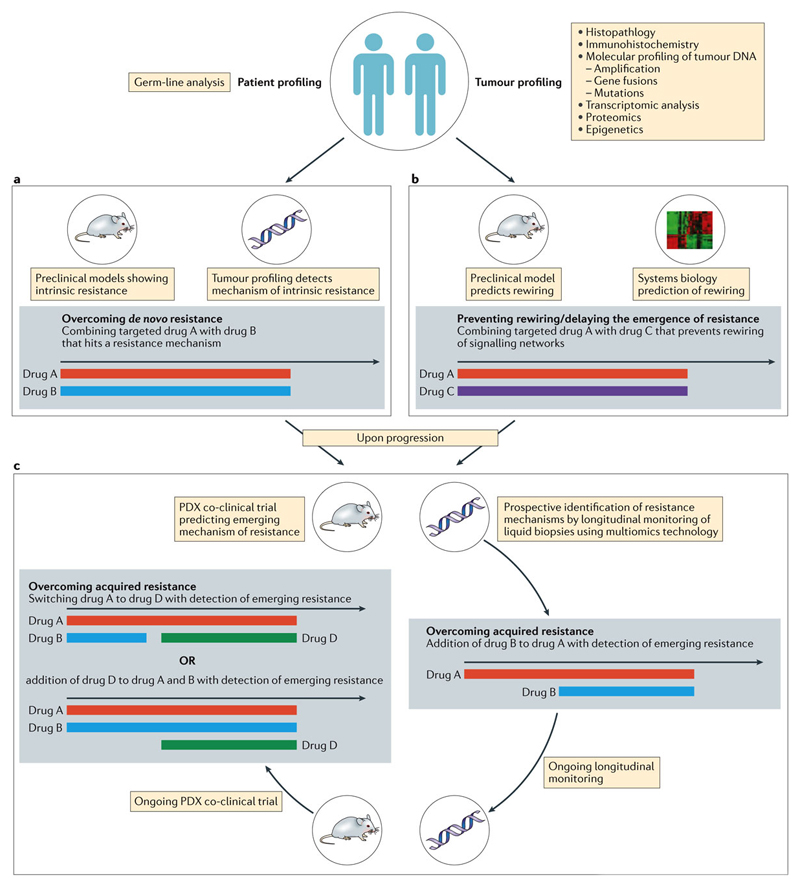
Figure 3. The future: proposed clinical trial designs to overcome resistance.
Patients are their tumours are profiled using -omics technology as shown and various strategies proposed for each hypothetical scenario A) Should profiling indicate a degree of de-novo resistance to the proposed Drug A, in which case, could it be reversed by addition of Drug B, and the combination used up-front. B) Should profiling indicate sensitivity to Drug A, but preclinical models and system biology predict the eventual rewiring of signalling networks causing resistance, Drug A can be combined with Drug C that has a broader epigenetic role. C) Co-clinical strategies employing patient-derived xenografts alongside prospective longitudinal monitoring of circulating cell-free DNA (cfDNA) in patients treated with Drug A. At the earliest sign of the development of resistant clones, Drug B is added in combination with continuation of the PDXs in a co-clinical trial and cfDNA monitoring. With emergence of an alternative mechanism of acquired resistance, Drug D can be added to the cocktail of Drug A & B, or the patient could be switched to a combination of Drug A & D. The black arrows are timelines, with the coloured bars indicating the various drugs described as colour coded. [Au: I have removed Box 1 as this is just repeating the subheadings in the text. However, I think a Box of glossary items could be useful. Suggested terms include synthetic lethality, Synergistic Additive etc.

References

    1. Hanahan D, Weinberg RA. Hallmarks of cancer: the next generation. Cell. 2011;144(5):646–74. - PubMed
    1. Westin JR, Kurzrock R. It's about time: lessons for solid tumors from chronic myelogenous leukemia therapy. Molecular cancer therapeutics. 2012;11(12):2549–55. - PMC - PubMed
    1. Molife LR, Dean EJ, Blanco-Codesido M, et al. A phase I, dose-escalation study of the multitargeted receptor tyrosine kinase inhibitor, golvatinib, in patients with advanced solid tumors. Clinical cancer research : an official journal of the American Association for Cancer Research. 2014;20(24):6284–94. - PubMed
    1. Yap TA, Bjerke L, Clarke PA, et al. Drugging PI3K in cancer: refining targets and therapeutic strategies. Current opinion in pharmacology. 2015;23:98–107. - PMC - PubMed
    1. Ellis LM, Hicklin DJ. Resistance to Targeted Therapies: Refining Anticancer Therapy in the Era of Molecular Oncology. Clinical cancer research : an official journal of the American Association for Cancer Research. 2009;15(24):7471–7478. - PubMed