


Compression of Morbidity Is Observed Across Cohorts with Exceptional Longevity
- PMID: 27377170
- PMCID: PMC4988893
- DOI: 10.1111/jgs.14222
Compression of Morbidity Is Observed Across Cohorts with Exceptional Longevity
Abstract
Objectives: To determine, in a sample of Ashkenazi Jewish aged 95 and older, whether there is a compression of morbidity similar to what has been reported in other cohorts with exceptional longevity.
Design: Case-control study.
Setting: Longevity Genes Project (LGP) and New England Centenarian Study (NECS).
Participants: LGP (n = 439, mean age 97.8 ± 2.8) and NECS (n = 1,498, mean age 101.4 ± 4.0) participants with exceptional longevity and their respective younger referent cohorts (LGP, n = 696; NECS, n = 302).
Measurements: Self- and proxy reports of age of onset of cancer, cardiovascular disease, diabetes mellitus, hypertension, osteoporosis, and stroke.
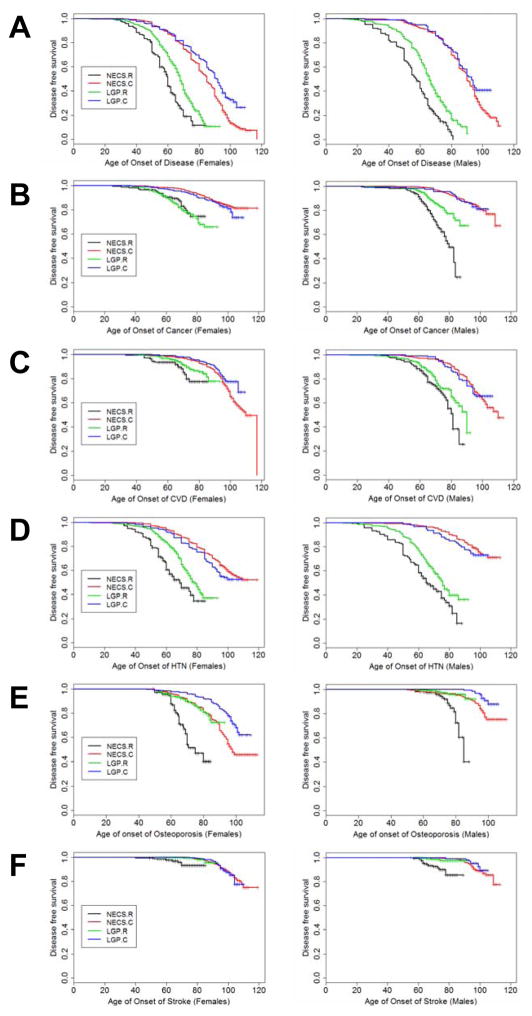
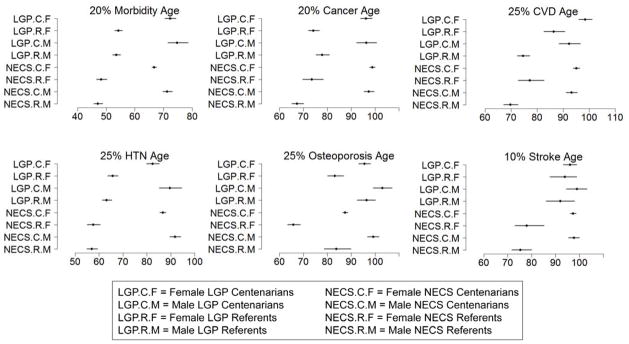
Results: Long-lived individuals from LGP and NECS had later age of onset of cancer, cardiovascular disease, diabetes mellitus, hypertension, and osteoporosis than their respective younger reference groups. The risk of overall morbidity was lower in participants with exceptional longevity than in younger participants (NECS men: relative risk (RR) = 0.12, women: RR = 0.20; LGP men: RR = 0.18, women: RR = 0.24). The age at which 20% of each of the groups with exceptional longevity experienced specific diseases was between 18 and 24 years later than in the reference groups, stratified according to sex.
Conclusion: The similar extension of health span and compression of morbidity seen in NECS and LGP participants with exceptional longevity further validates the utility of these rare individuals for the study of factors that delay or prevent a broad spectrum of diseases otherwise associated with mortality and disability.
Keywords: compression of morbidity; health span; longevity; older adults.
© 2016, Copyright the Authors Journal compilation © 2016, The American Geriatrics Society.
Conflict of interest statement
Figures
References
-
- Hoyert D, Xu J. Deaths: Preliminary Data for 2011. Natl Vital Stat Rep. 2012;61:1–51. - PubMed
-
- National Research Council (US), Institute of Medicine (US) U.S. Health in International Perspective: Shorter Lives, Poorer Health. Washington (DC): National Academies Press (US); 2013. - PubMed
-
- Evert J, Lawler E, Bogan H, et al. Morbidity profiles of centenarians: survivors, delayers, and escapers. J Gerontol A Biol Sci Med Sci. 2003;58:232–237. - PubMed
Publication types
MeSH terms
Grants and funding
LinkOut - more resources
Full Text Sources
Other Literature Sources
Medical
