Review
. 2016 Aug 5;371(1700):20150428.
doi: 10.1098/rstb.2015.0428.

The homeostatic astroglia emerges from evolutionary specialization of neural cells

Affiliations
Review

The homeostatic astroglia emerges from evolutionary specialization of neural cells

Alexei Verkhratsky et al. Philos Trans R Soc Lond B Biol Sci. .

Abstract

Evolution of the nervous system progressed through cellular diversification and specialization of functions. Conceptually, the nervous system is composed from electrically excitable neuronal networks connected with chemical synapses and non-excitable glial cells that provide for homeostasis and defence. Astrocytes are integrated into neural networks through multipartite synapses; astroglial perisynaptic processes closely enwrap synaptic contacts and control homeostasis of the synaptic cleft, supply neurons with glutamate and GABA obligatory precursor glutamine and contribute to synaptic plasticity, learning and memory. In neuropathology, astrocytes may undergo reactive remodelling or degeneration; to a large extent, astroglial reactions define progression of the pathology and neurological outcome.This article is part of the themed issue 'Evolution brings Ca(2+) and ATP together to control life and death'.

Keywords: astroglia; astroglial cradle; evolution; memory; multipartite synapse; neuropathology.


Figures

Figure 1.
Figure 1.
Phylogenetical advance of neuroglia. (a) Glia-to-neuron ratio in the nervous system of invertebrates and in the cortex of vertebrates. Glia-to-neuron ratio is generally increased in phylogenies; more or less, this ratio linearly follows an increase in the size of the brain. (b) Relative increase in glial dimensions and complexity during evolution. Linear dimensions of human astrocytes when compared with mice are approximately 2.75 times larger and their volume is 27 times larger; human astrocytes have approximately 10 times more processes and every astrocyte in human cortex enwraps approximately 20 times more synapses. (c) Comparison of morphological appearance (at the same magnification) of mouse, monkey and human protoplasmic astrocytes. Scale bar, 10 µm. (a,b) Reproduced with permission from [7] and (c) from [74]. (Online version in colour.)
Figure 2.
Figure 2.
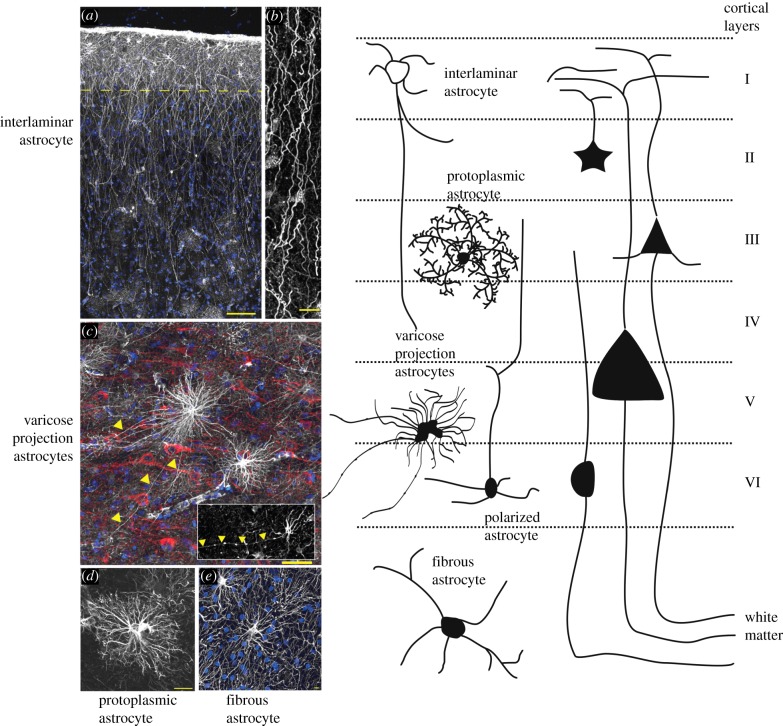
Morphological heterogeneity and subtypes of astrocytes in human cortex. (a) Pial surface and layers 1–2 of human cortex. GFAP staining in white; 4′,6-diamidino-2-phenylindole (DAPI), in blue. Scale bar, 100 µm. Yellow dashed line indicates border between layers 1 and 2. (b) Interlaminar astrocyte processes. Scale bar, 10 µm. (c) Varicose projection astrocytes reside in layers 5–6 and extend long processes characterized by evenly spaced varicosities. Inset: varicose projection astrocyte from chimpanzee cortex. Yellow arrowheads indicate varicose projections. Scale bar, 50 µm. (d) Typical human protoplasmic astrocyte. Scale bar, 20 µm. (e) Human fibrous astrocytes in white matter. Scale bar, 10 µm. (Reproduced with permission from [37]).

References

    1. Bartol TM, Bromer C, Kinney J, Chirillo MA, Bourne JN, Harris KM, Sejnowski TJ. 2015. Nanoconnectomic upper bound on the variability of synaptic plasticity. Elife 4, e10778 ( 10.7554/eLife.10778) - DOI - PMC - PubMed
    1. Zhu XH, Qiao H, Du F, Xiong Q, Liu X, Zhang X, Ugurbil K, Chen W. 2012. Quantitative imaging of energy expenditure in human brain. Neuroimage 60, 2107–2117. ( 10.1016/j.neuroimage.2012.02.013) - DOI - PMC - PubMed
    1. Magistretti PJ. 2009. Neuroscience. Low-cost travel in neurons. Science 325, 1349–1351. ( 10.1126/science.1180102) - DOI - PubMed
    1. Molofsky AV, Deneen B. 2015. Astrocyte development: a guide for the perplexed. Glia 63, 1320–1329. ( 10.1002/glia.22836) - DOI - PubMed
    1. Mitew S, Hay CM, Peckham H, Xiao J, Koenning M, Emery B. 2014. Mechanisms regulating the development of oligodendrocytes and central nervous system myelin. Neuroscience 276, 29–47. ( 10.1016/j.neuroscience.2013.11.029) - DOI - PubMed

Publication types