


Synchrony in Psychotherapy: A Review and an Integrative Framework for the Therapeutic Alliance
- PMID: 27378968
- PMCID: PMC4907088
- DOI: 10.3389/fpsyg.2016.00862
Synchrony in Psychotherapy: A Review and an Integrative Framework for the Therapeutic Alliance
Abstract
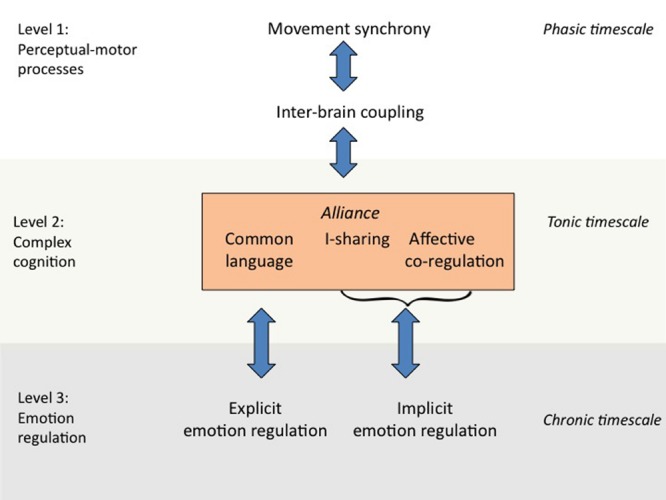
During psychotherapy, patient and therapist tend to spontaneously synchronize their vocal pitch, bodily movements, and even their physiological processes. In the present article, we consider how this pervasive phenomenon may shed new light on the therapeutic relationship- or alliance- and its role within psychotherapy. We first review clinical research on the alliance and the multidisciplinary area of interpersonal synchrony. We then integrate both literatures in the Interpersonal Synchrony (In-Sync) model of psychotherapy. According to the model, the alliance is grounded in the coupling of patient and therapist's brains. Because brains do not interact directly, movement synchrony may help to establish inter-brain coupling. Inter-brain coupling may provide patient and therapist with access to another's internal states, which facilitates common understanding and emotional sharing. Over time, these interpersonal exchanges may improve patients' emotion-regulatory capacities and related therapeutic outcomes. We discuss the empirical assessment of interpersonal synchrony and review preliminary research on synchrony in psychotherapy. Finally, we summarize our main conclusions and consider the broader implications of viewing psychotherapy as the product of two interacting brains.
Keywords: co-regulation; implicit emotion regulation; inter-brain coupling; interpersonal emotion regulation; interpersonal neural synchronization; interpersonal sychrony; linguistic alignment.
Figures
References
-
- American Psychiatric Association (2013). Diagnostic and Statistical Manual of Mental Disorders 5th Edn. New York, NY: American Psychiatric Association.
LinkOut - more resources
Full Text Sources
Other Literature Sources
