. 2016 Jun 14:7:916.
doi: 10.3389/fmicb.2016.00916. eCollection 2016.

Rapid Detection of Candida albicans by Polymerase Spiral Reaction Assay in Clinical Blood Samples

Affiliations

Rapid Detection of Candida albicans by Polymerase Spiral Reaction Assay in Clinical Blood Samples

Xiaoqun Jiang et al. Front Microbiol. .

Abstract

Candida albicans is the most common human yeast pathogen which causes mucosal infections and invasive fungal diseases. Early detection of this pathogen is needed to guide preventative and therapeutic treatment. The aim of this study was to establish a polymerase spiral reaction (PSR) assay that rapidly and accurately detects C. albicans and to assess the clinical applicability of PSR-based diagnostic testing. Internal transcribed spacer 2 (ITS2), a region between 5.8S and 28S fungal ribosomal DNA, was used as the target sequence. Four primers were designed for amplification of ITS2 with the PSR method, which was evaluated using real time turbidity monitoring and visual detection using a pH indicator. Fourteen non-C. albicans yeast strains were negative for detection, which indicated the specificity of PSR assay was 100%. A 10-fold serial dilution of C. albicans genomic DNA was subjected to PSR and conventional polimerase chain reaction (PCR) to compare their sensitivities. The detection limit of PSR was 6.9 pg/μl within 1 h, 10-fold higher than that of PCR (69.0 pg/μl). Blood samples (n = 122) were collected from intensive care unit and hematological patients with proven or suspected C. albicans infection at two hospitals in Beijing, China. Both PSR assay and the culture method were used to analyze the samples. Of the 122 clinical samples, 34 were identified as positive by PSR. The result was consistent with those obtained by the culture method. In conclusion, a novel and effective C. albicans detection assay was developed that has a great potential for clinical screening and point-of-care testing.

Keywords: C. albicans; ITS2; PSR; isothermal; rapid diagnosis.


Figures

FIGURE 1
FIGURE 1
polymerase spiral reaction (PSR) primer design for the detection of Candida albicans. (A) Locations of primers on the ITS2 region are underlined. (B) Nucleotide sequence of primers.
FIGURE 2
FIGURE 2
Temperature optimization of PSR assay. Different temperatures were tested and 65°C was chosen as the optimal temperature for PSR amplification.
FIGURE 3
FIGURE 3
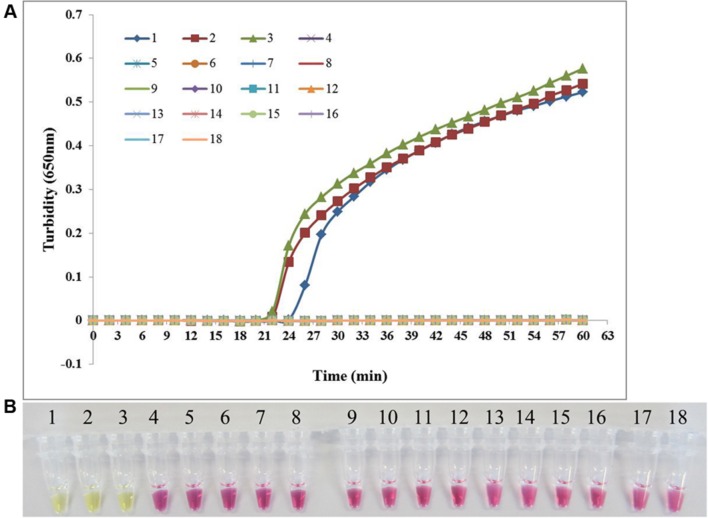
The specificity of PSR method. The PSR assay specificity for C. albicans detection was evaluated by real-time turbidimeter (A) and the pH indicator colorimetric assay (B). 1, C. albicans ATCC 24433; 2, C. albicans ATCC 90028; 3, C. albicans CGMCC 2.4159; 4, Candida glabrata ATCC 2001; 5, Candida tropicalis CGMCC 2.3967; 6, Candida parapsilosis CGMCC 2.3962; 7, Candida krusei CGMCC 2.1047; 8, Cryptococcus neoformans ATCC 66031; 9, Candida metapsilosis ATCC 96144; 10, Saccharomyces cerevisiae CGMCC 2.3889; 11, Debaryomyces hansenii CGMCC 2.3948; 12, Kluyveromyces marxianus CGMCC 2.3959; 13, Metschnikowia pulcherrima CGMCC 2.3776; 14, Pichia membranifaciens CGMCC 2.4060; 15, Pichia anomala CGMCC 2.1819; 16, Kluyveromyces marxianus CGMCC 2.3959; 17, Trichosporon cutaneum CGMCC 2.2163; 18, negative control (double-distilled water).
FIGURE 4
FIGURE 4
The sensitivity of PSR assay. Sensitivity of the PSR method (A, B) versus conventional PCR (C) for the detection of C. albicans. 1–7, 10-fold serial dilutions of C. albicans ATCC 24433 genomic DNA (69.0 ng/μl–0.069 pg/μl); 8, double-distilled water.

References

    1. Alam M. Z., Alam Q., Jiman-Fatani A., Kamal M. A., Abuzenadah A. M., Chaudhary A. G., et al. (2014). Candida identification: a journey from conventional to molecular methods in medical mycology. World J. Microbiol. Biotechnol. 30 1437–1451. 10.1007/s11274-013-1574-z - DOI - PubMed
    1. Aliotta J. M., Pelletier J. J., Ware J. L., Moran L. S., Benner J. S., Kong H. (1996). Thermostable Bst DNA polymerase I lacks a 3′– > 5′ proofreading exonuclease activity. Genet. Anal. 12 185–195. 10.1016/S1050-3862(96)80005-2 - DOI - PubMed
    1. Bouchara J. P., Declerck P., Cimon B., Planchenault C., de Gentile L., Chabasse D. (1996). Routine use of CHROMagar Candida medium for presumptive identification of Candida yeast species and detection of mixed fungal populations. Clin. Microbiol. Infect. 2 202–208. 10.1016/S1198-743X(14)65143-0 - DOI - PubMed
    1. Dong D., Zou D., Liu H., Yang Z., Huang S., Liu N., et al. (2015). Rapid detection of Pseudomonas aeruginosa targeting the toxA gene in intensive care unit patients from Beijing, China. Front. Microbiol. 6:1100 10.3389/fmicb.2015.01100 - DOI - PMC - PubMed
    1. Fan S. R., Bai F. Y., Liao Q. P., Liu Z. H., Li J., Liu X. P. (2008). Genotype distribution of Candida albicans strains associated with different conditions of vulvovaginal candidiasis, as revealed by microsatellite typing. Sex. Transm. Infect. 84 103–106. 10.1136/sti.2007.025700 - DOI - PubMed