


Blood concentrations of carotenoids and retinol and lung cancer risk: an update of the WCRF-AICR systematic review of published prospective studies
- PMID: 27384231
- PMCID: PMC4971935
- DOI: 10.1002/cam4.676
Blood concentrations of carotenoids and retinol and lung cancer risk: an update of the WCRF-AICR systematic review of published prospective studies
Abstract
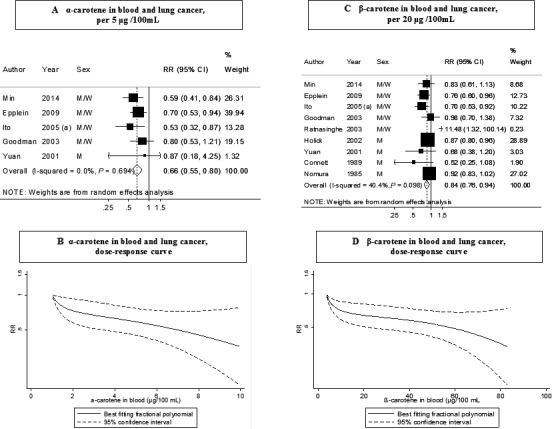
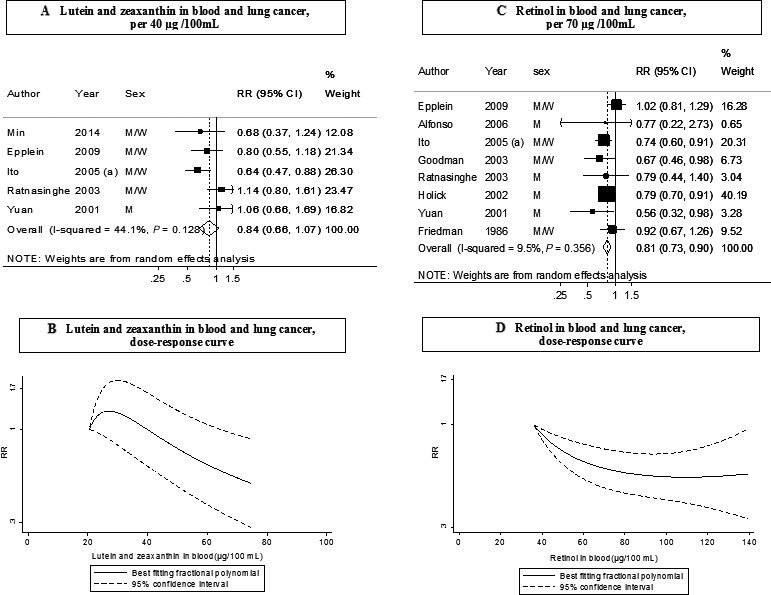
Carotenoids and retinol are considered biomarkers of fruits and vegetables intake, and are of much interest because of their anti-inflammatory and antioxidant properties; however, there is inconsistent evidence regarding their protective effects against lung cancer. We conducted a meta-analysis of prospective studies of blood concentrations of carotenoids and retinol, and lung cancer risk. We identified relevant prospective studies published up to December 2014 by searching the PubMed and several other databases. We calculated summary estimates of lung cancer risk for the highest compared with lowest carotenoid and retinol concentrations and dose-response meta-analyses using random effects models. We used fractional polynomial models to assess potential nonlinear relationships. Seventeen prospective studies (18 publications) including 3603 cases and 458,434 participants were included in the meta-analysis. Blood concentrations of α-carotene, β-carotene, total carotenoids, and retinol were significantly inversely associated with lung cancer risk or mortality. The summary relative risk were 0.66 (95% confidence interval [CI]: 0.55-0.80) per 5 μg/100 mL of α-carotene (studies [n] = 5), 0.84 (95% CI: 0.76-0.94) per 20 μg/100 mL of β-carotene (n = 9), 0.66 (95% CI: 0.54-0.81) per 100 μg/100 mL of total carotenoids (n = 4), and 0.81 (95% CI: 0.73-0.90) per 70 μg/100 mL of retinol (n = 8). In stratified analysis by sex, the significant inverse associations for β-carotene and retinol were observed only in men and not in women. Nonlinear associations were observed for β-carotene, β-cryptoxanthin, and lycopene, with stronger associations observed at lower concentrations. There were not enough data to conduct stratified analyses by smoking. In conclusion, higher blood concentrations of several carotenoids and retinol are associated with reduced lung cancer risk. Further studies in never and former smokers are needed to rule out confounding by smoking.
Keywords: Carotenoids; continuous update project; lung cancer; meta-analysis; retinol.
© 2016 The Authors. Cancer Medicine published by John Wiley & Sons Ltd.
Figures



References
-
- Ferlay, J. , Soerjomataram I., Dikshit R., Eser S., Mathers C., Rebelo M., et al. 2015. Cancer incidence and mortality worldwide: sources, methods and major patterns in GLOBOCAN 2012. Int. J. Cancer 136:E359–E386. - PubMed
-
- American Cancer Society . 2014. Cancer facts & figures. 2014. American Cancer Society, Atlanta.
-
- WHO . Tobacco free initiative (TFI). 2015.
-
- Bradbury, K. E. , Appleby P. N., and Key T. J.. 2014. Fruit, vegetable, and fiber intake in relation to cancer risk: findings from the European Prospective Investigation into Cancer and Nutrition (EPIC). Am. J. Clin. Nutr. 100(Suppl. 1):394S–398S. - PubMed
Publication types
MeSH terms
Substances
LinkOut - more resources
Full Text Sources
Other Literature Sources
Medical
