. 2016 Jul 26;7(30):48027-48037.
doi: 10.18632/oncotarget.10338.

Dragon (RGMb) induces oxaliplatin resistance in colon cancer cells

Affiliations

Dragon (RGMb) induces oxaliplatin resistance in colon cancer cells

Ying Shi et al. Oncotarget. .

Abstract

Colorectal cancer (CRC) is one of the most commonly diagnosed cancers and a major cause of cancer mortality. Chemotherapy resistance remains a major challenge for treating advanced CRC. Therefore, the identification of targets that induce drug resistance is a priority for the development of novel agents to overcome resistance. Dragon (also known as RGMb) is a member of the repulsive guidance molecule (RGM) family. We previously showed that Dragon expression increases with CRC progression in human patients. In the present study, we found that Dragon inhibited apoptosis and increased viability of CMT93 and HCT116 cells in the presence of oxaliplatin. Dragon induced resistance of xenograft tumor to oxaliplatinin treatment in mice. Mechanistically, Dragon inhibited oxaliplatin-induced JNK and p38 MAPK activation, and caspase-3 and PARP cleavages. Our results indicate that Dragon may be a novel target that induces drug resistance in CRC.

Keywords: JNK; colon cancer; oxaliplatin resistance; p38 MAPK; Dragon.


Conflict of interest statement

The authors declare no competing financial interests.

Figures
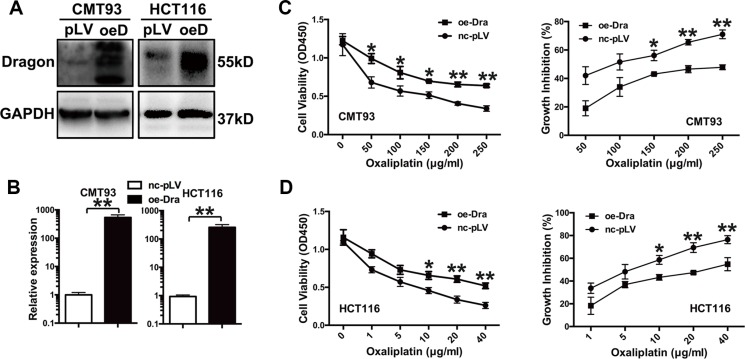
Figure 1
Figure 1. Dragon-overexpression induces the resistance of colon cancer cells to oxaliplatin in vitro
(A and B) Expression of Dragon in Dragon-overexpressing CMT93 and HCT116 cells. Control (pLV or nc-pLV) and Dragon-overexpressing (oeD or oe-Dra) CMT93 and HCT116 cells were lysed to examine Dragon protein expression by Western blot analysis (A) and Dragon mRNA expression by qRT-PCR (B). GAPDH was used as a control. (C) Effect of Dragon overexpression on the viability and growth rate of CMT93 cells cultured in the presence of oxaliplatin. CCK8 assays were used to determine the viability (left panel) and growth inhibition rate (right panel) of control and Dragon-overexpressing CMT93 cells in the presence of increasing doses of oxaliplatin. (D) Effect of Dragon overexpression on the viability (left panel) and growth rate (right panel) of HCT116 cells in the presence of oxaliplatin. *P < 0.05 and **P < 0.01.
Figure 2
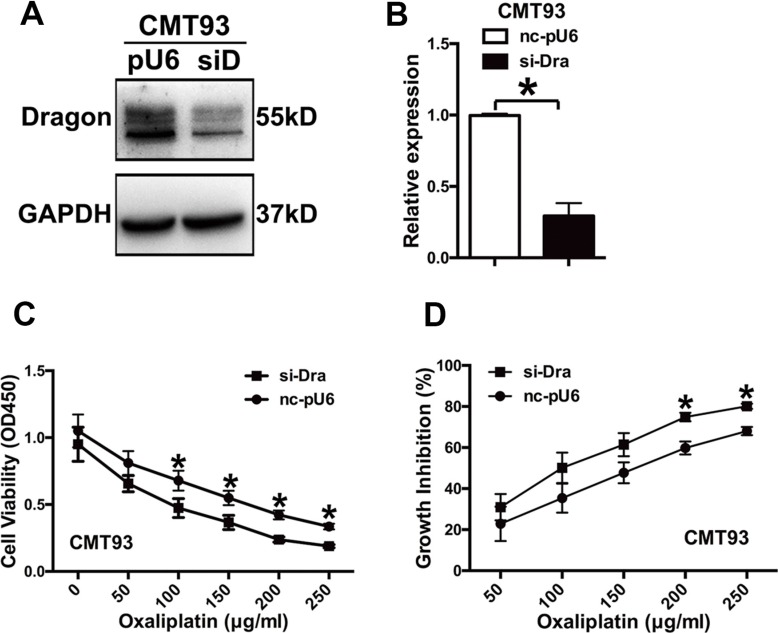
Figure 2. Inhibition of Dragon expression sensitizes CMT93 cells to oxaliplatin
(A and B) Expression of Dragon in Dragon knockdown CMT93 cells. Control (pU6 or nc-pU6) and Dragon-knockdown (siD or si-Dra) CMT93 cells were lysed to examine Dragon protein expression by Western blot analysis (A) and Dragon mRNA expression by qRT-PCR (B). GAPDH was used as a control. (C and D) Effect of Dragon knockdown on the viability and growth rate of CMT93 cells in the presence of oxaliplatin. CCK8 assays were used to determine the viability (C) and growth inhibition rate (D) in control and Dragon knockdown CMT93 cells in the presence of increasing doses of oxaliplatin. *P < 0.05.
Figure 3
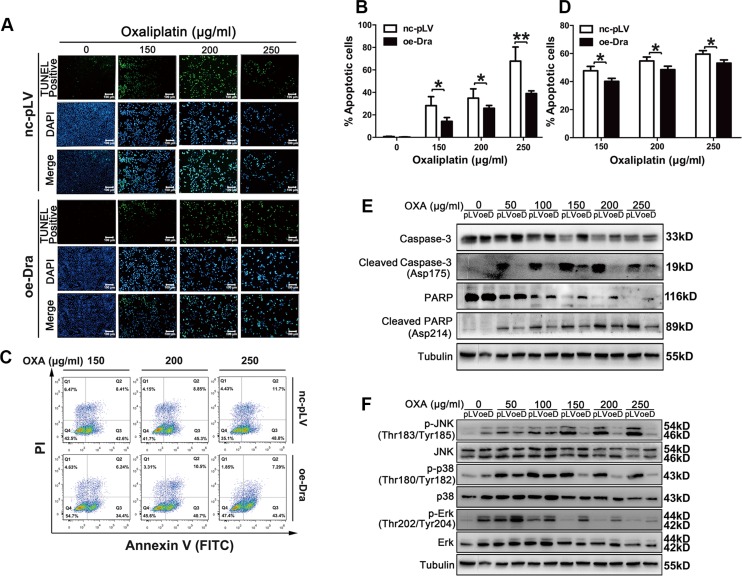
Figure 3. Dragon overexpression inhibits oxaliplatin-induced apoptosis in CMT93 cells
(A and B) Glucose-deprived control (nc-pLV) and Dragon-overexpressing (oe-Dra) CMT93 cells were treated with increasing doses of oxaliplatin for 24 h before the TUNEL assay was performed. TUNEL-positive cells are shown in green, and the nuclei are shown in blue (A). The percentages of TUNEL-positive cells over total cell numbers are presented (B). (C and D) Control and Dragon-overexpressing CMT93 cells cultured in low-glucose medium were treated with increasing doses of oxaliplatin for 24 h before the cells were stained with AnnexinV-FITC/PI. Cell apoptosis was analyzed by flow cytometry (C). The percentages of apoptotic cells is shown (D). The data are presented as the mean ± SD of three independent experiments. *P < 0.05 and **P < 0.01. (E) Effect of Dragon overexpression on cleaved caspase-3 and cleaved PARP levels in CMT93 cells. Control (pLV) and Dragon overexpressing (oeD) CMT93 cells cultured in low glucose medium were treated with increasing doses of oxaliplatin for 24 h before the cells were harvested for Western blotting to detect cleaved caspase-3, full length caspase-3, cleaved PARP and full length PARP. (F) Effect of Dragon-overexpression on JNK, p38 and Erk phosphorylation in the presence of oxaliplatin under a glucose deprivation condition. Control (pLV) and Dragon-overexpressing (oeDra) CMT93 cells cultured in low glucose medium were treated with increasing doses of oxaliplatin for 24 h before the cells were collected for Western blotting to detect p-JNK/JNK, p-p38/p38 and p-Erk/Erk.
Figure 4
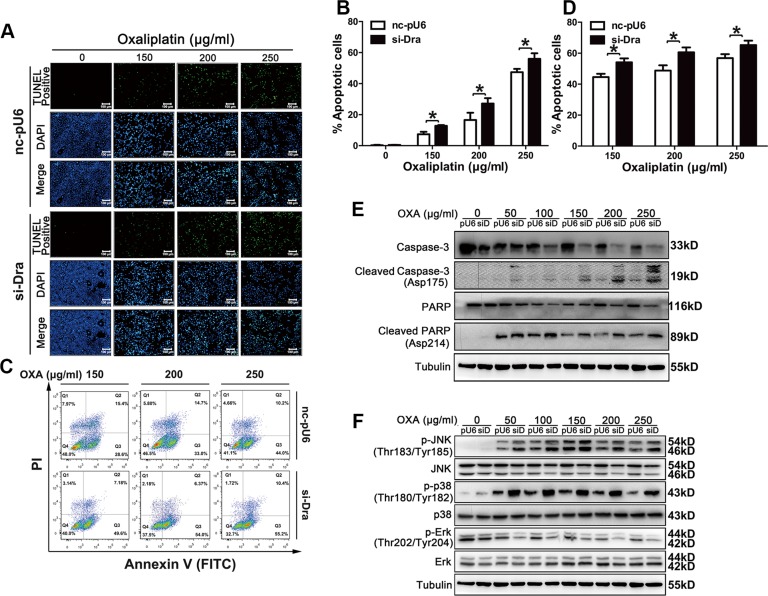
Figure 4. Dragon knockdown increases oxaliplatin-induced apoptosis in CMT93 cells
(A and B) Control (nc-pU6) and Dragon knockdown (si-Dra) CMT93 cells cultured in low glucose medium were treated with increasing doses of oxaliplatin for 24 h before the TUNEL assay was performed. TUNEL-positive cells are shown in green, and the nuclei are shown in blue (A). The percentages of TUNEL-positive cells is presented (B). (C and D) Control and Dragon-knockdown CMT93 cells cultured in low glucose medium were treated with increasing doses of oxaliplatin for 24 h before the cells were stained with AnnexinV-FITC/PI. Cell apoptosis was analyzed by flow cytometry (C). The percentages of apoptotic cells is shown (D). The data are presented as the mean ± SD of three independent experiments. *P < 0.05. (E) Effect of Dragon-knockdown on cleaved caspase-3 and cleaved PARP levels in CMT93 cells. Control (pU6) and Dragon-knockdown (siD) CMT93 cells cultured in low glucose medium were treated with increasing doses of oxaliplatin for 24 h before the cells were harvested for Western blotting to detect cleaved caspase-3, full-length caspase-3, cleaved PARP and full-length PARP. Tubulin was used as a loading control. (F) Effect of Dragon knockdown on JNK, p38 and Erk phosphorylation in the presence of oxaliplatin. Control (pU6) and Dragon-knockdown (siD) CMT93 cells cultured in low glucose medium were treated with increasing doses of oxaliplatin for 24 h before the cells were collected for Western blotting to detect p-JNK/JNK, p-p38/p38 and p-Erk/Erk. Tubulin was used as a loading control.
Figure 5
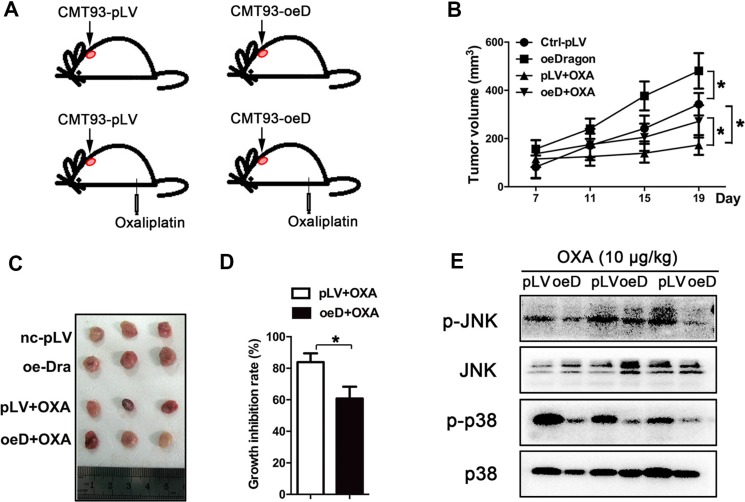
Figure 5. Dragon-overexpression induces the resistance of xenograft tumors to oxaliplatin in vivo
(AD) Effect of Dragon-overexpression on xenograft tumor growth. C57/BL6 mice were subcutaneously injected with control (pLV) or Dragon-overexpressing (oeD) CMT93 cells. Seven days after cell injection, oxaliplatin (10 mg/kg) was intraperitoneally injected into the mice once every 3-4 days (A). Xenograft tumor volumes were measured once every 4 days using a caliper (B). Nineten days after cell injection, the xenograft tumors were dissected and presented (C). The tumor growth inhibition rates were calculated (D). *P < 0.05. (E) Effect of Dragon overexpression on JNK and p38 phosphorylation in mouse xenograft tumors treated with oxaliplatin. Control (pLV) and Dragon-overexpressing (oeD) xenograft tumors derived from CMT93 cells treated with oxaliplatin were collected for Western blotting to detect p-JNK/JNK and p-p38/p38

References

    1. Edwards BK, Noone AM, Mariotto AB, Simard EP, Boscoe FP, Henley SJ, Jemal A, Cho H, Anderson RN, Kohler BA, Eheman CR, Ward EM. Annual Report to the Nation on the status of cancer, 1975–2010, featuring prevalence of comorbidity and impact on survival among persons with lung, colorectal, breast, or prostate cancer. Cancer. 2014;120:1290–1314. - PMC - PubMed
    1. Mattick JS, Makunin Non-coding RNA. Hum Mol Genet. 2006;15(Spec No 1):R17–29. - PubMed
    1. Stec R, Bodnar L, Charkiewicz R, Korniluk J, Rokita M, Smoter M, Ciechowicz M, Chyczewski L, Niklinski J, Kozlowski W, Szczylik C. K-Ras gene mutation status as a prognostic and predictive factor in patients with colorectal cancer undergoing irinotecan- or oxaliplatin-based chemotherapy. Cancer Biol Ther. 2012;13:1235–1243. - PMC - PubMed
    1. Robert G, Hardy SJ, Jankowski Janusz A. ABC of colorectal cancer Molecular basis for risk factors. BMJ. 2000;321:886–889. - PMC - PubMed
    1. Curia MC, De Iure S, De Lellis L, Veschi S, Mammarella S, White MJ, Bartlett J, Di Iorio A, Amatetti C, Lombardo M, Di Gregorio P, Battista P, Mariani-Costantini R, et al. Increased variance in germline allele-specific expression of APC associates with colorectal cancer. Gastroenterology. 2012;142:71–77. e71. - PMC - PubMed