


Energy expenditure and body composition changes after an isocaloric ketogenic diet in overweight and obese men
- PMID: 27385608
- PMCID: PMC4962163
- DOI: 10.3945/ajcn.116.133561
Energy expenditure and body composition changes after an isocaloric ketogenic diet in overweight and obese men
Abstract
Background: The carbohydrate-insulin model of obesity posits that habitual consumption of a high-carbohydrate diet sequesters fat within adipose tissue because of hyperinsulinemia and results in adaptive suppression of energy expenditure (EE). Therefore, isocaloric exchange of dietary carbohydrate for fat is predicted to result in increased EE, increased fat oxidation, and loss of body fat. In contrast, a more conventional view that "a calorie is a calorie" predicts that isocaloric variations in dietary carbohydrate and fat will have no physiologically important effects on EE or body fat.
Objective: We investigated whether an isocaloric low-carbohydrate ketogenic diet (KD) is associated with changes in EE, respiratory quotient (RQ), and body composition.
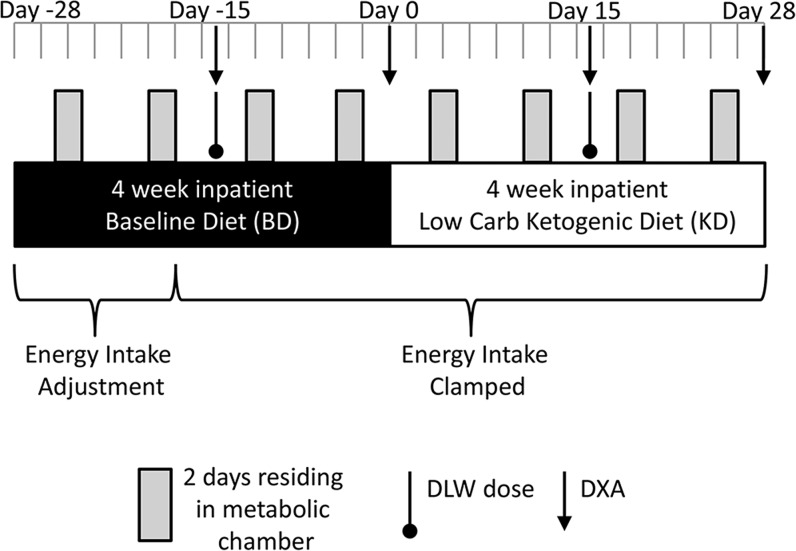
Design: Seventeen overweight or obese men were admitted to metabolic wards, where they consumed a high-carbohydrate baseline diet (BD) for 4 wk followed by 4 wk of an isocaloric KD with clamped protein. Subjects spent 2 consecutive days each week residing in metabolic chambers to measure changes in EE (EEchamber), sleeping EE (SEE), and RQ. Body composition changes were measured by dual-energy X-ray absorptiometry. Average EE during the final 2 wk of the BD and KD periods was measured by doubly labeled water (EEDLW).
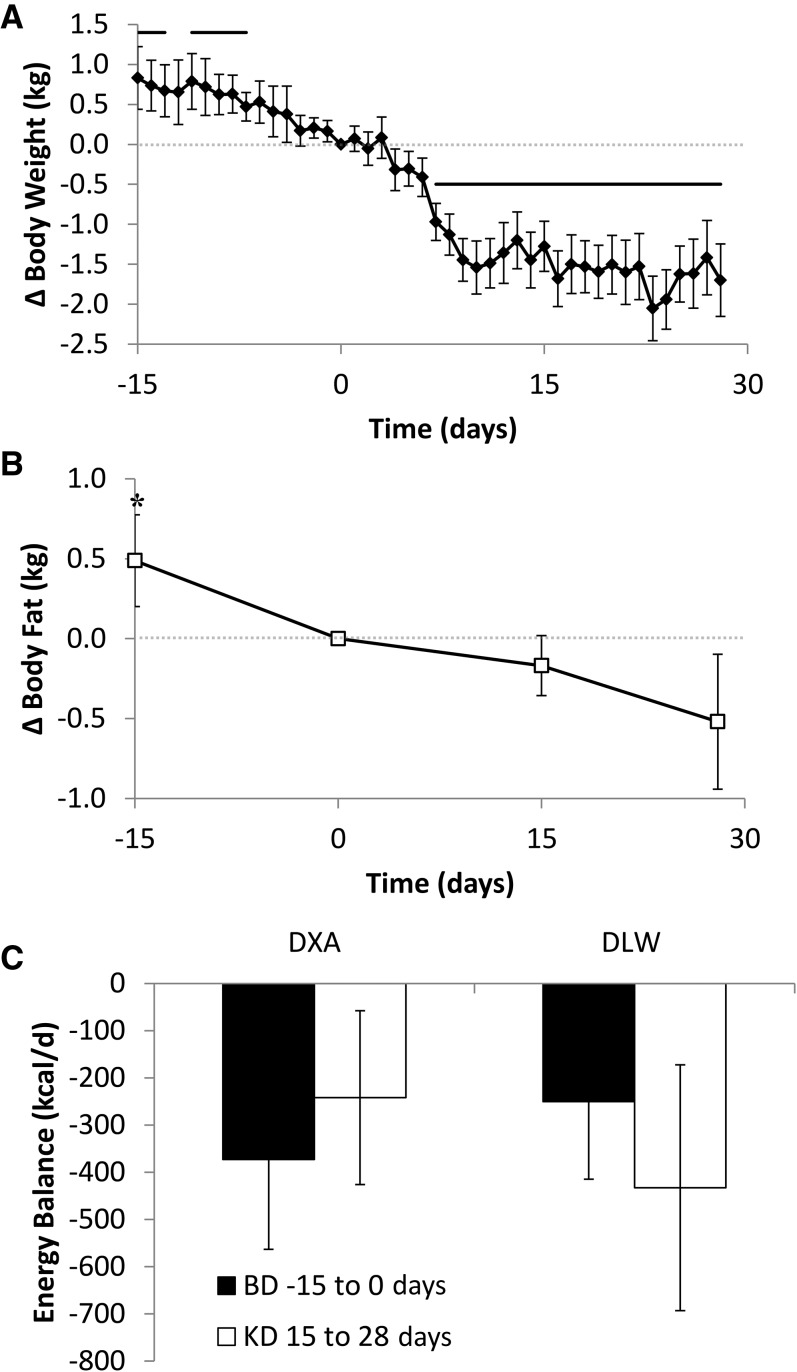
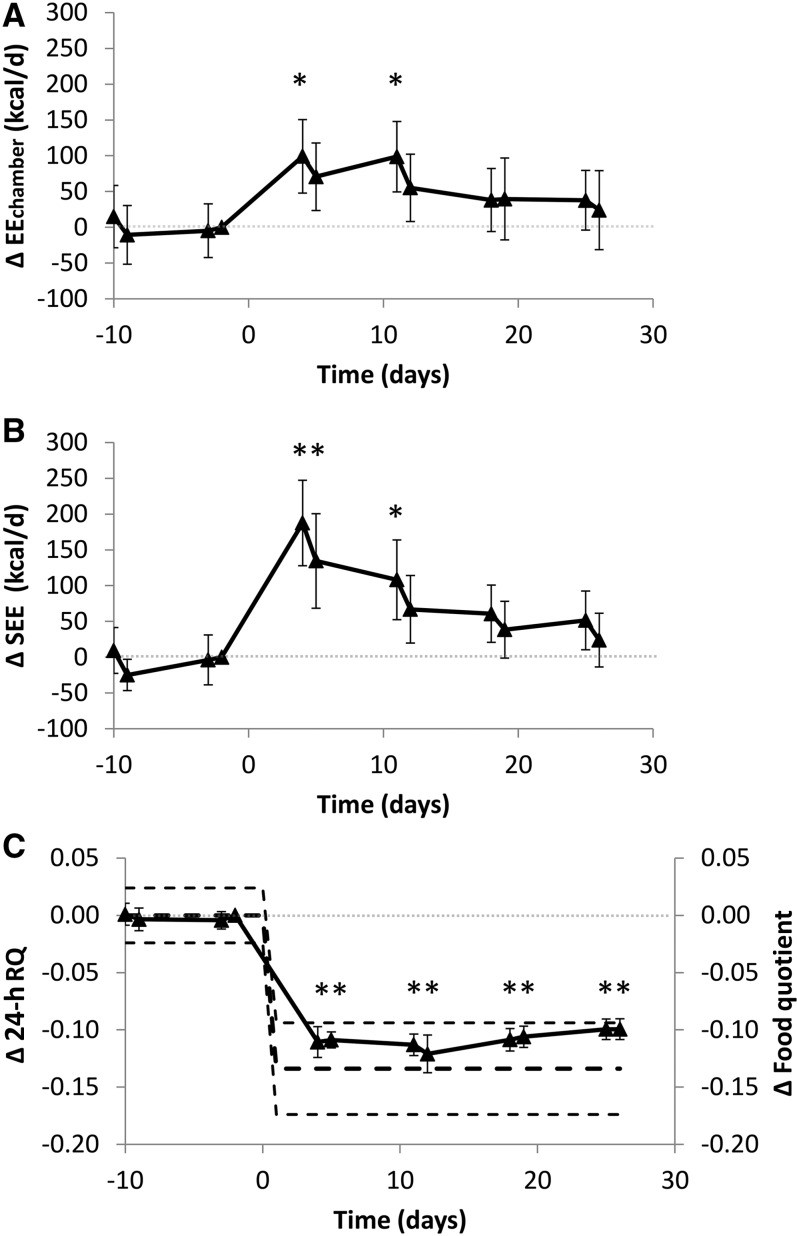
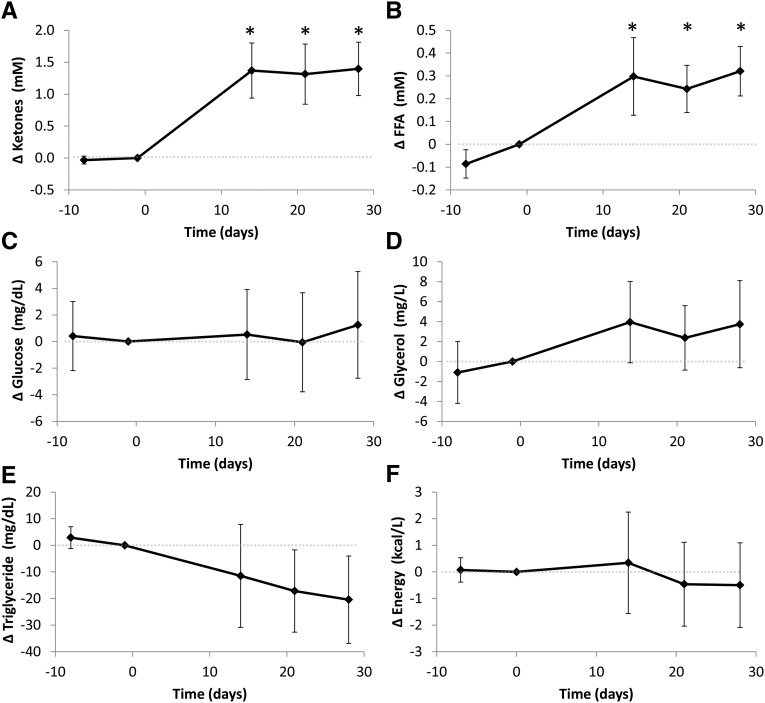
Results: Subjects lost weight and body fat throughout the study corresponding to an overall negative energy balance of ∼300 kcal/d. Compared with BD, the KD coincided with increased EEchamber (57 ± 13 kcal/d, P = 0.0004) and SEE (89 ± 14 kcal/d, P < 0.0001) and decreased RQ (-0.111 ± 0.003, P < 0.0001). EEDLW increased by 151 ± 63 kcal/d (P = 0.03). Body fat loss slowed during the KD and coincided with increased protein utilization and loss of fat-free mass.
Conclusion: The isocaloric KD was not accompanied by increased body fat loss but was associated with relatively small increases in EE that were near the limits of detection with the use of state-of-the-art technology. This trial was registered at clinicaltrials.gov as NCT01967563.
Keywords: body composition; carbohydrate; energy expenditure; fat; insulin; ketogenic diet; macronutrients.
© 2016 American Society for Nutrition.
Figures
Comment in
-
Raising the bar on the low-carbohydrate diet.Am J Clin Nutr. 2016 Nov;104(5):1487-1488. doi: 10.3945/ajcn.116.142182. Am J Clin Nutr. 2016. PMID: 27802995 Free PMC article. No abstract available.
-
Reply to DS Ludwig and CB Ebbeling.Am J Clin Nutr. 2016 Nov;104(5):1488-1490. doi: 10.3945/ajcn.116.143628. Am J Clin Nutr. 2016. PMID: 27802997 Free PMC article. No abstract available.
References
-
- Ludwig DS, Friedman MI. Increasing adiposity: consequence or cause of overeating? JAMA 2014;311:2167–8. - PubMed
-
- Lustig RH. Childhood obesity: behavioral aberration or biochemical drive? Reinterpreting the First Law of Thermodynamics. Nat Clin Pract Endocrinol Metab 2006;2:447–58. - PubMed
-
- Taubes G. The science of obesity: what do we really know about what makes us fat? An essay by Gary Taubes. BMJ 2013;346:f1050. - PubMed
-
- Wells JC, Siervo M. Obesity and energy balance: is the tail wagging the dog? Eur J Clin Nutr 2011;65:1173–89. - PubMed
-
- Astwood EB. The heritage of corpulence. Endocrinology 1962;71:337–41. - PubMed
Publication types
MeSH terms
Substances
Associated data
Grants and funding
LinkOut - more resources
Full Text Sources
Other Literature Sources
Medical
