. 2016 Jul 6;108(11):djw153.
doi: 10.1093/jnci/djw153. Print 2016 Nov.

Selenium and Prostate Cancer: Analysis of Individual Participant Data From Fifteen Prospective Studies

Affiliations

Selenium and Prostate Cancer: Analysis of Individual Participant Data From Fifteen Prospective Studies

Naomi E Allen et al. J Natl Cancer Inst. .

Abstract

Background: Some observational studies suggest that a higher selenium status is associated with a lower risk of prostate cancer but have been generally too small to provide precise estimates of associations, particularly by disease stage and grade.

Methods: Collaborating investigators from 15 prospective studies provided individual-participant records (from predominantly men of white European ancestry) on blood or toenail selenium concentrations and prostate cancer risk. Odds ratios of prostate cancer by selenium concentration were estimated using multivariable-adjusted conditional logistic regression. All statistical tests were two-sided.

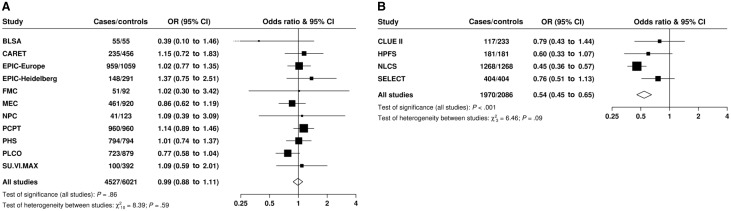
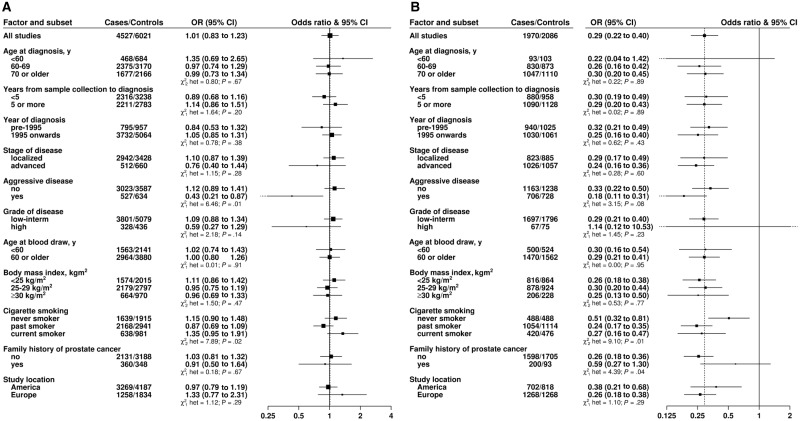
Results: Blood selenium was not associated with the risk of total prostate cancer (multivariable-adjusted odds ratio [OR] per 80 percentile increase = 1.01, 95% confidence interval [CI] = 0.83 to 1.23, based on 4527 case patients and 6021 control subjects). However, there was heterogeneity by disease aggressiveness (ie, advanced stage and/or prostate cancer death, Pheterogeneity = .01), with high blood selenium associated with a lower risk of aggressive disease (OR = 0.43, 95% CI = 0.21 to 0.87) but not with nonaggressive disease. Nail selenium was inversely associated with total prostate cancer (OR = 0.29, 95% CI = 0.22 to 0.40, Ptrend < .001, based on 1970 case patients and 2086 control subjects), including both nonaggressive (OR = 0.33, 95% CI = 0.22 to 0.50) and aggressive disease (OR = 0.18, 95% CI = 0.11 to 0.31, Pheterogeneity = .08).

Conclusions: Nail, but not blood, selenium concentration is inversely associated with risk of total prostate cancer, possibly because nails are a more reliable marker of long-term selenium exposure. Both blood and nail selenium concentrations are associated with a reduced risk of aggressive disease, which warrants further investigation.


Figures

Figure 1.
Figure 1.
Odds ratios (95% confidence intervals [CIs]) of prostate cancer associated with fifths of blood and nail selenium concentration, adjusted for age at blood collection, body mass index, height, marital status, education, and smoking. The Ptrend was calculated by replacing the fifths of selenium with a continuous variable that was scored as 0, 0.25, 0.5, 0.75, and 1 in the conditional logistic regression model. Median concentrations in each fifth (using overall cutpoints) are: 874, 1184, 1467, 1677, and 1939 nmol/L for blood selenium and 0.46, 0.54, 0.63, 0.77, and 0.96 ppm for nail selenium. All statistical tests were two-sided. Results in the figures are presented as squares and lines, representing the odds ratios and corresponding 95% confidence intervals, respectively. The position of the square indicates the value of the odds ratio while the size of the square is inversely proportional to the variance of the logarithm of the odds ratio and indicates the amount of statistical information available for that particular estimate. The open diamonds (the lateral points of which are the 95% CIs) represent the overall odds ratio for an 80th percentile increase in selenium concentration. 80%le = 80 percentile; CI = confidence interval; OR = odds ratio; Ptr = Ptrend.
Figure 2.
Figure 2.
Study-specific odds ratios (95% confidence intervals [CIs]) of prostate cancer per 80th percentile increase in (A) blood and (B) nail selenium concentration. The odds ratios are calculated by conditioning on the matching variables within each study (but not further adjusted). Heterogeneity in linear trends between studies was tested by comparing the χ2 values for models with and without a (study) x (linear trend) interaction term. All statistical tests were two-sided. Results in the figures are presented as squares and lines, representing the odds ratios and corresponding 95% confidence intervals, respectively. The position of the square indicates the value of the odds ratio while the size of the square is inversely proportional to the variance of the logarithm of the odds ratio and indicates the amount of statistical information available for that particular estimate. The open diamonds (the lateral points of which are the 95% CIs) represent the overall odds ratio for an 80th percentile increase in selenium concentration. BLSA = Baltimore Longitudinal Study of Aging; CARET = the beta-Carotene and Retinol Efficacy Trial; CI = confidence interval; CLUE II = Campaign against Cancer and Stroke ("Give us a Clue to Cancer") Study; EPIC = European Prospective Investigation into Cancer and Nutrition; EPIC-Heidel = EPIC-Heidelberg; FMC = Finnish Mobile Clinic Health Examination Survey; HPFS = Health Professionals Follow-up Study; MEC = Multiethnic Cohort; NLCS = Netherlands Cohort Study; NPC = Nutritional Prevention of Cancer Trial; PCPT = Prostate Cancer Prevention Trial; PHS = Physicians’ Health Study; PLCO = Prostate, Lung, Colorectal and Ovarian Cancer Screening Trial; SELECT = Selenium and Vitamin E Cancer Prevention Trial; SU.VI.MAX = SUpplémentation en VItamines et Minéraux Anti-oXydants Trial.
Figure 3.
Figure 3.
Odds ratios (95% confidence intervals [CIs]) of prostate cancer associated with an 80th percentile increase across all studies combined in (A) blood and (B) nail selenium concentration in selected subgroups, adjusted for age at blood collection, body mass index, height, marital status, education, and smoking. Tests for heterogeneity for the case-defined factors were obtained by fitting separate models for each subgroup and assuming independence of the odds ratios using a method analogous to a meta-analysis. Tests for heterogeneity for the non-case-defined factors were assessed with a χ2-test of interaction between subgroup and the continuous trend test variable. All statistical tests were two-sided. Results in the figures are presented as squares and lines, representing the odds ratios and corresponding 95% confidence intervals, respectively. The position of the square indicates the value of the odds ratio while the size of the square is inversely proportional to the variance of the logarithm of the odds ratio and indicates the amount of statistical information available for that particular estimate. The open diamonds (the lateral points of which are the 95% CIs) represent the overall odds ratio for an 80th percentile increase in selenium concentration. CI = confidence interval; het = heterogeneity; OR = odds ratio.

References

    1. Combs GF, Jr, Gray WP. Chemopreventive agents: selenium. Pharmacol Therap. 1998;79(3):179–192. - PubMed
    1. Duffield-Lillico AJ, Dalkin BL, Reid ME, et al. Selenium supplementation, baseline plasma selenium status and incidence of prostate cancer: an analysis of the complete treatment period of the Nutritional Prevention of Cancer Trial. BJU Int. 2003;91(7):608–612. - PubMed
    1. Lippman SM, Klein EA, Goodman PJ, et al. Effect of selenium and vitamin E on risk of prostate cancer and other cancers: the Selenium and Vitamin E Cancer Prevention Trial (SELECT). JAMA. 2009;301(1):39–51. - PMC - PubMed
    1. Kristal AR, Darke AK, Morris JS, et al. Baseline selenium status and effects of selenium and vitamin e supplementation on prostate cancer risk. J Natl Cancer Inst. 2014;106(3):XXX-XXX. - PMC - PubMed
    1. Marshall JR, Tangen CM, Sakr WA, et al. Phase III trial of selenium to prevent prostate cancer in men with high-grade prostatic intraepithelial neoplasia: SWOG S9917. Cancer Prev Res. 2011;4(11):1761–1769. - PMC - PubMed

Publication types