


A comparative study of the photosynthetic capacity in two green tide macroalgae using chlorophyll fluorescence
- PMID: 27386261
- PMCID: PMC4912542
- DOI: 10.1186/s40064-016-2488-7
A comparative study of the photosynthetic capacity in two green tide macroalgae using chlorophyll fluorescence
Abstract
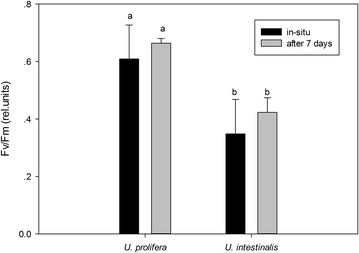
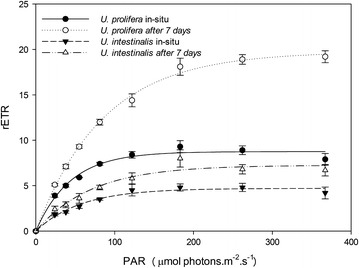
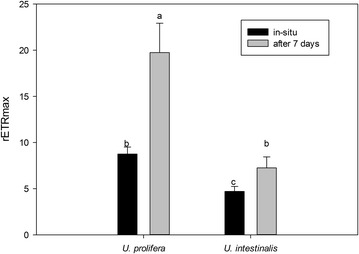
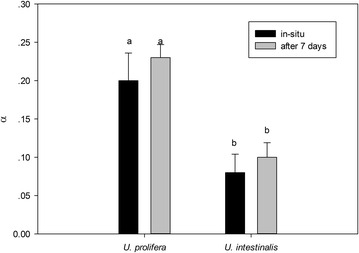
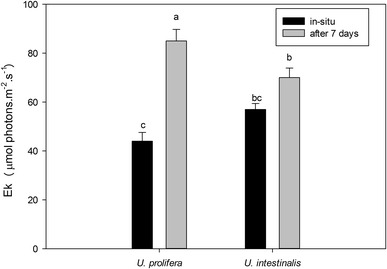
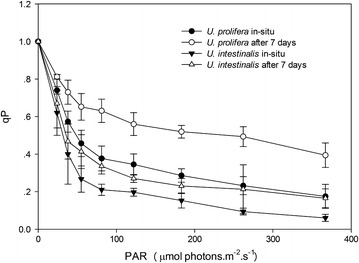
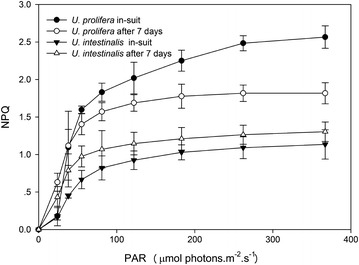
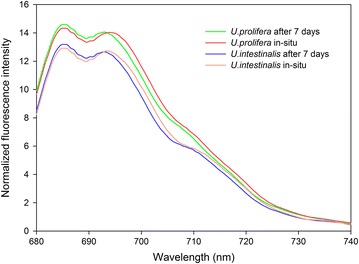
Green tides have occurred in the Yellow Sea, China, every year from 2007 to 2015. The free-floating Ulva prolifera (Müller) J. Agardh was the causative macroalgal species. The co-occurring, attached U. intestinalis was also observed. Photosynthetic capacities were determined using chlorophyll fluorescence in situ and after 7 days lab acclimation, and a significant differences were noted. Pigment composition showed no obvious differences, but concentrations varied significantly, especially chlorophyll b in U. prolifera two times increase was observed after acclimation. The optimal photochemical efficiency of PS II (Fv/Fm) was significantly higher in U. prolifera. Photosynthetic rate (α), maximum relative electron transport rate (rETRmax), and minimum saturating irradiance (Ek), obtained from rapid light response curves (RLCs), showed almost the same photosynthetic physiological status as Fv/Fm. Quenching coefficients and low temperature (77 K) chlorophyll fluorescence emission spectra of thylakoid membranes analysis showed U. prolifera has a better recovery activity and plasticity of PSII than U. intestinalis. Furthermore, energy dissipation via non-photochemical quenching (NPQ) and state transitions showed efficacious photoprotection solution especially in U. prolifera suffered from the severe stresses. Results in the present study suggested that U. prolifera's higher photosynthetic capacity would contribute to its free-floating proliferation, and efficacious photoprotection in addition to favorable oceanographic conditions and high nutrient levels support its growth and aggregation.
Keywords: 77 K chlorophyll fluorescence; Chlorophyll fluorescence; Optimal photochemical efficiency; Quenching coefficient; Yellow sea green tide.
Figures
References
-
- Baeck S, Lehvo A, Blomster J. Mass occurrence of unattached Enteromorpha intestinalis on the Finnish Baltic Sea coast. Annales Botanici Fennici. 2000;37:155–161.
-
- Bischof K, Rautenberger R, Perez-Llorens JL. Physiological acclimation to gradients of solar irradiance within mats of the filamentous green macroalga Chaetomorpha linum from southern Spain. Marine Ecol Prog Series. 2006;306:165–175. doi: 10.3354/meps306165. - DOI
-
- Choi T, Kang E, Kim J, Kim K. Effect of salinity on growth and nutrient uptake of Ulva pertusa (Chlorophyta) from an eelgrass bed. Algae. 2010;25:17–26. doi: 10.4490/algae.2010.25.1.017. - DOI
LinkOut - more resources
Full Text Sources
Other Literature Sources
Research Materials
Miscellaneous
