


Tumor Heterogeneity in Hepatocellular Carcinoma: Facing the Challenges
- PMID: 27386431
- PMCID: PMC4906428
- DOI: 10.1159/000367754
Tumor Heterogeneity in Hepatocellular Carcinoma: Facing the Challenges
Abstract
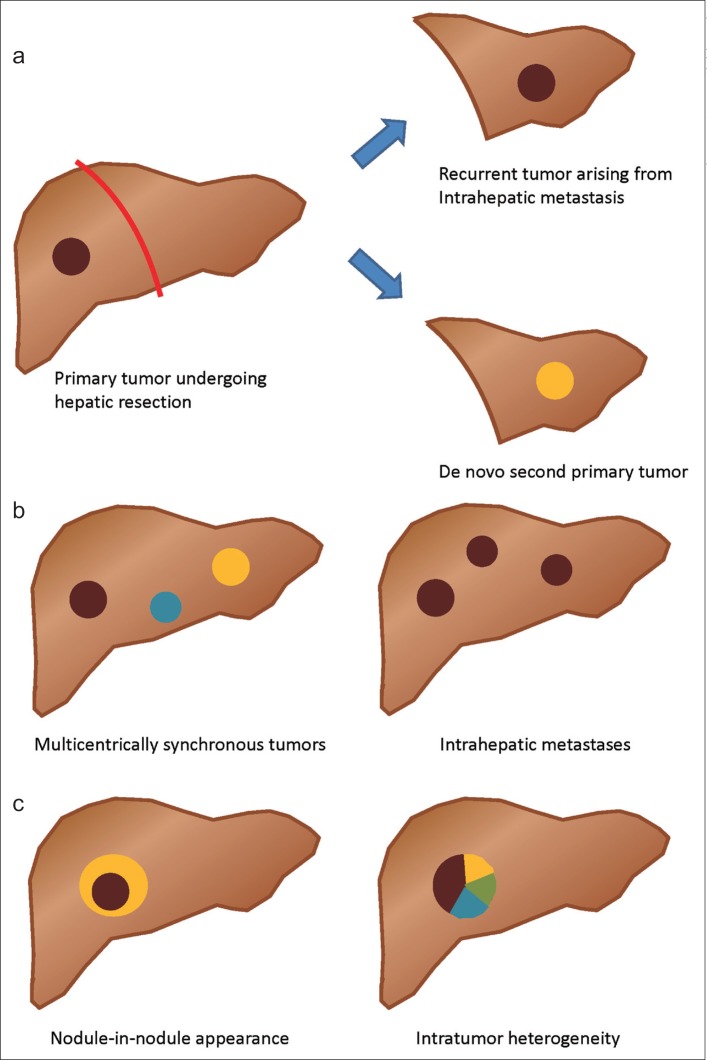
Tumor heterogeneity in hepatocellular carcinoma (HCC), such as that found in second primary tumors after curative treatment, synchronous multifocal tumors of different clonality, or intratumor heterogeneity, poses severe challenges for the development and administration of systemic molecular targeted therapies. Various methodologies, including historical DNA ploidy analysis, integrated hepatitis B virus DNA analysis, DNA fingerprinting, and next-generation sequencing technologies, are used to explore tumor heterogeneity in HCC. It is estimated that 30%-60% of recurrent or metastatic tumors harbor clones different from the primary tumor, 22%-79% of synchronous tumors vary clonally, and 12%-66% of single tumors contain intratumor heterogeneity. Substantial intertumor and intratumor heterogeneity renders biomarker identification, which is critical for the development and administration of molecular targeted therapy, challenging when applied to a single tumor biopsy specimen. The use of circulating tumor cells or circulating tumor DNA to evaluate overall tumor heterogeneity may help resolve this problem. This article reviews previous studies of tumor heterogeneity and discusses the implications and future opportunities regarding tumor heterogeneity in HCC.
Keywords: Circulating tumor DNA; Circulating tumor cell; Clonality; Hepatocellular carcinoma; Tumor heterogeneity.
Figures
References
-
- Lawrence MS, Stojanov P, Polak P, Kryukov GV, Cibulskis K, Sivachenko A, Carter SL, Stewart C, Mermel CH, Roberts SA, Kiezun A, Hammerman PS, McKenna A, Drier Y, Zou L, Ramos AH, Pugh TJ, Stransky N, Helman E, Kim J, Sougnez C, Ambrogio L, Nickerson E, Shefler E, Cortés ML, Auclair D, Saksena G, Voet D, Noble M, DiCara D, Lin P, Lichtenstein L, Heiman DI, Fennell T, Imielinski M, Hernandez B, Hodis E, Baca S, Dulak AM, Lohr J, Landau DA, Wu CJ, Melendez-Zajgla J, Hidalgo-Miranda A, Koren A, McCarroll SA, Mora J, Lee RS, Crompton B, Onofrio R, Parkin M, Winckler W, Ardlie K, Gabriel SB, Roberts CW, Biegel JA, Stegmaier K, Bass AJ, Garraway LA, Meyerson M, Golub TR, Gordenin DA, Sunyaev S, Lander ES, Getz G. Mutational heterogeneity in cancer and the search for new cancer-associated genes. Nature. 2013;499:214–218. - PMC - PubMed
-
- McGranahan N, Swanton C. Biological and therapeutic impact of intratumor heterogeneity in cancer evolution. Cancer Cell. 2015;27:15–26. - PubMed
-
- Gerlinger M, Rowan AJ, Horswell S, Larkin J, Endesfelder D, Gronroos E, Martinez P, Matthews N, Stewart A, Tarpey P, Varela I, Phillimore B, Begum S, McDonald NQ, Butler A, Jones D, Raine K, Latimer C, Santos CR, Nohadani M, Eklund AC, Spencer-Dene B, Clark G, Pickering L, Stamp G, Gore M, Szallasi Z, Downward J, Futreal PA, Swanton C. Intratumor heterogeneity and branched evolution revealed by multiregion sequencing. N Engl J Med. 2012;366:883–892. - PMC - PubMed
-
- de Bruin EC, McGranahan N, Mitter R, Salm M, Wedge DC, Yates L, Jamal-Hanjani M, Shafi S, Murugaesu N, Rowan AJ, Grönroos E, Muhammad MA, Horswell S, Gerlinger M, Varela I, Jones D, Marshall J, Voet T, Van Loo P, Rassl DM, Rintoul RC, Janes SM, Lee SM, Forster M, Ahmad T, Lawrence D, Falzon M, Capitanio A, Harkins TT, Lee CC, Tom W, Teefe E, Chen SC, Begum S, Rabinowitz A, Phillimore B, Spencer-Dene B, Stamp G, Szallasi Z, Matthews N, Stewart A, Campbell P, Swanton C. Spatial and temporal diversity in genomic instability processes defines lung cancer evolution. Science. 2014;346:251–256. - PMC - PubMed
-
- Zhang J, Fujimoto J, Zhang J, Wedge DC, Song X, Zhang J, Seth S, Chow CW, Cao Y, Gumbs C, Gold KA, Kalhor N, Little L, Mahadeshwar H, Moran C, Protopopov A, Sun H, Tang J, Wu X, Ye Y, William WN, Lee JJ, Heymach JV, Hong WK, Swisher S, Wistuba II, Futreal PA. Intratumor heterogeneity in localized lung adenocarcinomas delineated by multiregion sequencing. Science. 2014;346:256–259. - PMC - PubMed
Publication types
LinkOut - more resources
Full Text Sources
Other Literature Sources
