. 2016 Jul 7:16:187.
doi: 10.1186/s12906-016-1180-3.

Hominis Placenta facilitates hair re-growth by upregulating cellular proliferation and expression of fibroblast growth factor-7

Affiliations

Hominis Placenta facilitates hair re-growth by upregulating cellular proliferation and expression of fibroblast growth factor-7

Hyung-Sik Seo et al. BMC Complement Altern Med. .

Abstract

Background: Hominis Placenta (HP) known as a restorative medicine in Traditional Chinese Medicine (TCM), has been widely applied in the clinics of Korea and China as an anti-aging agent to enhance the regeneration of tissue. This study was conducted to investigate whether topical treatment of HP promotes hair regrowth in the animal model.

Methods: The dorsal hairs of 8-week-old C57BL/6 mice were depilated to synchronize hair follicles to the anagen phase. HP was applied topically once a day for 15 days. Hair growth was evaluated visually and microscopically. The incorporation of bromodeoxyuridine (BrdU) and expression of proliferating cell nuclear antigen (PCNA), fibroblast growth factor-7 (FGF-7) in dorsal skin tissue was examined by immunohistochemical analysis. Reverse transcription polymerase chain reaction (RT-PCR) was used to measure the mRNA expression of FGF-7.

Results: HP exhibited potent hair growth-promoting activity in C57BL/6 mice. Gross examination indicated that HP markedly increased hair regrowth as well as hair density and diameter. Histologic analysis showed that HP treatment enhanced the anagen induction of hair follicles. Immunohistochemical analysis revealed that BrdU incorporation and the expressions of PCNA were increased by treatment of HP. HP treatment significantly increased the expression of FGF-7, which plays pivotal roles to maintain anagen phase both protein and mRNA levels.

Conclusions: Taken together, our results indicate that HP has a potent hair growth-promoting activity; therefore, it may be a good candidate for the treatment of alopecia.

Keywords: Anagen; Bromodeoxyuridine; Fibroblast growth factor-7; Hair growth; Hominis Placenta.


Figures

Fig. 1
Fig. 1
Experimental scheme. Dorsal hairs of 8-week-old C57BL/6 mice, which were in the telogen phase of the hair cycle, were depilated to synchronize anagen induction. The mice were divided into following three groups: group 1, normal saline-treated negative control; group 2, 5 % minoxidil-treated positive control; group 3, Hominis Placenta (HP)-treated experimental group (n = 5 per group). Each agent were topically applied from the 1st to the 15th day after hair depilation. Bromodeoxyuridine (BrdU) was administered twice a day on the 1st, 2nd, and the 3rd day after depilation. Depilated dorsal skin lesions were collected at the 16th day after depilation and stained with hematoxylin and eosin. ●, Topical treatment with normal saline, 5 % minoxidil, or HP
Fig. 2
Fig. 2
Gross observation of hair re-growth in C57BL/6 mice. At the 14th and 16th days after depilation, skin color and hair growth of the depilated skin lesions were observed. Each group of mice has been topically treated with normal saline or 5 % minoxidil or HP once a day for consecutive 15 days respectively. Depilated dorsal skin lesions were photographed at the 14th and 16th day after depilation. Hair regrowth, as well as skin darkness, was increased in mice treated with HP as compared to normal control mice
Fig. 3
Fig. 3
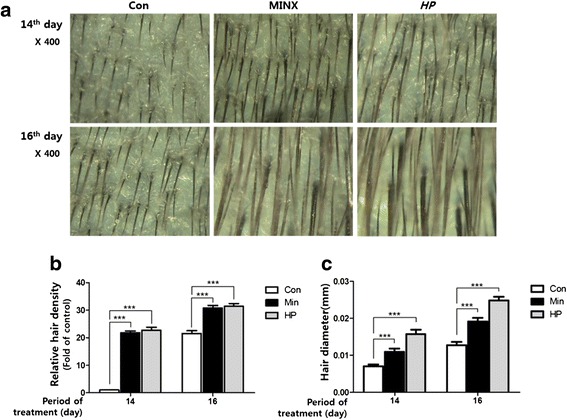
Dermoscopic observation of hair regrowth in C57BL/6 mice. Dorsal skins of mice were photographed by dermoscopy at the 14th and 16th day after depilation. Hair density was expressed as the number of hairs per unit area. Compared to the skin of the mice in the normal saline-treated control group (Con), the skin of the mice in the 5 % minoxidil (Min)- or HP-treated group had increased hair density and diameter (a). Hair density and hair diameter was greater in HP treated group than normal control group (b, c). Original Magnification: X100, X400. Values represent the mean ± standard deviation. ***P < 0.001, compared to control
Fig. 4
Fig. 4
Microscopic observation of hair follicle in C57BL/6 mice. Histologic examination reveals hair follicle development in C57BL/6 mice treated with normal saline or MINX or HP for 15 days. Dorsal skin sections were stained with hematoxylin and eosin. Immunohistochemical staining were performed to examine the expression of BrdU and PCNA. MINX: minoxidil; HP: Hominis placenta; Original magnification: X100, large box: X200
Fig. 5
Fig. 5
HP upregulates the expression of FGF-7 involved in anagen development Dorsal skins were collected from C57BL/6 mice treated with normal saline (Con), 5 % minoxidil (MINX), or HP for 15 days. Immunohistochemical analysis of hair follicles against FGF-7 was performed (a). Original magnification: X100, large box: X200. RT-PCR and western blot method was used to determine the expression of FGF7 at the mRNA and protein level (b)

References

    1. Ellis JA, Stebbing M, Harrap SB. Polymorphism of the androgen receptor gene is associated with male pattern baldness. J Invest Dermatol. 2001;116(3):452–5. doi: 10.1046/j.1523-1747.2001.01261.x. - DOI - PubMed
    1. Kaufman KD. Androgens and alopecia. Mol Cell Endocrinol. 2002;198(1-2):89–95. doi: 10.1016/S0303-7207(02)00372-6. - DOI - PubMed
    1. Hadshiew IM, Foitzik K, Arck PC, Paus R. Burden of hair loss: stress and the underestimated psychosocial impact of telogen effluvium and androgenetic alopecia. J Invest Dermatol. 2004;123(3):455–7. doi: 10.1111/j.0022-202X.2004.23237.x. - DOI - PubMed
    1. Gilhar A, Keren A, Shemer A, d'Ovidio R, Ullmann Y, Paus R. Autoimmune Disease Induction in a Healthy Human Organ: A Humanized Mouse Model of Alopecia Areata. J Invest Dermatol. 2013;133(3):844–7. doi: 10.1038/jid.2012.365. - DOI - PubMed
    1. Botchkarev VA, Komarova EA, Siebenhaar F, Botchkareva NV, Komarov PG, Maurer M, Gilchrest BA, Gudkov AV. p53 is essential for chemotherapy-induced hair loss. Cancer Res. 2000;60(18):5002–6. - PubMed

MeSH terms