. 2016 Jul 8;353(6295):158-62.
doi: 10.1126/science.aaf4292.

Phototactic guidance of a tissue-engineered soft-robotic ray

Affiliations

Phototactic guidance of a tissue-engineered soft-robotic ray

Sung-Jin Park et al. Science. .

Abstract

Inspired by the relatively simple morphological blueprint provided by batoid fish such as stingrays and skates, we created a biohybrid system that enables an artificial animal--a tissue-engineered ray--to swim and phototactically follow a light cue. By patterning dissociated rat cardiomyocytes on an elastomeric body enclosing a microfabricated gold skeleton, we replicated fish morphology at 1/10 scale and captured basic fin deflection patterns of batoid fish. Optogenetics allows for phototactic guidance, steering, and turning maneuvers. Optical stimulation induced sequential muscle activation via serpentine-patterned muscle circuits, leading to coordinated undulatory swimming. The speed and direction of the ray was controlled by modulating light frequency and by independently eliciting right and left fins, allowing the biohybrid machine to maneuver through an obstacle course.


Figures

Fig. 1
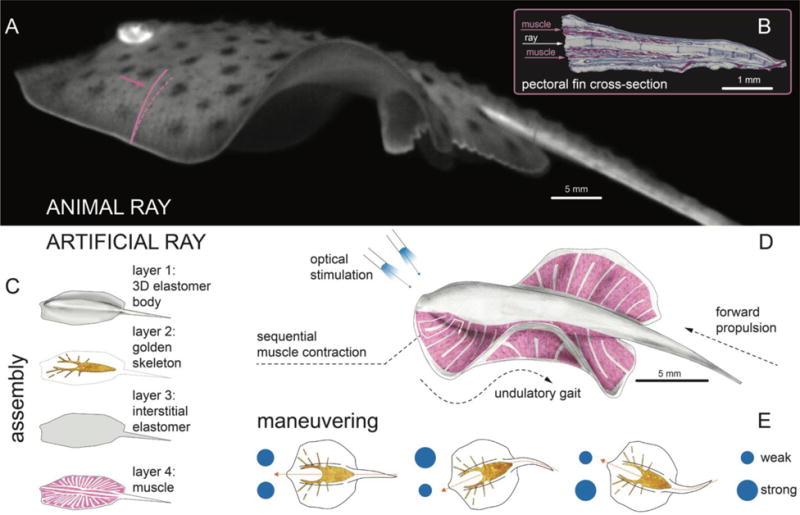
Fig. 1. Bioinspired concept design of the tissue-engineered ray
(A) A live Little skate, Leucoraja. erinacea, swimming and (B) its musculoskeletal structure. (C to E) Tissue-engineered ray with four layers of body architecture (C), concept (D), and phototactic control (E). Upon optical stimulation, the tissue-engineered ray induces sequential muscle activation via serpentine patterned muscle tissues, generates undulatory locomotion, and sustains steady forward swimming. It changes directions by generating asymmetric undulating motion between left and right fins, modulated by light pulse frequency.
Fig. 2
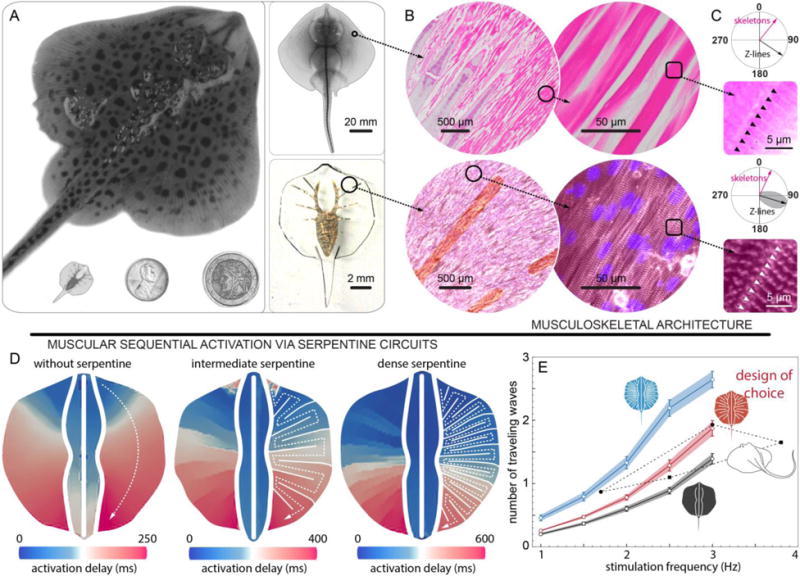
Fig. 2. Engineering solutions
(A) System level design for skate (top) and tissue-engineered ray (bottom left) comparable with one penny and a two Euros coin (bottom middle and right). (B and C) Musculoskeletal (B) meso- and (C) micro-architecture of a skate, L. erinacea (top) is replicated in tissue-engineered ray (bottom). Horizontal sections of the skate were stained with hematoxylin and eosin (top) and the engineered tissue was immunostained with a light-sensitive membrane protein, ChR2 (red, bottom left), sarcomeric α-actinin (red, bottom right of B and C), and nuclei (blue, bottom). (C) Orientation of the Z-lines (skate: black arrow and black triangle, top, and tissue-engineered ray: black arrow with gray distribution and white triangle, bottom). In both cases Z-lines are perpendicular to the skeleton rays (pink arrows). (D) Muscle circuits with pre-programmed activation pattern. A point light stimulus directed at the front of the fins with 1.5 Hz frequency triggers the calcium wave that propagates along the predefined serpentine patterns. (E) Operating range of the muscle circuits. The circuit with intermediate serpentine pattern density represents the best tradeoff between contraction time reproducibility (Standard error of the mean, SEM) and overlap with batoids’ operating range (Taeniura. lymma (20) and Potamotrygon orbignyi (22), black symbols). Black, red and blue indicates muscle circuit without serpentine patterns, with intermediate and dense serpentine patterns, respectively. Each colored band indicates SEM of number of traveling waves.
Fig. 3
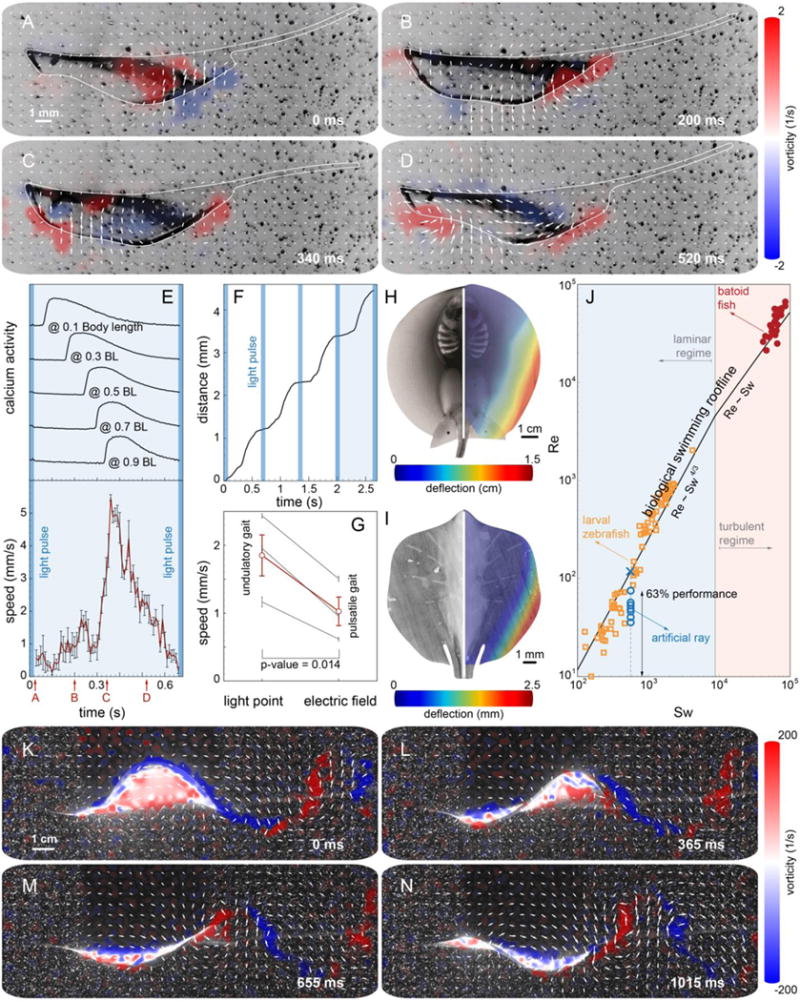
Fig. 3. Kinematics and hydrodynamics
(A to D) PIV flow measurements highlight the production of alternated positive and negative vortices by the tissue-engineered ray. The viscosity associated to the relatively small Re is responsible for the dissipation of the vortex street in the wake. (E) Correlation between calcium activity and undulatory locomotion. (F) The moving distance during four strokes. (G) Comparison of swimming speed between the tissue-engineered rays stimulated by point and field stimulations. Undulatory locomotion produced by sequential muscle activation (point: 1.85 mm/s) improved swimming speed significantly compared with pulsatile propulsion generated by global muscle activation (field: 1.03 mm/s, matched pairs test, p=0.014, n=3 rays). Gray and red lines indicate the speed of individual rays and their average, respectively. (H and I) Out-of-plane fin deflection in both a live stingray, P. orbignyi (H) and a tissue-engineered ray (maximum amplitude: 2.54 ± 0.02 mm) (I). (J) Comparison of swimming performance between tissue-engineered rays (n=7 rays) and aquatic swimmers (batoid fish (20) and larval zebrafish (32)) using the scaling analysis (23). (K to M) PIV analysis of live Little skate, L. erinacea.
Fig. 4
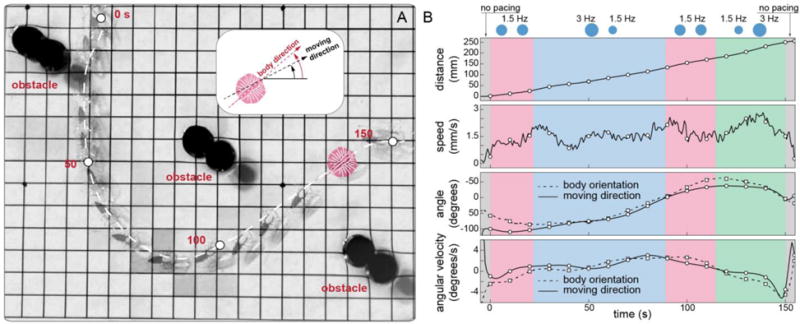
Fig. 4. Phototactic steering of the tissue-engineered ray through an obstacle course
(A) The ray completed a course that required complex coordination and maneuvering. Motion began with a forward protocol (at 0 s) to gain acceleration. A following left turn protocol allowed the ray to overcome forward momentum, making a left turn (at ~50 s). Next, another forward protocol was employed to dissipate counterclockwise angular momentum and regain directionality (at ~100 s). While the ray made its way back to the other side of the obstacles, a final right turn protocol was given to make a right turn, winding the last obstacle. (B) Corresponding kinematic analysis relative to light frequency modulation protocols employed for guidance. Grids, 1 cm.

Comment in

References

    1. Pfeifer R, Lungarella M, Iida F. Self-organization, embodiment, and biologically inspired robotics. Science. 2007;318:1088–1093. doi: 10.1126/science.1145803. - DOI - PubMed
    1. Haberland M, Kim S. On extracting design principles from biology: I. Method-General answers to high-level design questions for bioinspired robots. Bioinspir Biomim. 2015;10:14. doi: 10.1088/1748-3190/10/1/016010. - DOI - PubMed
    1. Kim S, Laschi C, Trimmer B. Soft robotics: a bioinspired evolution in robotics. Trends Biotechnol. 2013;31:23–30. doi: 10.1016/j.tibtech.2013.03.002. - DOI - PubMed
    1. Rus D, Tolley MT. Design, fabrication and control of soft robots. Nature. 2015;521:467–475. doi: 10.1038/nature14543. - DOI - PubMed
    1. Ma KY, Chirarattananon P, Fuller SB, Wood RJ. Controlled flight of a biologically inspired, insect-scale robot. Science. 2013;340:603–607. doi: 10.1126/science.1231806. - DOI - PubMed

Publication types