. 2016 Jul 7;9(1):387.
doi: 10.1186/s13071-016-1675-2.

Mosquito communities and disease risk influenced by land use change and seasonality in the Australian tropics

Affiliations

Mosquito communities and disease risk influenced by land use change and seasonality in the Australian tropics

Dagmar B Meyer Steiger et al. Parasit Vectors. .

Abstract

Background: Anthropogenic land use changes have contributed considerably to the rise of emerging and re-emerging mosquito-borne diseases. These diseases appear to be increasing as a result of the novel juxtapositions of habitats and species that can result in new interchanges of vectors, diseases and hosts. We studied whether the mosquito community structure varied between habitats and seasons and whether known disease vectors displayed habitat preferences in tropical Australia.

Methods: Using CDC model 512 traps, adult mosquitoes were sampled across an anthropogenic disturbance gradient of grassland, rainforest edge and rainforest interior habitats, in both the wet and dry seasons. Nonmetric multidimensional scaling (NMS) ordinations were applied to examine major gradients in the composition of mosquito and vector communities.

Results: We captured ~13,000 mosquitoes from 288 trap nights across four study sites. A community analysis identified 29 species from 7 genera. Even though mosquito abundance and richness were similar between the three habitats, the community composition varied significantly in response to habitat type. The mosquito community in rainforest interiors was distinctly different to the community in grasslands, whereas forest edges acted as an ecotone with shared communities from both forest interiors and grasslands. We found two community patterns that will influence disease risk at out study sites, first, that disease vectoring mosquito species occurred all year round. Secondly, that anthropogenic grasslands adjacent to rainforests may increase the probability of novel disease transmission through changes to the vector community on rainforest edges, as most disease transmitting species predominantly occurred in grasslands.

Conclusion: Our results indicate that the strong influence of anthropogenic land use change on mosquito communities could have potential implications for pathogen transmission to humans and wildlife.

Keywords: Deforestation; Edge effects; Land use change; Mosquito community; Rainforest disturbance.


Figures
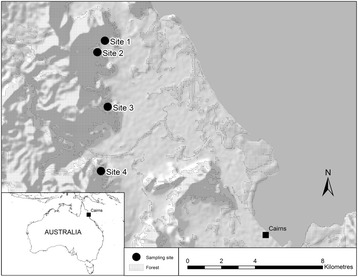
Fig. 1
Fig. 1
Map of study area and sampling sites. The study area, north of Cairns, Australia showing the four sampling sites which feature similar ecological habitats and environmental gradients
Fig. 2
Fig. 2
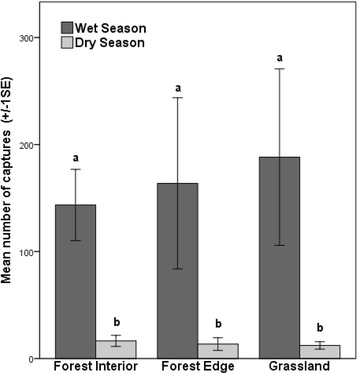
Abundance of mosquitoes in the three sampled habitats. The mean number of mosquitoes caught in forest interior, forest edge and grassland habitats during the wet and dry season. Mean values are similar in the three habitats but are significantly lower in the dry season than those in the wet season. Error bars denote the standard error. Different letters denote significant differences
Fig. 3
Fig. 3
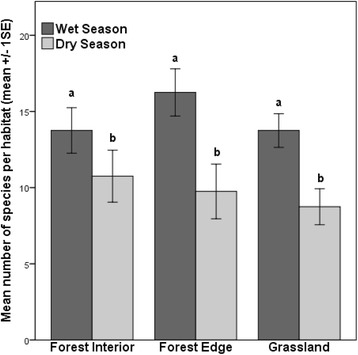
Mean number of mosquito species in the three sampled habitats. Mean number of mosquito species captured in forest interior, forest edge and grassland habitats during the wet and dry season in each habitat. Mean species richness was quite similar between the three habitats but significantly fewer species were captured in the dry season compared to the wet season, especially along forest edges and grassland sites. Error bars denote the standard error. Different letters denote significant differences
Fig. 4
Fig. 4
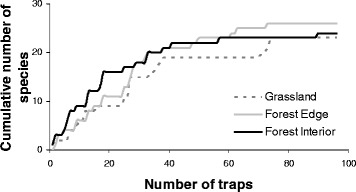
Species accumulation curves for sampled mosquitoes. Species accumulation curves for mosquitoes sampled from forest interior, forest edge and grassland habitats suggest that most common species were captured. The curves display adequate sampling effort for all habitats and indicate that further sampling would not have produced the discovery of more species, except for very rare ones
Fig. 5
Fig. 5
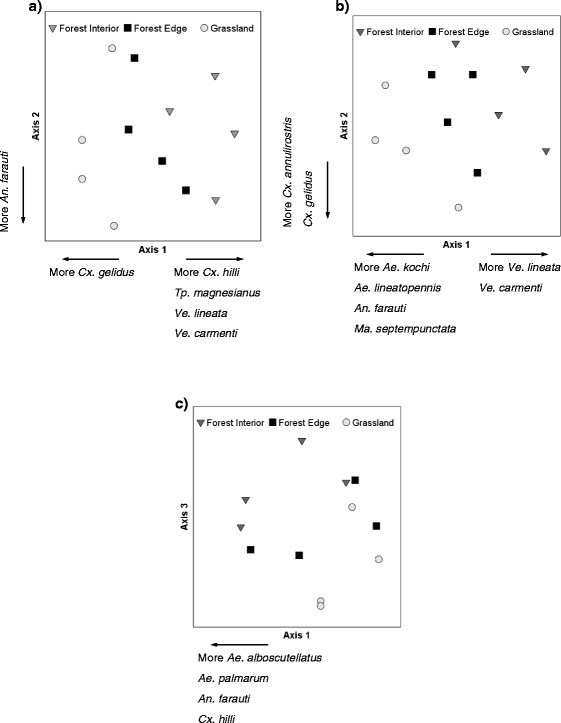
Ordination analyses of mosquito communities for habitats and seasons. Ordination analyses (NMS) show that the mosquito community varied strongly in response to habitat type. Forest interior sites are distinctly different from grassland sites when (a) the data for the wet season and dry season were combined, the data for the wet season (b) and the dry season (c) (only two of the three dimensions obtained in the analysis are displayed) were analysed separately
Fig. 6
Fig. 6
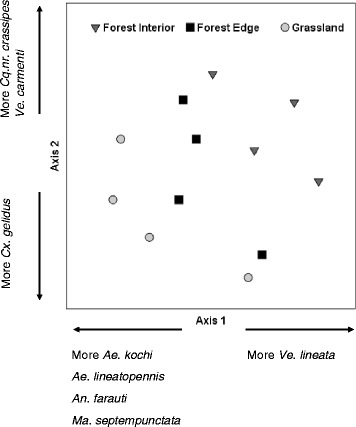
Ordination analysis of the vector community. Ordination analysis (NMS) of the vector community displays a distinctly different species composition for forest interior and grassland sites
Fig. 7
Fig. 7
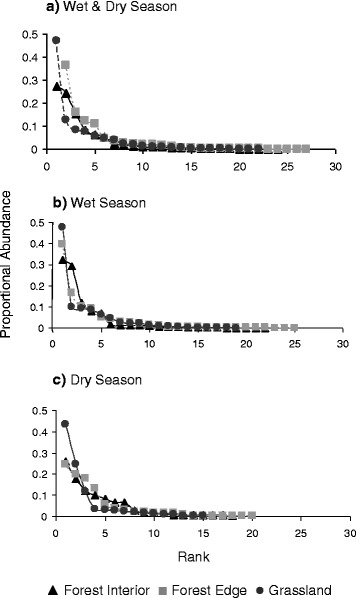
Rank-abundance diagrams for the diversity of mosquito species. Rank-abundance diagrams displaying the diversity of mosquito species in the three habitats; taking into account not just the number of species (richness) but also the distribution of individuals among species (evenness). Overall (a) (wet and dry season combined) forest interior had 2 dominant species; forest edge and grassland had one dominant species. In the wet season (b) two dominant species were discovered in the forest interior but only one dominant species in both grassland and forest edge. During the dry season sampling (c) one dominant species was captured in the grassland and forest edge and two species dominated the forest interior
Fig. 8
Fig. 8
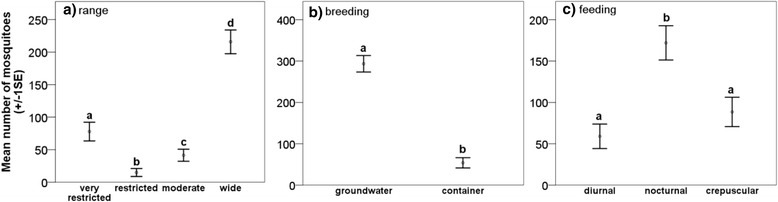
Mosquito characteristics. Mean number of captured mosquito groups in regards to geographical range, breeding habitat and time of feeding in northern Australia. Most captures were from the mosquitoes which have a wide distribution (a), use groundwater environments for depositing eggs (b) and blood-feed mainly during the night (c). Different letters denote significant differences

References

    1. Morse S. Factors in the emergence of infectious diseases. Emerg Infect Dis. 1995;1:7–15. doi: 10.3201/eid0101.950102. - DOI - PMC - PubMed
    1. Gubler D. Resurgent vector-borne diseases as a global health problem. Emerg Infect Dis. 1998;4:442–50. doi: 10.3201/eid0403.980326. - DOI - PMC - PubMed
    1. Patz J, Graczyk T, Geller N, Vittor A. Effects of environmental change on emerging parasitic diseases. Int Journal Parasitol. 2000;30:1395–405. doi: 10.1016/S0020-7519(00)00141-7. - DOI - PubMed
    1. Vittor AY, Pan W, Gilman RH, Tielsch J, Glass G, Shields T, Sanchez-Lozano W, Pinedo VV, Salas-Cobos E, Flores S, Patz JA. Linking deforestation to malaria in the Amazon: characterization of the breeding habitat of the principal malaria vector, Anopheles darlingi. Am J Trop Med Hyg. 2009;81:5–12. - PMC - PubMed
    1. Foley J, Asner G, Costa M, Coe M, DeFries R, Gibbs H, Howard E, Olson S, Patz J, Ramankutty N. Amazonia revealed: forest degradation and loss of ecosystem goods and services in the Amazon Basin. Front Ecol Environ. 2007;5:25–32. doi: 10.1890/1540-9295(2007)5[25:ARFDAL]2.0.CO;2. - DOI

Publication types

LinkOut - more resources