Review
. 2016 Aug;16(8):525-37.
doi: 10.1038/nrc.2016.56. Epub 2016 Jul 8.

Biomarker development in the precision medicine era: lung cancer as a case study

Affiliations
Review

Biomarker development in the precision medicine era: lung cancer as a case study

Ashley J Vargas et al. Nat Rev Cancer. 2016 Aug.

Abstract

Precision medicine relies on validated biomarkers with which to better classify patients by their probable disease risk, prognosis and/or response to treatment. Although affordable 'omics'-based technology has enabled faster identification of putative biomarkers, the validation of biomarkers is still stymied by low statistical power and poor reproducibility of results. This Review summarizes the successes and challenges of using different types of molecule as biomarkers, using lung cancer as a key illustrative example. Efforts at the national level of several countries to tie molecular measurement of samples to patient data via electronic medical records are the future of precision medicine research.


Conflict of interest statement

Competing interests statement

The authors declare no competing interests.

Figures
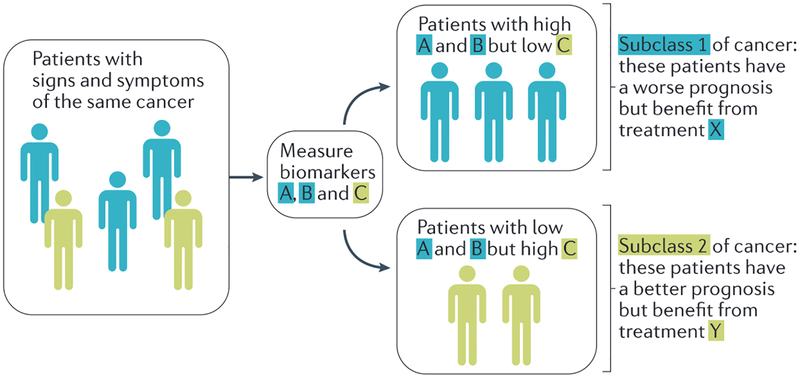
Figure 1|
Figure 1|. Classifying patients into new, specific taxa.
Patients with the same signs and symptoms of cancer often have different outcomes. The precision medicine approach provides a research strategy to develop biomarkers that can be used to classify patients with the same cancer into finer taxa (subclass 1 versus subclass 2) by biomarkers that predict prognoses derived from the synthesis of large amounts of data to identify discriminating biomarkers. For example, patients in subclass 1 who have a worse prognosis (that is, have biomarkers that are associated with poor survival) may be given a more aggressive treatment (treatment X) versus those in subclass 1 who have a better prognosis (that is, have biomarkers that are associated with good outcome) and require a less aggressive therapy (treatment Y). Additionally, the converse may be true where individuals with a worse prognosis are provided less aggressive therapy if no benefit from aggressive treatment has been observed for this subclass.
Figure 2 |
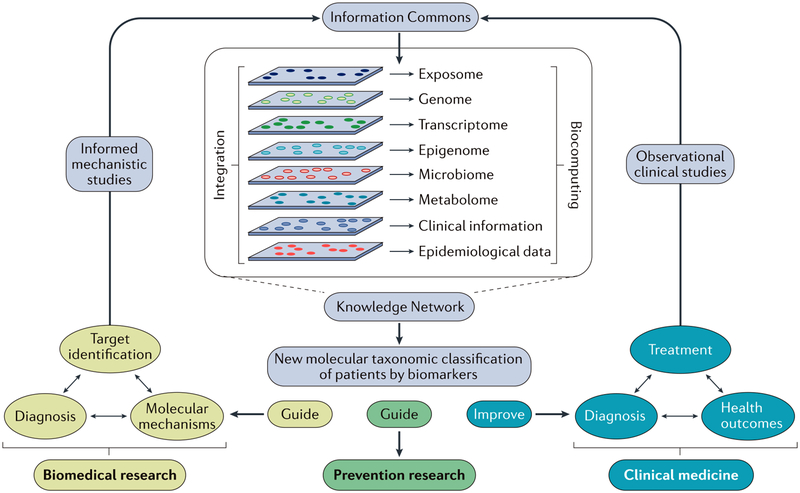
Figure 2 |. A precision medicine research strategy.
As outlined in the 2011 Institute of Medicines National Research Council report entitled Toward Precision Medicine: Building a Knowledge Network for Biomedical Research and a New Taxonomy of Disease, an Information Commons will be analysed to develop a Knowledge Network to inform research and medicine. The Information Commons will serve as a reservoir of data on a group of individuals from multiple sources (clinical data, demographic and epidemiological data, and multiple types of ‘omics’ data). Analyses of the Information Commons will result in the generation of a Knowledge Network that will specify clinical, demographic and ‘omics’ characteristics that predict disease risk, diagnosis, response and prognosis, thus allowing for the reclassification of individuals into subtypes (taxa). These new taxa will require further research and clinical follow-up to validate their existence and to determine the most suitable taxon-specific standards of care. Adapted with permission from REF. by the National Academy of Sciences, Courtesy of the National Academies Press, Washington, DC, USA.
Figure 3|
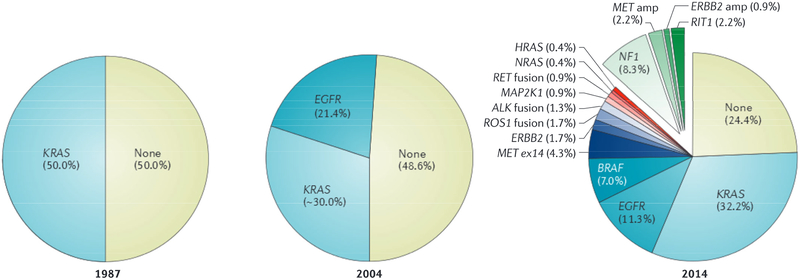
Figure 3|. Knowledge of non-small cell lung adenocarcinoma has evolved in recent decades.
Traditionally, lung cancer was grouped by histology into small cell lung cancer and non-small cell squamous cell carcinoma or adenocarcinoma. In 1987, a KRAS mutation was identified in ~25% of all non-small cell lung cancers, and 50% of lung adenocarcinomas. In 2004, epidermal growth factor receptor (EGFR) mutations were identified as an additional mutation in lung adenocarcinomas. The Cancer Genome Atlas (TCGA) Network’s next-generation sequencing of lung adenocarcinoma in 2014 led to the identification of more than 15 different gene events that could be exploited for treatment and/or used for subclassifying patients into new taxa. ALK, anaplastic lymphoma kinase; amp, amplification; ex, exon; RIT1, Ras like without CAAX1. Data in the left panel were abstracted from Rodenhuis et al.. Data in the middle panel were abstracted from Paez et al and Riley et al.. The right panel of the figure is from REF. , Nature Publishing Group.
Figure 4|
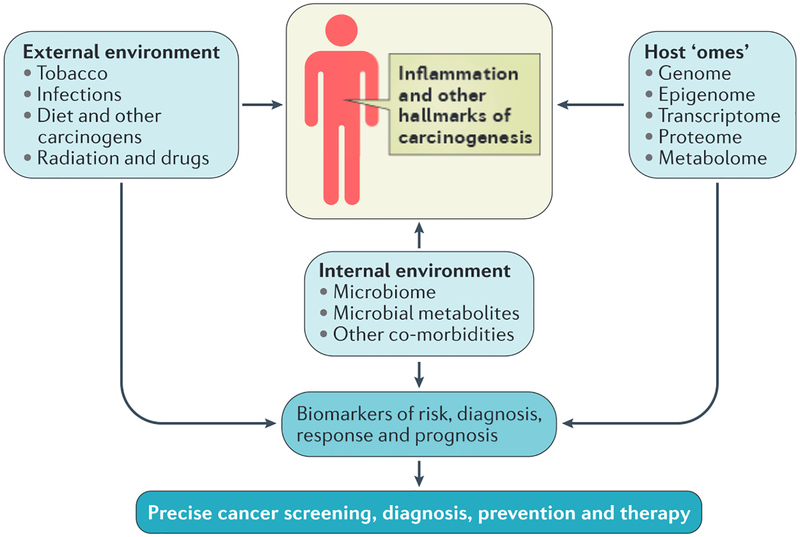
Figure 4|. The lung exposome.
The exposome of the lung comprises a diverse array of molecules and events (including carcinogens from tobacco, asbestos and radon) that come from the external and internal lung environment. These external and internal influences interact with each other and host’omes’to alter the lung cell environment (including inflammation and the microbiome) and may promote or protect against the development of the hallmarks of cancer. Smoking is estimated to cause 90% of lung cancers. Occupational exposures to carcinogens and radon exposure are estimated to cause 9–15% and 10% of lung cancer cases, respectively. Measurement of the exposome, in addition to other host ‘omics’, has led to the development of precise biomarkers of risk, diagnosis, treatment response and prognosis by which patients can be classified into new taxa. These new taxa then require different standards of care for cancer screening, diagnosis, prevention and therapy.
Figure 5 |
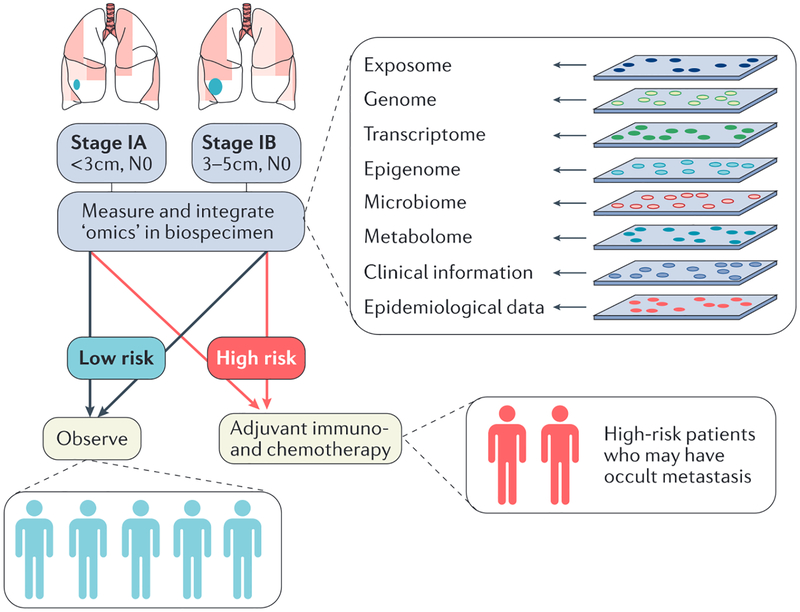
Figure 5 |. Use of precision medicine to classify patients with early-stage lung cancer into subclasses to provide appropriate treatment.
Approximately 25% of patients with stage I lung cancer will have recurrent disease associated with occult metastasis. This figure depicts the classification of early stage (IA and IB) lung cancers by a single biomarker or a panel of biomarkers that predicts risk of recurrence generated using a precision medicine research strategy into’low risk for recurrence’and ‘high risk for recurrence’. Once classified into subclasses (taxa), low-risk patients can be observed post-curative surgery whereas high-risk patients can be provided options for adjuvant therapy post-surgery.

References

    1. Obama B Remarks by the President in State of the Union Address | January 20, 2015. The White House https://www.whitehouse.gov/the-press-office/2015/01/20/remarks-president... (2015).
    1. Collins FS & Varmus H A new initiative on precision medicine. N. Engl. J. Med 372, 793–795 (2015). - PMC - PubMed
    2. An overview of the US approach to generate a national cohort for precision medicine research.

    1. US National Institutes of Health (NIH). NIH workshop on building a precision medicine research cohort NIH http://www.nih.gov/precisionmedicine/wprKshop.htm (2015).
    1. Elliott P, Peakman TC & Biobank UK. The UK Biobank sample handling and storage protocol for the collection, processing and archiving of human blood and urine. Int. J. Epidemiol 37, 234–244 (2008). - PubMed
    2. A summary of the UK Biobank, which will serve as an important resource for precision medicine research.

    1. Frank L Epidemiology. When an entire country is a cohort. Science 287, 2398–2399 (2000). - PubMed

Substances