. 2016 Oct 1;118(4):621-635.
doi: 10.1093/aob/mcw130.

Understanding deep roots and their functions in ecosystems: an advocacy for more unconventional research

Affiliations

Understanding deep roots and their functions in ecosystems: an advocacy for more unconventional research

Alain Pierret et al. Ann Bot. .

Abstract

Background Deep roots are a common trait among a wide range of plant species and biomes, and are pivotal to the very existence of ecosystem services such as pedogenesis, groundwater and streamflow regulation, soil carbon sequestration and moisture content in the lower troposphere. Notwithstanding the growing realization of the functional significance of deep roots across disciplines such as soil science, agronomy, hydrology, ecophysiology or climatology, research efforts allocated to the study of deep roots remain incommensurate with those devoted to shallow roots. This is due in part to the fact that, despite technological advances, observing and measuring deep roots remains challenging. Scope Here, other reasons that explain why there are still so many fundamental unresolved questions related to deep roots are discussed. These include the fact that a number of hypotheses and models that are widely considered as verified and sufficiently robust are only partly supported by data. Evidence has accumulated that deep rooting could be a more widespread and important trait among plants than usually considered based on the share of biomass that it represents. Examples that indicate that plant roots have different structures and play different roles with respect to major biochemical cycles depending on their position within the soil profile are also examined and discussed. Conclusions Current knowledge gaps are identified and new lines of research for improving our understanding of the processes that drive deep root growth and functioning are proposed. This ultimately leads to a reflection on an alternative paradigm that could be used in the future as a unifying framework to describe and analyse deep rooting. Despite the many hurdles that pave the way to a practical understanding of deep rooting functions, it is anticipated that, in the relatively near future, increased knowledge about the deep rooting traits of a variety of plants and crops will have direct and tangible influence on how we manage natural and cultivated ecosystems.

Keywords: Deep roots; climate change; drought tolerance; maximum rooting depth; rooting profile; soil carbon.


Figures

Fig. 1.
Fig. 1.
Drawings of the above- and below-ground extension of the species Pinus sylvestris, Pimpinella saxifrage, Zygophullum xanthoxylo and Convolvulus tragacanthoides. H/D is the ratio of the above-ground plant height divided by the maximum rooting depth (MRD). This figure illustrates the large inter-specific variability in H/D ratio and demonstrates the risk of establishing misleading allometric relationships between these parameters when MRD is not accurately determined (adapted from Kutschera et al., 1997).
Fig. 2.
Fig. 2.
Illustration of the influence of maximum sampling depth on the shape of the inferred cumulative root profile. The root system drawing (A) depicts a specimen of Raphanus raphanistrum (from Kutschera, 1960). The plot in (B) illustrates the fact that truncated rooting profiles can yield misleading information about the actual depth distribution of roots, which may subsequently result in spurious conclusions regarding root functioning; from grossly undersampled (fine dashed horizontal line and curve in A and B, respectively), to moderately undersampled (solid horizontal line and curve in A and B, respectively) and fully sampled (dashed dotted horizontal line and curve in A and B, respectively).
Fig. 3.
Fig. 3.
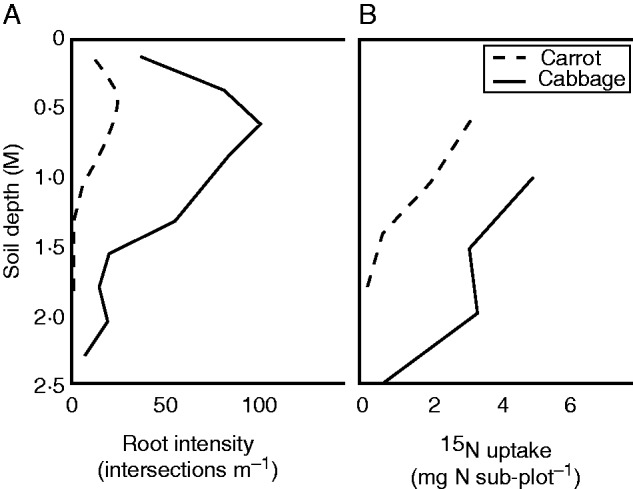
Average deep rooting and nutrient uptake in annual crops (n = 4). (A) Root intensity; (B) plant 15N uptake determined, 6 d after tracer injection, from 15N enrichment in the above-ground biomass of plants grown in sub-plots where 15N was injected at four different soil depth increments (0·6, 1·0, 1·4 and 1·8 m for carrot and 1·0, 1·5, 2·0 and 2·5 m for cabbage) (redrawn from Kristensen and Thorup-Kristensen, 2004a).
Fig. 4.
Fig. 4.
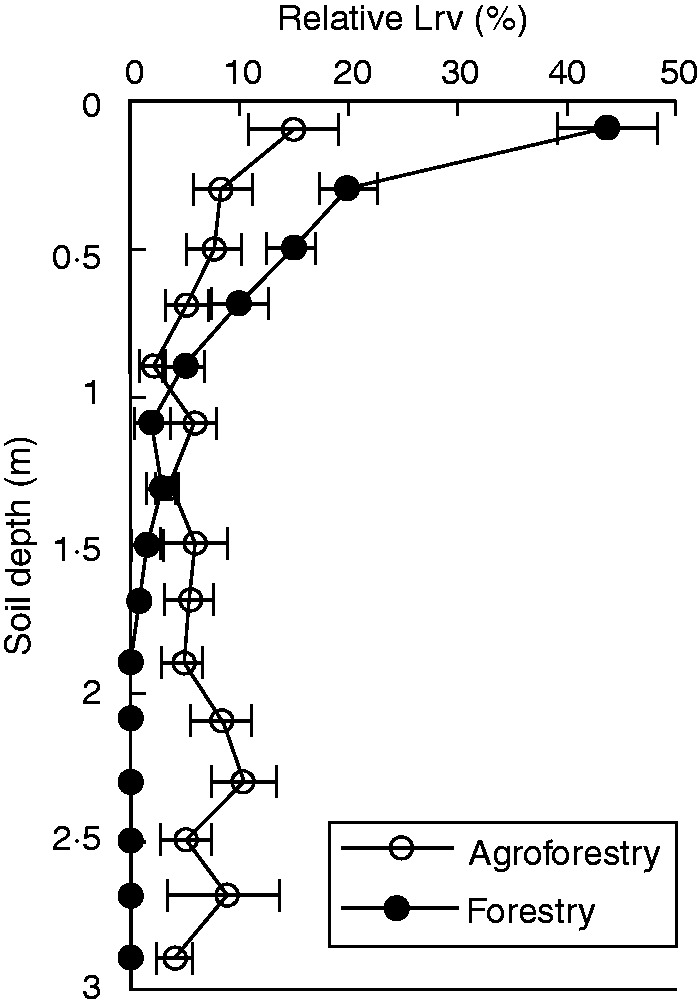
Root distribution profiles of walnut in agroforestry and forestry plots. Horizontal bars extend ± 1 s.e. around mean values for each soil depth. Note enhanced root growth below 1·5 m in the agroforestry plot (redrawn from Mulia and Dupraz, 2006).
Fig. 5.
Fig. 5.
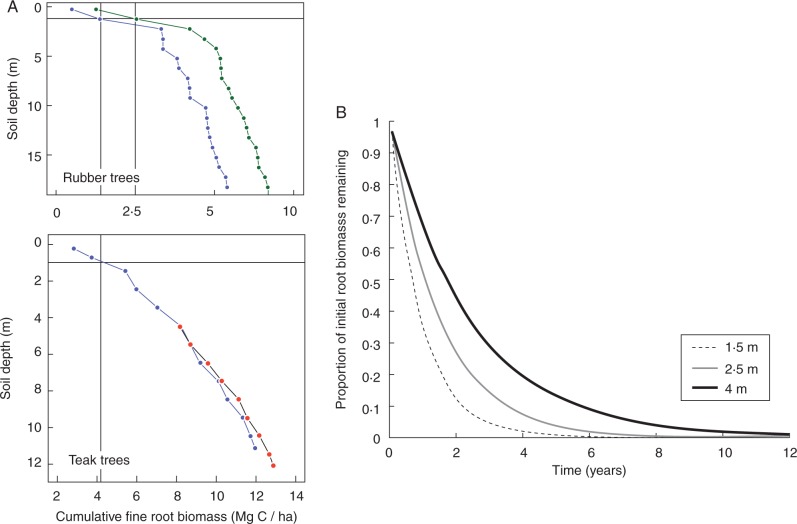
(A) Examples of deep rooting profiles of rubber trees in Southern Thailand (top) and teak trees in Laos (bottom). Horizontal and vertical dotted lines indicate a soil depth of 1 m and the amount of fine root C (in Mg ha–1) found in the top first metre of soil, respectively, for each cumulative root profile. Fine root biomass below 1 m is about 3-fold that above 1 m. Note that roots may still be present below the sampled depths. (B) Dynamics of root tissue breakdown at different soil depths in a rubber tree plantation of north-eastern Thailand. Breakdown was the fastest at a depth of 2·5 m, intermediate at 1·5 m and the slowest at 4 m. In relation to rooting profiles shown in (A), which indicate that root carbon deposition below 1 m can be substantial, such differences in root degradation with depth suggest that the residence time of root-derived C at depth may be longer than near the soil surface (adapted from Gonkhamdee et al., 2010b; Maeght, 2014).
Fig. 6.
Fig. 6.
(A) Cumulative dry root biomass fraction in boreholes drilled down to 32 m in a young rubber tree plantation of north-eastern Thailand, established after clearing dipterocarp secondary forest. Given that the rubber trees were very young (<5 years old) at the time of sampling, it is assumed that these rooting profile correspond to the pre-existing forest. The groundwater level at the time of drilling, for each rooting profile is indicated to the right hand side of the plot by horizontal lines whose style and shade of grey matches that of the corresponding rooting profile. (B Scanning electron microscopy image of one of the roots retrieved from a depth of 24 m (Montoroi et al., 2015). Note the well-preserved overall structure of the root and visible cell walls.
Fig. 7.
Fig. 7.
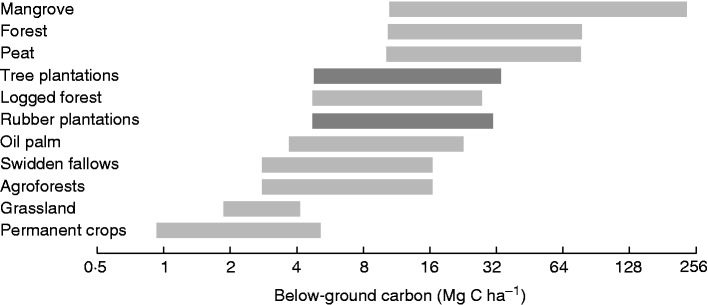
Below-ground carbon biomass for 11 land-covers in south-east Asia: thick lines correspond to adjusted ranges of values after the removal of outlying values. Ranges corresponding to teak and rubber trees, species for which we provided below-ground carbon profiles in Fig. 5 are indicated in dark grey. Note that (1) the ranges reported here include all root types, not only fine roots as in Fig. 5 and (2) most published rooting profiles are truncated, which results in the wide variability of below-ground carbon estimates (adapted from Yuen et al., 2013).

References

    1. Aalde H, Gonzalez P, Gytarsky M, et al. 2006. Generic methodologies applicable to multiple land-use categories In: Eggleston S, Buendia L, Miwa K, Ngara T, Tanabe K, eds. IPCC guidelines for national greenhouse gas inventories, vol. 4. Agriculture, forestry and other land use. Kanagawa: IGES.
    1. Abramoff RZ, Finzi AC. 2015. Are above- and below-ground phenology in sync? New Phytologist 205: 1054–1061. - PubMed
    1. Amato M, Pardo A. 1994. Root length and biomass losses during sample preparation with different screen mesh sizes. Plant and Soil 161: 299–303.
    1. Angelini IM, Garstang M, Davis RE, et al. 2011. On the coupling between vegetation and the atmosphere. Theoretical and Applied Climatology 105: 243–261.
    1. Battaglia M, Atkinson MA. 2015. The streetlight effect in type 1 diabetes. Diabetes 64: 1081–90. - PMC - PubMed

LinkOut - more resources