Case Reports
. 2016 Jul 7;99(1):236-45.
doi: 10.1016/j.ajhg.2016.05.026.

Bi-allelic Mutations in KLHL7 Cause a Crisponi/CISS1-like Phenotype Associated with Early-Onset Retinitis Pigmentosa

Affiliations
Case Reports

Bi-allelic Mutations in KLHL7 Cause a Crisponi/CISS1-like Phenotype Associated with Early-Onset Retinitis Pigmentosa

Andrea Angius et al. Am J Hum Genet. .

Erratum in

Abstract

Crisponi syndrome (CS)/cold-induced sweating syndrome type 1 (CISS1) is a very rare autosomal-recessive disorder characterized by a complex phenotype with high neonatal lethality, associated with the following main clinical features: hyperthermia and feeding difficulties in the neonatal period, scoliosis, and paradoxical sweating induced by cold since early childhood. CS/CISS1 can be caused by mutations in cytokine receptor-like factor 1 (CRLF1). However, the physiopathological role of CRLF1 is still poorly understood. A subset of CS/CISS1 cases remain yet genetically unexplained after CRLF1 sequencing. In five of them, exome sequencing and targeted Sanger sequencing identified four homozygous disease-causing mutations in kelch-like family member 7 (KLHL7), affecting the Kelch domains of the protein. KLHL7 encodes a BTB-Kelch-related protein involved in the ubiquitination of target proteins for proteasome-mediated degradation. Mono-allelic substitutions in other domains of KLHL7 have been reported in three families affected by a late-onset form of autosomal-dominant retinitis pigmentosa. Retinitis pigmentosa was also present in two surviving children reported here carrying bi-allelic KLHL7 mutations. KLHL7 mutations are thus associated with a more severe phenotype in recessive than in dominant cases. Although these data further support the pathogenic role of KLHL7 mutations in a CS/CISS1-like phenotype, they do not explain all their clinical manifestations and highlight the high phenotypic heterogeneity associated with mutations in KLHL7.


Figures

Figure 1
Figure 1
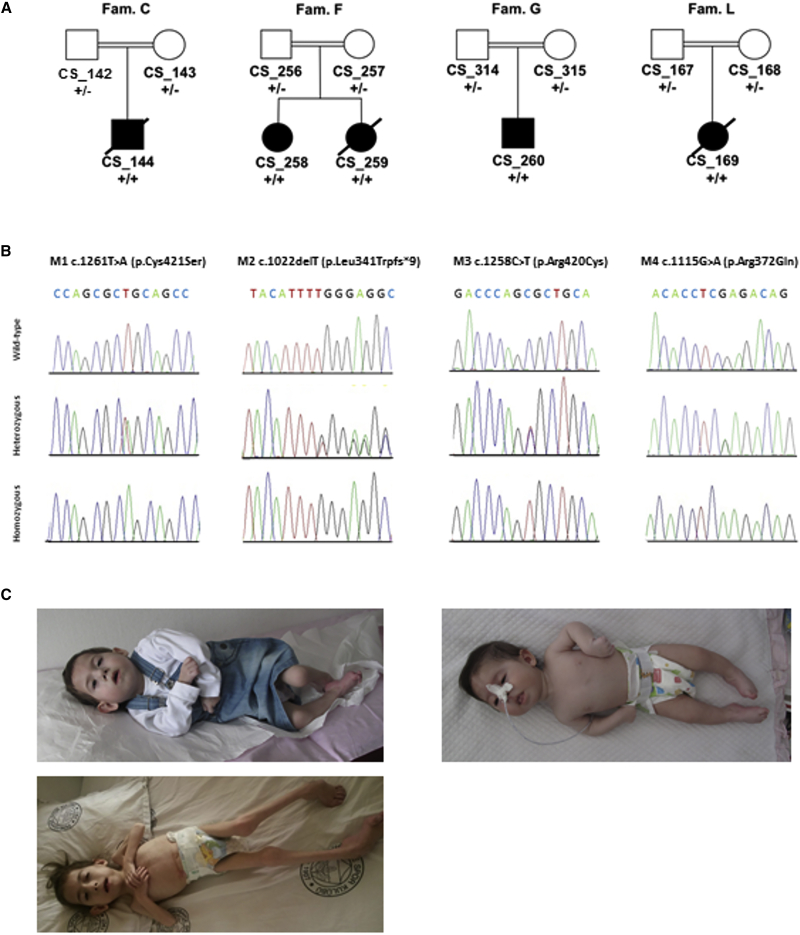
Rank 1 Families Selected for Exome Sequencing and Sanger Sequencing of the Four KLHL7 Mutations Found (A) Family pedigrees of individuals with KLHL7 mutations. Symbols and colors are defined as follows: square, male; circle, female; white, unaffected; dot, unaffected carrier; black, affected. (B) Sanger sequencing of four KLHL7 mutations found in the four Turkish consanguineous families. Mutation status of KLHL7 is indicated beneath symbols for each subject: +/−, heterozygous carriers; +/+, homozygous for KLHL7 mutation. Panels shows wild-type, heterozygous, and homozygous status for M1 (c.1261T>A [p.Cys421Ser]), M2 (c.1022delT [p.Leu341Trpfs9]), M3 (c.1258C>T [p.Arg420Cys]), and M4 (c.1115G>A [p.Arg372Gln]), respectively. (C) Clinical features of CS_258 (top left at the age of 3 years and 10 months and bottom left at the age of 7 years old) and CS_259 (right at the age of 5 months) from family F. Written informed consent for publication of their clinical images was obtained from their parent.
Figure 2
Figure 2
KLHL7 Protein Structure and In Silico Analysis of the Mutants Found in CS/CISS1 Phenotype (A) Schematic representation of the KLHL7 protein. Substitutions reported here and in Friedman et al. are indicated. The corresponding positions are referred to the KLHL7 splice isoform 1. (B) Protein alignment of the KLHL7 KELCH domain. All substitutions are marked in red with an asterisk. Position indicated as follows: asterisk (), identical; colon (:), strongly conserved; period (.), conserved; stabilized loops underlined. Sequence data used from Uniprot: human, Q8IXQ5; bovine (Bos taurus), Q0VCQ5; frog (Xenopus tropicalis), F6UPT8; bird (Gallus gallus), Q5ZI33; fly (Musca domestica), T1PLA9; worm (Caenorhabditis remanei), E3MGH6; plant (Oryza sativa), Q84S70; KEAP1: human Kelch-like ECH-associated protein 1, Q14145. (C) Structure of human KLHL7 Kelch domain (PDB: 3II7) in schematic representation with substitutions p.Arg372Gln and p.Arg420Cys involved in salt bridges (stabilized loops in dark green); p.Cys421Ser with partial exposition to the solvent.
Figure 3
Figure 3
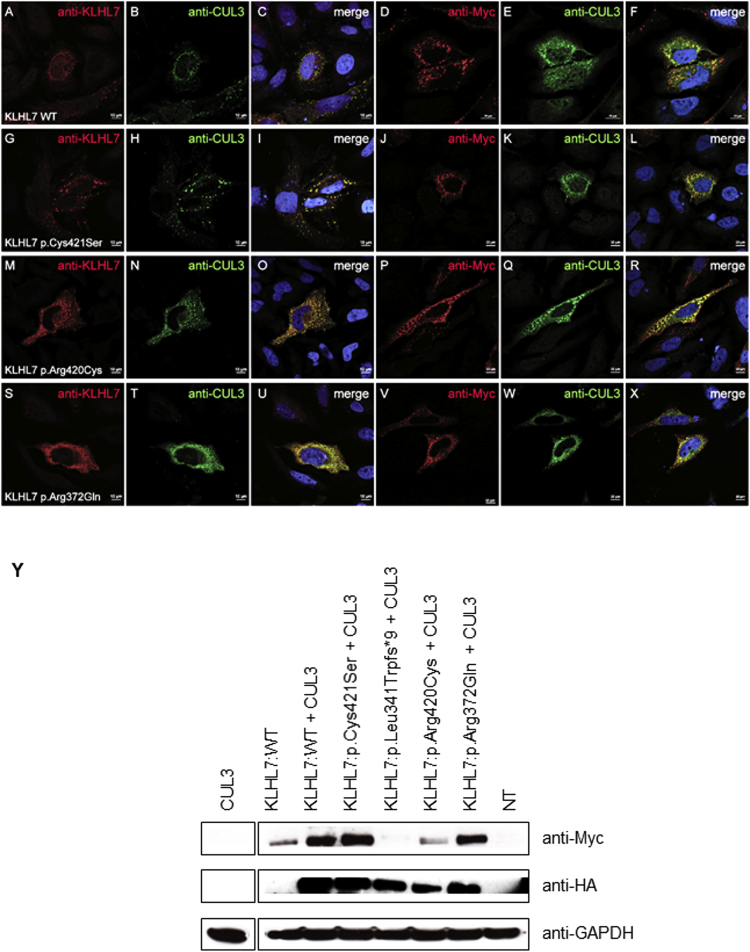
Subcellular Localization of the KLHL7 Mutants Found in CS/CISS1 Phenotype and Their Co-localization with CUL3 (A–X) HeLa cells cultured on coverslips were transfected with plasmids encoding either KLHL7:WT (A–F), KLHL7:p.Cys421Ser (G–L), KLHL7:p.Arg420Cys (M–R), KLHL7:p.Arg372Gln (S–X), and HA-CUL3 (kindly donated by Prof. Chiba). The cells were then fixed and stained with either anti-KLHL7 (Abnova Corp., cat# H00055975-B01P, RRID: AB_1576675; dilution 1:200) or anti-Myc (Abcam cat# ab18185, RRID: AB_444307; dilution 1:1,000) and anti-CUL3 antibodies (Bethyl cat# A301-109A, RRID: AB_873023; dilution 1:250). The nucleus was stained with DAPI. Confocal microscopy analysis shows KLHL7:WT and mutants in red and CUL3 in green. Scale bars represent 10 μm. (Y) HeLa cells were transfected with plasmids encoding either KLHL7:WT, KLHL7:p.Cys421Ser, KLHL7:p.Leu341Trpfs9, KLHL7:p.Arg420Cys, KLHL7:p.Arg372Gln, and HA-CUL3, and the cell lysates were immunoblotted with anti-Myc, anti-HA, and anti-GAPDH. NT = not transfected.
Figure 4
Figure 4
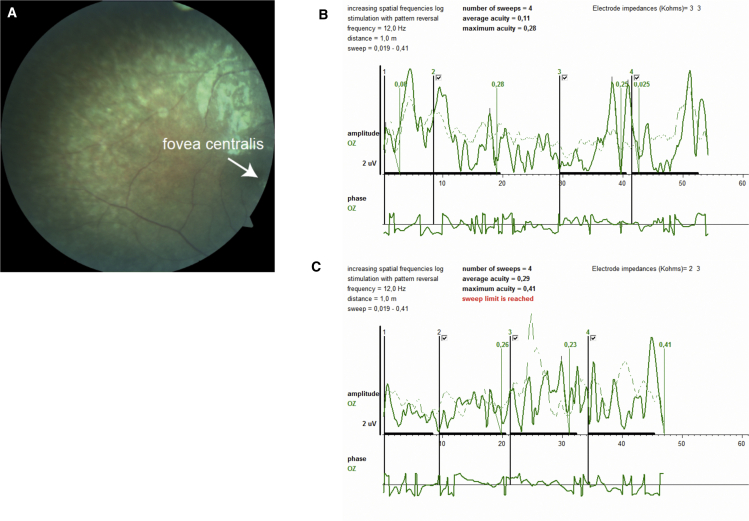
Pigmentary Retinopathy and Loss of Visual Acuity in CS_258 (A) Fundus photography taken by digital Fundus Camera (Carl Zeiss Meditec, VISUCAM 500) showed retinal pigmentary changes, and an abnormal appearance of the macula with attenuated arteriolar vessels (the arrow indicates the fovea centralis). (B and C) Left (B) and right (C) eye electrophysiological examination done to assess visual function of the proband: sVEP (sweep visual evoked potential) was performed 1 m from the optoelectronic stimulator (Metrovision-Vision Monitor). Potential for mean and maximum visual acuity in both eyes was obtained from sVEP recordings. A VEP produced by a pattern stimulus that is altered at a high temporal frequency rate between 5 and 15 Hz was obtained. Recorded amplitudes were consistent with an equivalent Snellen visual acuity of 0.11 (mean) and 0.28 (maximal) for the left eye and 0.29 (mean) and 0.41 (maximal) for the right eye. The sVEP shows maximal amplitude values in four phases corresponding to Snellen equivalent. Maximal visual acuity and mean visual acuity for the left eye was consistent with 0.28 and 0.11, respectively (B). Maximum visual acuity and mean visual acuity for the right eye was consistent with 0.41 and 0.29, respectively (C).

References

    1. Crisponi L., Crisponi G., Meloni A., Toliat M.R., Nurnberg G., Usala G., Uda M., Masala M., Hohne W., Becker C. Crisponi syndrome is caused by mutations in the CRLF1 gene and is allelic to cold-induced sweating syndrome type 1. Am. J. Hum. Genet. 2007;80:971–981. - PMC - PubMed
    1. Dagoneau N., Bellais S., Blanchet P., Sarda P., Al-Gazali L.I., Di Rocco M., Huber C., Djouadi F., Le Goff C., Munnich A., Cormier-Daire V. Mutations in cytokine receptor-like factor 1 (CRLF1) account for both Crisponi and cold-induced sweating syndromes. Am. J. Hum. Genet. 2007;80:966–970. - PMC - PubMed
    1. Forger N.G., Prevette D., deLapeyrière O., de Bovis B., Wang S., Bartlett P., Oppenheim R.W. Cardiotrophin-like cytokine/cytokine-like factor 1 is an essential trophic factor for lumbar and facial motoneurons in vivo. J. Neurosci. 2003;23:8854–8858. - PMC - PubMed
    1. Heinrich P.C., Behrmann I., Haan S., Hermanns H.M., Müller-Newen G., Schaper F. Principles of interleukin (IL)-6-type cytokine signalling and its regulation. Biochem. J. 2003;374:1–20. - PMC - PubMed
    1. Piras R., Chiappe F., Torraca I.L., Buers I., Usala G., Angius A., Akin M.A., Basel-Vanagaite L., Benedicenti F., Chiodin E. Expanding the mutational spectrum of CRLF1 in Crisponi/CISS1 syndrome. Hum. Mutat. 2014;35:424–433. - PubMed

Publication types

MeSH terms

Supplementary concepts