


doi: 10.1080/87565641.2016.1195833.
Neural Correlates of Response Inhibition in Adolescents Prospectively Predict Regular Tobacco Smoking
Affiliations
- PMID: 27392089
- PMCID: PMC4993600
- DOI: 10.1080/87565641.2016.1195833
Item in Clipboard
Neural Correlates of Response Inhibition in Adolescents Prospectively Predict Regular Tobacco Smoking
Dev Neuropsychol.
2016 Jan-Mar.
Abstract
Inhibitory deficits have been widely reported in addiction; however, it remains unclear whether such deficits represent a determinant or a consequence of substance use. Here we show, using a prospective longitudinal design, that developmental abnormalities in the neural correlates of response inhibition in adolescents increase the risk for subsequent cigarette smoking. Reduced No-Go P3 amplitude, delayed latency of Go P3 peak, and reduced synchrony of neuronal oscillations at age 14 prospectively predicted regular smoking at age 18. The present findings suggest that functional brain correlates of response inhibition represent a developmental marker of risk for future substance abuse.
Figures

The cued Go/No-Go Continuous Performance Task (CPT). The letter O serves as a warning cue alerting the subject about the impending Go stimulus and thus creates a response prepotency. An X following O represents a Go stimulus that requires a speeded response; any other letter following O is a No-Go stimulus. Go and No-Go stimuli (O-X and O-non-X combinations, respectively) occur in a pseudo-random order with an equal probability (40 combinations of each type out of 400 letters in total; all other letters represent neutral distracters). Thus, the relatively rare Go stimulus (10% of all letters) in this task is similar to an oddball stimulus in a classical oddball task. Equal probability of Go and No-Go stimuli allows to avoid the confounding of the No-Go effect with an oddball effect.
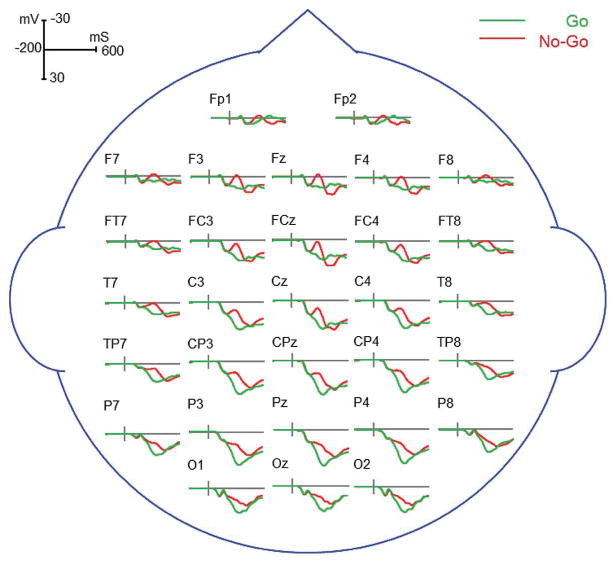
ERPs during the Go/No-Go task (top view of the head, nose up). Voltage negativity is plotted up, positivity is down. The vertical line indicates the stimulus onset. ERPs in Go trials (green line) are superimposed on the ERPs in the No-Go trials (red line) to facilitate comparison between conditions. Note the “anteriorization” of the P3 potential: In the Go condition, which is similar to the classic “oddball” condition, the P3 component peaks at the mid-parietal (Pz) area, whereas in the No-Go condition P3 is attenuated in parietal areas and increased in central and frontal areas, peaking at Cz.
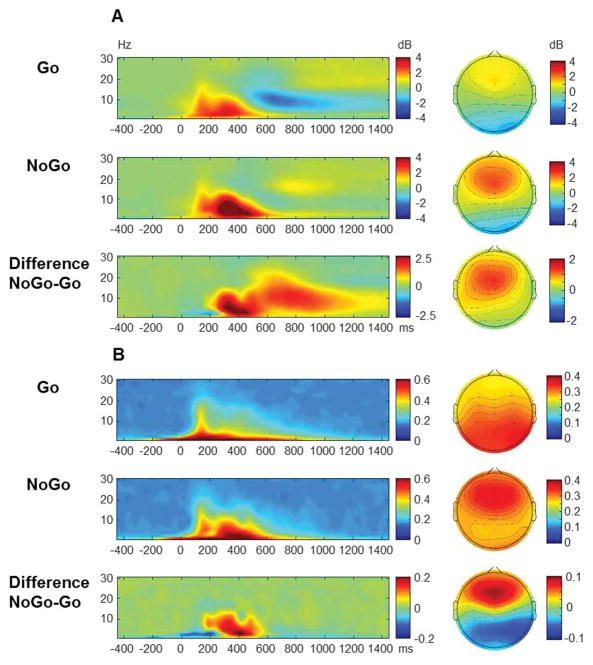
Event-related neuronal oscillations in the Go/No-Go task: increased power and synchrony in the No-Go relative to Go condition in the midline frontocentral area (FCz). A. Event-Related Spectral Perturbations (ERSP): time course of changes in the spectral power of neuronal oscillations at different frequencies elicited by Go and No-Go stimuli relative to the pre-stimulus baseline. Horizontal axis: time in milliseconds (ms); 0 indicates the stimulus onset. Vertical axis: frequency, Hz. Color scale shows the change relative to the baseline in decibels (dB). Topographical maps (top view of the head, nose up) show the distribution of the mean values extracted from the region of interest (250–400 ms, 8–13 Hz). B. Inter-Trial Coherence (ITC) shows changes in neural synchrony (phase consistency of oscillations across trials).
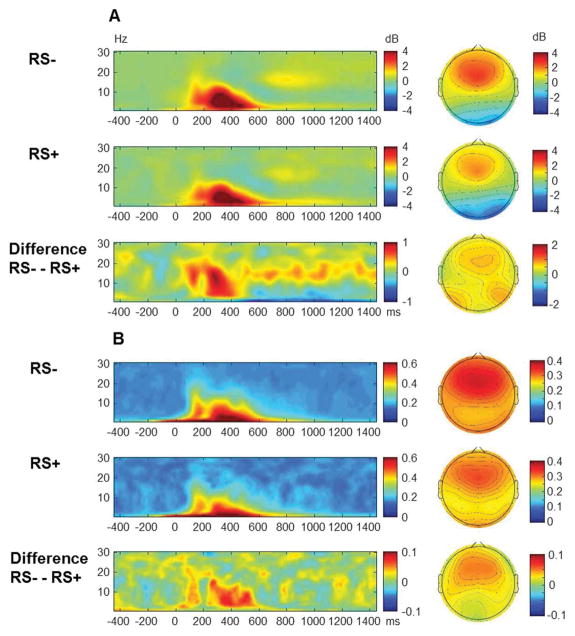
Regular smokers show attenuated power and reduced synchrony of event-related neuronal oscillations in No-Go trials in the midline fronto-central area. A. Event-Related Spectral Perturbations (ERSP) assessed at age 14 in individuals with (RS+) and without (RS-) a history of regular smoking at age 18. The lower panel shows areas of significant RS− - RS+ differences in theta, alpha, and beta1 frequency bands. Topographical maps (top view of the head, nose up) show the distribution of the mean values extracted from the region of interest (250–400 ms, 8–13 Hz). B. Inter-Trial Coherence (ITC) shows group differences in neural synchrony (phase consistency of oscillations across trials).
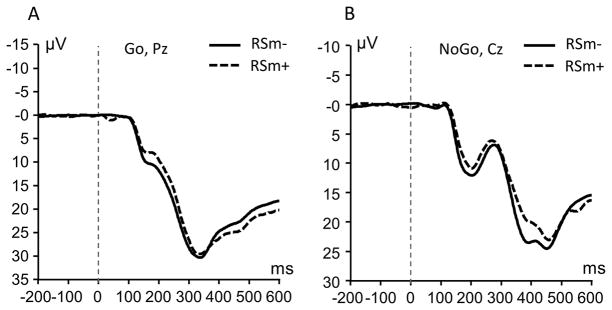
Event-related potentials (ERPs) in the Go/No-Go task assessed at age 14. A. Go trials, mid-parietal area (Pz). B. No-Go trials, mid-central area (Cz). RSm+ and RSm− represent grand-averaged waveforms for participants with and without history of regular smoking by age 18, respectively. A vertical dashed line at zero time indicate the onset of the stimuli. Note that peak and latency of grand-averaged waveform provides only an approximate representation of the averages of individual peaks and latencies (see Figure 6).

Group differences in event-related brain activity at age 14. Future regular smokers show (A) reduced amplitude of the No-Go P3 component, (B) delayed latency of the Go P3 peak, (C) attenuated power of theta-band oscillations in No-Go trials, and (D) reduced theta-band neural synchrony in the No-Go trials. Error bars represent standard error of the mean; *p < 0.05. **p < 0.01.
References
-
- Anokhin AP, Heath AC, Myers E. Genetics, prefrontal cortex, and cognitive control: A twin study of event-related potentials in a response inhibition task. Neurosci Lett. 2004;368:314–318. - PubMed
-
- Anokhin AP, Lutzenberger W, Nikolaev A, Birbaumer N. Complexity of electrocortical dynamics in children: developmental aspects. Dev Psychobiol. 2000;36:9–22. - PubMed
-
- Baumeister S, Hohmann S, Wolf I, Plichta MM, Rechtsteiner S, Zangl M, Ruf M, Holz N, Boecker R, Meyer-Lindenberg A, Holtmann M, Laucht M, Banaschewski T, Brandeis D. Sequential inhibitory control processes assessed through simultaneous EEG-fMRI. NeuroImage. 2014;94:349–359. - PubMed
-
- Bekker EM, Kenemans JL, Verbaten MN. Electrophysiological correlates of attention, inhibition, sensitivity and bias in a continuous performance task. Clin Neurophysiol. 2004;115:2001–2013. - PubMed
Publication types
MeSH terms
Grants and funding
LinkOut - more resources
Full Text Sources
Other Literature Sources
Medical
