Review
. 2016 Sep;35(3):347-76.
doi: 10.1007/s10555-016-9629-x.

Origins, structures, and functions of circulating DNA in oncology

Affiliations
Review

Origins, structures, and functions of circulating DNA in oncology

A R Thierry et al. Cancer Metastasis Rev. 2016 Sep.

Abstract

While various clinical applications especially in oncology are now in progress such as diagnosis, prognosis, therapy monitoring, or patient follow-up, the determination of structural characteristics of cell-free circulating DNA (cirDNA) are still being researched. Nevertheless, some specific structures have been identified and cirDNA has been shown to be composed of many "kinds." This structural description goes hand-in-hand with the mechanisms of its origins such as apoptosis, necrosis, active release, phagocytosis, and exocytose. There are multiple structural forms of cirDNA depending upon the mechanism of release: particulate structures (exosomes, microparticles, apoptotic bodies) or macromolecular structures (nucleosomes, virtosomes/proteolipidonucleic acid complexes, DNA traps, links with serum proteins or to the cell-free membrane parts). In addition, cirDNA concerns both nuclear and/or mitochondrial DNA with both species exhibiting different structural characteristics that potentially reveal different forms of biological stability or diagnostic significance. This review focuses on the origins, structures and functional aspects that are paradoxically less well described in the literature while numerous reviews are directed to the clinical application of cirDNA. Differentiation of the various structures and better knowledge of the fate of cirDNA would considerably expand the diagnostic power of cirDNA analysis especially with regard to the patient follow-up enlarging the scope of personalized medicine. A better understanding of the subsequent fate of cirDNA would also help in deciphering its functional aspects such as their capacity for either genometastasis or their pro-inflammatory and immunological effects.

Keywords: Cancer; Cell-free circulating DNA; Functions; Origins; Structures.


Conflict of interest statement

The authors declare that they have are no conflicts of interest.

Figures

Fig. 1
Fig. 1
The first identification of extracellular nucleic acids in human blood compartment by Mandel and Metais in 1948 (adapted from Mandel and Métais [8])
Fig. 2
Fig. 2
Potential vesicular structures of circulating DNA (from Rykova et al. [48])
Fig. 3
Fig. 3
Distinct cellular origins of circulating DNA found in the blood of cancer patients
Fig. 4
Fig. 4
Circulating DNA levels correlate with tumor burden. a SW620 xenografted mouse model. Quantification by Q-PCR of cirDNA derived from malignant and non-malignant cells in the mouse model. Tumor weight is represented by the red curve (right axis). Concentration of cirDNA derived from mouse (normal) cells (mWT cirDNA) in control (not grafted) mice (mouse nos. 1–3) and in athymic nude mice (mouse nos. 4–11) xenografted with the SW620 colorectal human cells, determined using a primer set targeting a mouse KRAS second intron WT sequence. b SW620 xenografted mouse model. Concentration of cirDNA derived from human cells (hWT cirDNA) using a primer set targeting a human KRAS second intron WT sequence. c SW620 xenografted mouse model. Concentration of cirDNA derived from human cells (hKRASm cirDNA) using a primer set targeting a human KRAS second exon sequence that contains the G12V point mutation present in SW620. d Clinical mCRC plasma samples. Correlation between total cirDNA level and mutant cirDNA level in 4 KRAS mutant mCRC patients (adapted from Mouliere et al [68] and El Messaoudi  et al. [74]) (color figure online)
Fig. 5
Fig. 5
Strong interindividual heterogeneity of cirDNA mutation load values (mutant allele frequencies) (adapted from Mouliere et al. [68])
Fig. 6
Fig. 6
Correlation of circulating DNA parameters and overall survival. Overall survival analysis on a set of mCRC patients with KRAS or BRAF mutation. a Kaplan-Meier survival curve and log-rank test according to mA (mutant cirDNA concentration) determined by cirDNA analysis dichotomized around the median (3.06 ng/mL, n = 43). b Kaplan-Meier survival curve and log-rank test according to mA% (mutation load) dichotomized to the first tertile (4.14 %) determined by cirDNA analysis (n = 43). c Kaplan-Meier survival curve and log-rank test according to Ref A KRAS (total cirDNA concentration) dichotomized around the second tertile (107.0 ng/mL, n = 43). d Kaplan-Meier survival curve and log-rank test according to DNA integrity index (DII) determined by cirDNA analysis dichotomized around the second tertile (0.20, n = 43) (from El Messaoudi et al [74])
Fig. 7
Fig. 7
Neutrophil extracellular DNA traps. a Klebsiella pneumonia bacterium (pink) snared in a neutrophil extracellular trap (green) in a mouse lung. Credit: Papayannopoulos et al. (image by Volker Brinkman and Abdul Hakkim). b Immunostaining double-labeling of neutrophils releasing NETs isolated from tumor-bearing mice following 1 h activation with calcium ionophore (scale bar = 5 μm) (from Demers and Wagner 224)
Fig. 8
Fig. 8
Vizualization of circulating DNA by atomic force microscopy. Circulating DNA extracted from a metastatic colorectal cancer patient plasma sample vizualized by atomic force microscopy (AFM) and compared to SW620 genomic DNA extracted in the same conditions than circulating DNA (adapted from Mouliere et al. 69)
Fig. 9
Fig. 9
Malignant-derived circulating DNA is more fragmented than non-malignant derived circulating DNA. SW620 xenografted mouse model: a malignant (black bars) and non-malignant (hatched bars) cirDNA mean concentrations are expressed as ng/ml of plasma; the bar height is the sum of malignant and non-malignant cirDNA concentrations (estimated as the total ctDNA concentration). CirDNA was quantified by amplifying WT KRAS exon 2 sequences of increasing size: 60, 100, 150, 200, 250, 350, and 400 bp. b Fractional fragment size distribution of cirDNA amount from malignant and non-malignant cirDNA in xenografted mice and control cirDNA in non-xenografted mice. The cirDNA amount was arbitrarily estimated for the 60–100-, 100–150-, 150–400-, and >400-bp fragment size ranges. Clinical samples: c comparison of the cirDNA fragment size distribution of mutant (black bars) and WT (gray bars) cirDNA in four plasma samples from KRAS mutant mCRC patients. Mutant cirDNA was quantified by amplifying mutant KRAS exon 2 sequences of increasing size from 60 to 390 bp. Non-mutant cirDNA was quantified by amplifying WT KRAS exon 2 sequences of increasing size from 60 to 390 bp (adapted from Mouliere et al. [68, 72])
Fig. 10
Fig. 10
a Size distribution of malignant-derived circulating DNA. Ninety hepatocellular carcinoma patient plasma samples were examined by paired-end massively parallel sequencing. Different malignant-derived fractional concentrations were determined in HCC plasma samples (from <2 to >8 %). While size distribution peaks at 166 bp, it shifted progressively to the shorter size when malignant-derived cirDNA fraction increases (from Jiang et al. [107]). b Size distribution of circulating DNA in plasma sample from healthy individual as determined by next-generation sequencing from a single-stranded library preparation. Short fragments of 50–120 bp are considerably enriched as compared to conventional library preparation (from Snyder et al. [109])
Fig. 11
Fig. 11
CirDNA structure, origin, and function as regard to its analysis toward clinical application. Physicochemical analysis of cirDNA, i.e., analysis of its sequence, its quantity, and its structure brings qualitative and quantitative information useful for theragnostics, diagnostic, prognosis, and follow-up in the context of cancer management care. Analysis of the functions of cirDNA acting as an intercellular messenger, an immune activator, and a mediator in metastatic progression provides useful information for the follow-up of cancer patients by cirDNA analysis
Fig. 12
Fig. 12
Demonstration of transmission of inherited characters by hybridization in eggplants. Heterografts between S. melongena variety Long violet (mentor plant) and the variety White round (pupil plant) (from Stroun [16])
Fig. 13
Fig. 13
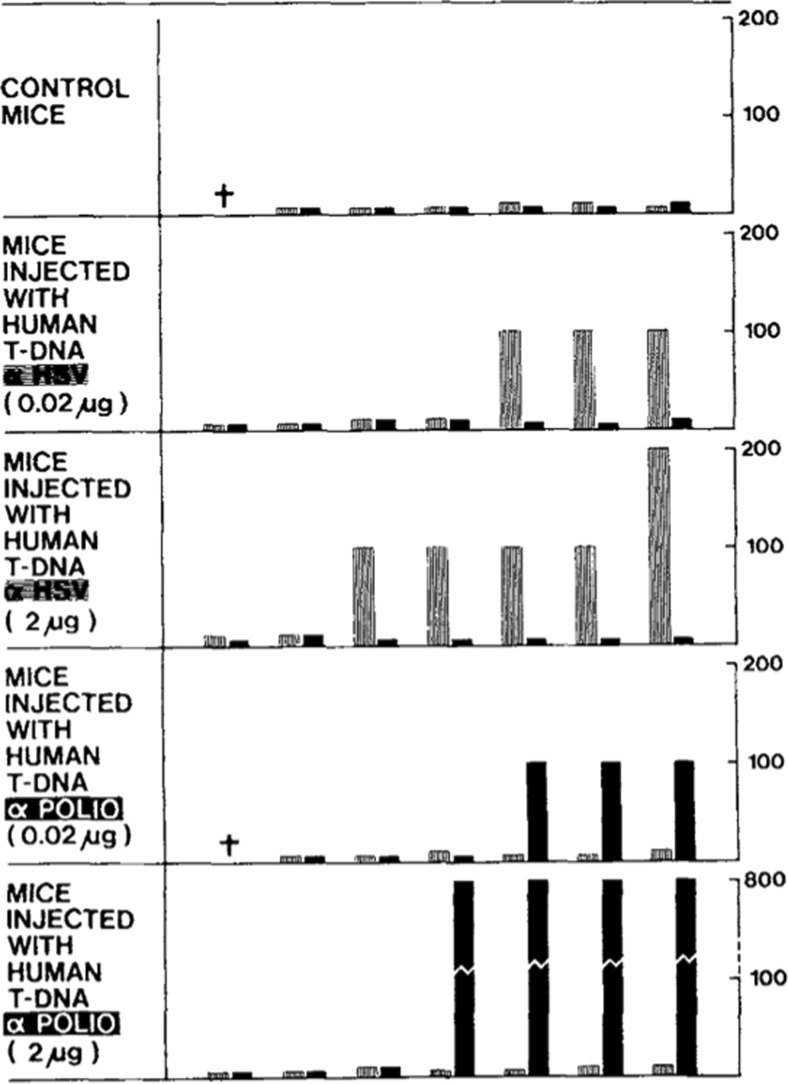
Representation of the main results showing the involvement of cirDNA released by T cells in the humoral immune response in vivo. Neutralizing activity of the serum of nude mice injected with DNA released by human T cells previously exposed to UV inactivated HSV or polio virus. Mice were injected with either 0.02 or 2 μg of human DNA. Control mice remained uninjected. After 5 days, the mice were killed and their serum was collected and frozen until tested. Numbers in ordinate represent highest dilutions of serum still presenting neutralizing activity (more than 3 units below virus control). Neutralization of HSV (hatched area); neutralization of polio (solid area). Human released T-DNA (α HSV) or T-DNA (α Polio) = DNA released by HSV or polio virus-exposed human T-lymph (from Anker et al. [184])
Fig. 14
Fig. 14
Schematic representation of the observing genometastasis. Plasma from colon cancer patients, in which a KRAS mutation had been detected, had been added to cultures of NIH/3T3 cells. Human KRAS DNA was detected soon afterward in these cells. Treated cells were injected, subsequently, into NOD-SCID mice and macroscopic tumors were generated. After sacrifice, human mutant KRAS sequences were detected in primary tumors, plasma, lungs, and livers of injected animals (from Garcia Olmo et al. [190])
Fig. 15
Fig. 15
Induction of double-strand DNA breaks and apoptosis by cirDNA into NIH/3T3 cells. Induction of γ H2AX and active caspase-3 by fragmented circulating DNA (DNAfs) and circulating chromatin (Cfs) derived from healthy volunteers (red bars) and cancer patients (gray bars). In vitro analysis of γ H2AX and active caspase-3: NIH/3T3 cells (10 × 104) were treated with DNAfs and Cfs (5 ng DNA each) for 6 h for detection of γ-H2AX (left) and for 24 h for detection of active caspase-3 (right) by immunofluorescence. For γ-H2AX (left-hand panel), 300 nuclei were counted and the percentage of nuclei showing positive foci were calculated and analyzed by chi-squared test. For active caspase-3 (right-hand panel), 200 cells were counted and the percentage of cells showing positive fluorescent signals were calculated and analyzed by chi-squared test (from Mittra et al. [195]) (color figure online)
Fig. 16
Fig. 16
Interaction between DNA and TLR9. Class III phosphatidylinositol 3-kinase (PI3K) facilitates the internalization of CpG oligodeoxynucleotides (ODNs) into endosomal vesicles that contain Toll-like receptor 9 (TLR9). The interaction between CpG DNA and TLR9 transduces an intracytoplasmic activation signal. The signal initiates with the recruitment of myeloid differentiation primary response gene 88 (MYD88) to the Toll–interleukin-1 receptor (TIR) domain of TLR9, followed by activation of the IRAK–TRAF6 complex. This leads to the activation of both the mitogen-activated protein kinase (MAPK: JNK1/2 and p38) and inhibitor of nuclear factor-kB (NF-kB) kinase (IKK) complexes, culminating in the upregulation of transcription factors, including NF-kB and activating protein 1 (AP1). ATF1, activating transcription factor 1; IRAK, IL-1 receptor-activated kinase; JNKK1, c-JUN N-terminal kinase (JNK) kinase 1; NIK, NF-kB-inducing kinase; TRAF6, tumor-necrosis factor receptor-associated factor 6 (from Klinman [215])
Fig. 17
Fig. 17
Involvement of mitochondrial cirDNA in the inflammatory process. Similar to the release of bacterial DNA following sepsis, the mitochondrial DNA released by severe trauma can also act through the Toll-like receptor 9 (TLR9) to activate neutrophils by activating p38 MAP kinase (MAPK). DAMPs damage-associated molecular patterns, PAMPs pathogen-associated molecular patterns. Adapted from © 2010 Nature Publishing Group Calfee, C. S. & Matthay, M. A. Clinical immunology: culprits with evolutionary ties. Nature 464, 41–42 (2010). All rights reserved
Fig. 18
Fig. 18
The metastasis suppression effect of RNase A or DNase I on Lewis lung carcinoma (LLC) metastatic mouse model. Typical histotopograms of lung lobes in the control and experimental groups treated with RNase A and DNase I. Hematoxylin and eosin staining. Arrows indicate large metastases. Bar corresponds to 5 mm (from Patutina et al. [228])
Fig. 19
Fig. 19
Real-time monitoring in the course of colorectal patients management care by cirDNA analysis. m mutant, WT wild type, MRD minimal residual disease, CDx companion diagnostics, CT chemotherapy, CRC colorectal cancer
Fig. 20
Fig. 20
Timeline of the main important discoveries about circulating DNA applications and functions

References

    1. Fleischhacker M, Schmidt B. Circulating nucleic acids (CNAs) and cancer--a survey. Biochimica et Biophysica Acta. 2007;1775(1):181–232. - PubMed
    1. Gahan PB, Swaminathan R. Circulating nucleic acids in plasma and serum. Recent developments. Annals of the New York Academy of Sciences. 2008;1137:1–6. - PubMed
    1. Miescher F. Ueber die chemische Zusammensetzung der Eiterzellen. Medicinisch-chemische Untersuchungen. 1871;4:441–460.
    1. Levene PA, Haller HL. On the configurational relationship of 3-Chlorobutyric and 3-Hydroxybutyric acids. Science (New York, N.Y.) 1929;69(1776):47. - PubMed
    1. Beadle GW, Tatum EL. Genetic Control of Biochemical Reactions in Neurospora. Proceedings of the National Academy of Sciences of the United States of America. 1941;27(11):499–506. - PMC - PubMed

MeSH terms