


Inhibition of Lithium-Sensitive Phosphatase BPNT-1 Causes Selective Neuronal Dysfunction in C. elegans
- PMID: 27397889
- PMCID: PMC4961587
- DOI: 10.1016/j.cub.2016.05.050
Inhibition of Lithium-Sensitive Phosphatase BPNT-1 Causes Selective Neuronal Dysfunction in C. elegans
Abstract
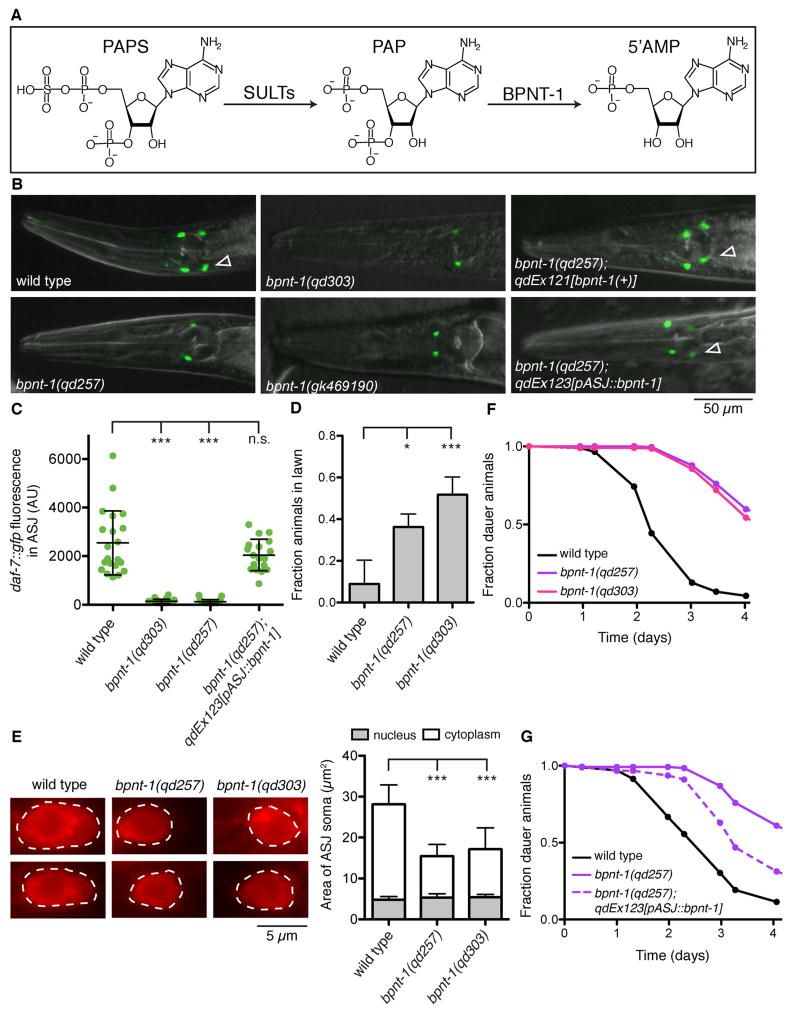
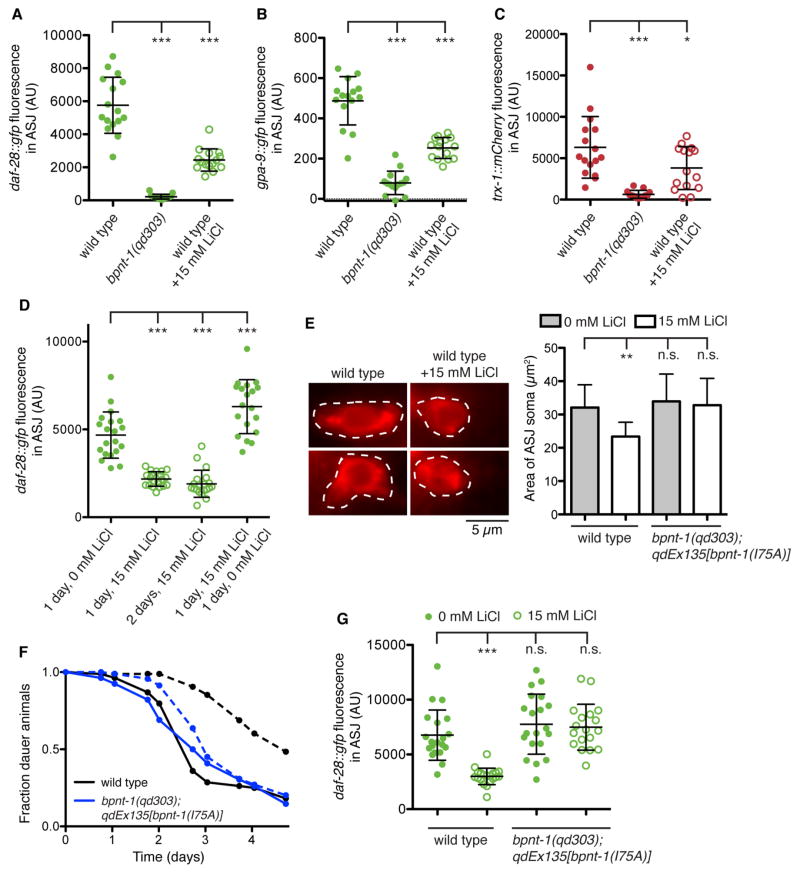
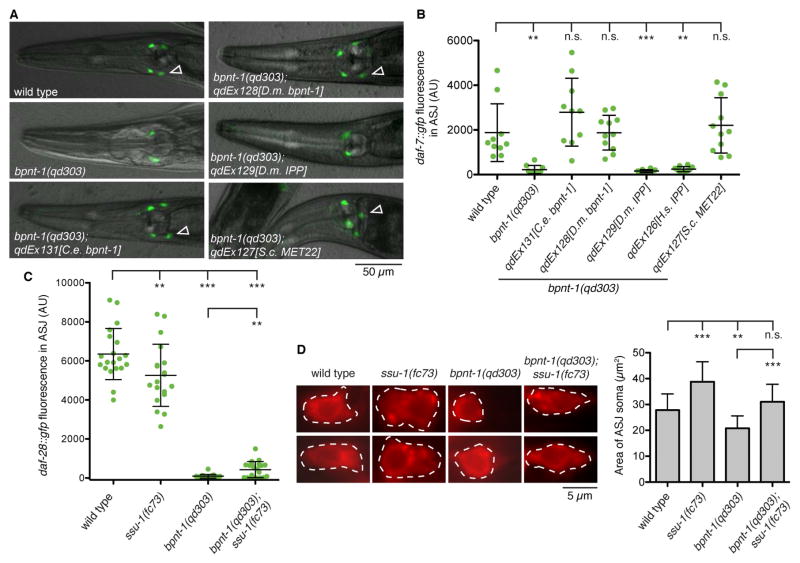
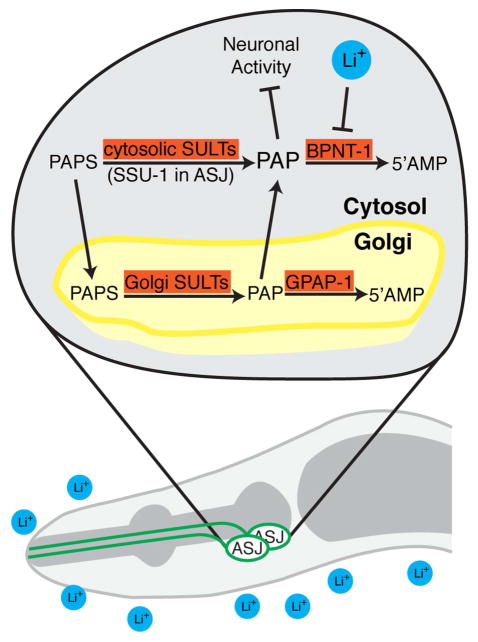
Lithium has been a mainstay for the treatment of bipolar disorder, yet the molecular mechanisms underlying its action remain enigmatic. Bisphosphate 3'-nucleotidase (BPNT-1) is a lithium-sensitive phosphatase that catalyzes the breakdown of cytosolic 3'-phosphoadenosine 5'-phosphate (PAP), a byproduct of sulfation reactions utilizing the universal sulfate group donor 3'-phosphoadenosine 5'-phosphosulfate (PAPS) [1-3]. Loss of BPNT-1 leads to the toxic accumulation of PAP in yeast and non-neuronal cell types in mice [4, 5]. Intriguingly, BPNT-1 is expressed throughout the mammalian brain [4], and it has been hypothesized that inhibition of BPNT-1 could contribute to the effects of lithium on behavior [5]. Here, we show that loss of BPNT-1 in Caenorhabditis elegans results in the selective dysfunction of two neurons, the bilaterally symmetric pair of ASJ chemosensory neurons. As a result, BPNT-1 mutants are defective in behaviors dependent on the ASJ neurons, such as dauer exit and pathogen avoidance. Acute treatment with lithium also causes dysfunction of the ASJ neurons, and we show that this effect is reversible and mediated specifically through inhibition of BPNT-1. Finally, we show that the selective effect of lithium on the nervous system is due in part to the limited expression of the cytosolic sulfotransferase SSU-1 in the ASJ neuron pair. Our data suggest that lithium, through inhibition of BPNT-1 in the nervous system, can cause selective toxicity to specific neurons, resulting in corresponding effects on behavior of C. elegans.
Copyright © 2016 Elsevier Ltd. All rights reserved.
Figures
References
-
- Murguía JR, Bellés JM, Serrano R. A salt-sensitive 3′ (2′),5′-bisphosphate nucleotidase involved in sulfate activation. Science. 1995;267:232–234. - PubMed
-
- Spiegelberg BD, Xiong JP, Smith JJ, Gu RF, York JD. Cloning and characterization of a mammalian lithium-sensitive bisphosphate 3′-nucleotidase inhibited by inositol 1,4-bisphosphate. J Biol Chem. 1999;274:13619–13628. - PubMed
-
- López-Coronado JM, Bellés JM, Lesage F, Serrano R, Rodriguez PL. A novel mammalian lithium-sensitive enzyme with a dual enzymatic activity, 3′-phosphoadenosine 5′-phosphate phosphatase and inositol-polyphosphate 1-phosphatase. J Biol Chem. 1999;274:16034–16039. - PubMed
-
- Spiegelberg BD, Cruz Dela J, Law T-H, York JD. Alteration of lithium pharmacology through manipulation of phosphoadenosine phosphate metabolism. J Biol Chem. 2005;280:5400–5405. - PubMed
Publication types
MeSH terms
Substances
Grants and funding
LinkOut - more resources
Full Text Sources
Other Literature Sources
Research Materials
