


Health services and policy research in the first decade at the Canadian Institutes of Health Research
- PMID: 27398366
- PMCID: PMC4933636
- DOI: 10.9778/cmajo.20150045
Health services and policy research in the first decade at the Canadian Institutes of Health Research
Abstract
Background: Health services and policy research is the innovation engine of a health care system. In 2000, the Canadian Institutes of Health Research (CIHR) was formed to foster the growth of all sciences that could improve health care. We evaluated trends in health services and policy research funding, in addition to determinants of funding success.
Methods: All applications submitted to CIHR strategic and open operating grant competitions between 2001 and 2011 were included in our analysis. Age, sex, size of research team, critical mass, season, year and research discipline were retrieved from application information. A cohort of 4725 applicants successfully funded between 2001 and 2005 were followed for 5 years to evaluate predictors of continuous funding. Multivariate generalized estimating equation logistic regression was used to estimate predictors of funding success and sustained funding.
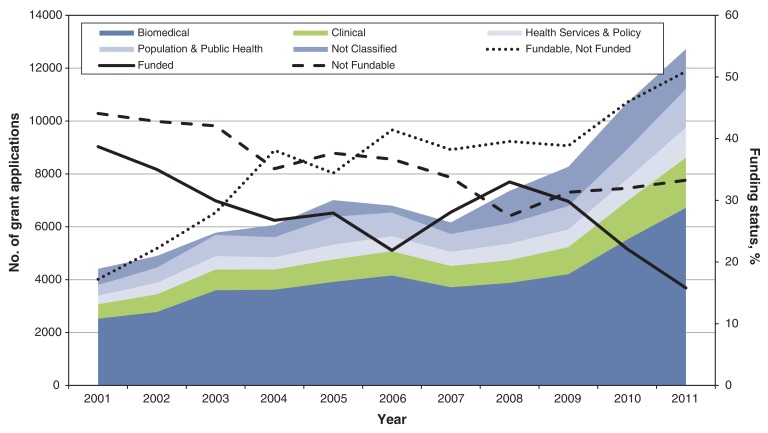
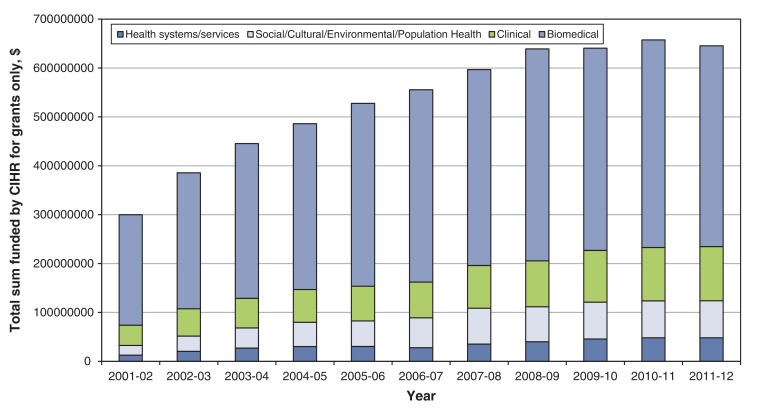
Results: Between 2001 and 2011, 80 163 applications were submitted to open and strategic grant competitions. Over time, grant applications increased from 327 to 1137 per year, and annual funding increased from $12.6 to $48.0 million. Grant applications from young male researchers were more likely to be funded than those from female researchers (odds ratio [OR] 1.40, 95% confidence interval [CI] 1.01-1.95), as were applications from larger research teams and institutions with a large critical mass. Only 24.0% of scientists whose first funded grant was in health services and policy research had sustained 5-year funding, compared with 52.8% of biomedical scientists (OR 0.34, 95% CI 0.24-0.49).
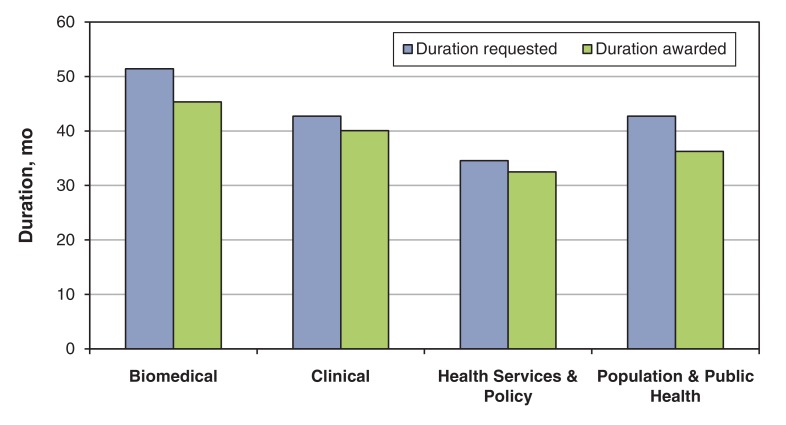
Interpretation: The CIHR has successfully increased the amount of health services and policy research in Canada. To enhance conditions for success, researchers should be encouraged to work in teams, request longer duration grants, resubmit unsuccessful applications and affiliate themselves with institutions with a greater critical mass.
Conflict of interest statement
Figures
References
-
- Scarbrough H, D'Andreta D, Evans S, et al. Southhampton (UK): NIHR Journals Library. Networked innovation in the health sector: comparative qualitative study of the role of Collaborations for Leadership in Applied Health Research and Care in translating research into practice. 2014. - PubMed
-
- Facing the facts: the impact of chronic disease in Canada. Geneva: World Health Organization. 2005. [accessed 2016 Jan. 8]. Available www.who.int/chp/chronic_disease_report/media/CANADA.pdf.
-
- Public Health Agency of Canada. Toward a healthy future: second report on the health of Canadians and strategies for population health: investing in the health of Canadians. Ottawa: Minister of Public Works and Government Services Canada. 2013. [accessed 2016 Jan. 8]. Available www.phac-aspc.gc.ca/ph-sp/determinants/determinants-eng.php.
LinkOut - more resources
Full Text Sources
Other Literature Sources
