


Effectiveness of Four Disinfectants against Ebola Virus on Different Materials
- PMID: 27399759
- PMCID: PMC4974520
- DOI: 10.3390/v8070185
Effectiveness of Four Disinfectants against Ebola Virus on Different Materials
Erratum in
-
Erratum: Smither, S.; et al. Effectiveness of Four Disinfectants against Ebola Virus on Different Materials. Viruses 2016, 8, 185.Viruses. 2016 Aug 4;8(8):217. doi: 10.3390/v8080217. Viruses. 2016. PMID: 27527208 Free PMC article.
Abstract
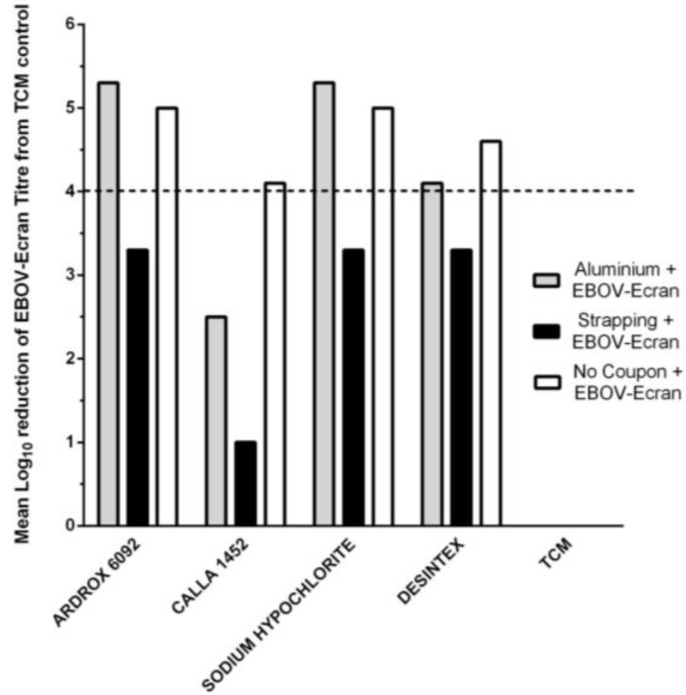
The West Africa Ebola virus (EBOV) outbreak has highlighted the need for effective disinfectants capable of reducing viral load in a range of sample types, equipment and settings. Although chlorine-based products are widely used, they can also be damaging to equipment or apparatus that needs continuous use such as aircraft use for transportation of infected people. Two aircraft cleaning solutions were assessed alongside two common laboratory disinfectants in a contact kill assay with EBOV on two aircraft relevant materials representative of a porous and non-porous surface. A decimal log reduction of viral titre of 4 is required for a disinfectant to be deemed effective and two of the disinfectants fulfilled this criteria under the conditions tested. One product, Ardrox 6092, was found to perform similarly to sodium hypochlorite, but as it does not have the corrosive properties of sodium hypochlorite, it could be an alternative disinfectant solution to be used for decontamination of EBOV on sensitive apparatus.
Keywords: Ebola virus; decontamination; disinfection; inactivation; safety; sodium hypochlorite.
Figures

References
-
- World Health Organization Situation Reports. [(accessed on 31 May 2016)]. Available online: http://www.who.int/csr/disease/ebola/situation-reports/archive/en/
-
- CDC Management of Patients with Suspected Viral Hemorrhagic Fever. [(accessed on 21 April 2016)]; Available online: http://www.cdc.gov/mmwr/preview/mmwrhtml/00037085.htm.
-
- CDC Interim Guidance for Managing Patients with Suspected Viral Hemorrhagic Fever in U.S. Hospitals. [(accessed on 21 April 2016)]; Available online: http://www.cdc.gov/HAI/pdfs/bbp/VHFinterimGuidance05_19_05.pdf.
Publication types
MeSH terms
Substances
LinkOut - more resources
Full Text Sources
Other Literature Sources
Medical
