. 2016 Jul 11;15(1):122.
doi: 10.1186/s12934-016-0520-9.

Revisiting overexpression of a heterologous β-glucosidase in Trichoderma reesei: fusion expression of the Neosartorya fischeri Bgl3A to cbh1 enhances the overall as well as individual cellulase activities

Affiliations

Revisiting overexpression of a heterologous β-glucosidase in Trichoderma reesei: fusion expression of the Neosartorya fischeri Bgl3A to cbh1 enhances the overall as well as individual cellulase activities

Xianli Xue et al. Microb Cell Fact. .

Abstract

Background: The filamentous fungus Trichoderma reesei has the capacity to secret large amounts of cellulase and is widely used in a variety of industries. However, the T. reesei cellulase is weak in β-glucosidase activity, which results in accumulation of cellobiose inhibiting the endo- and exo-cellulases. By expressing an exogenous β-glucosidase gene, the recombinant T. reesei cellulase is expected to degrade cellulose into glucose more efficiently.

Results: The thermophilic β-glucosidase NfBgl3A from Neosartorya fischeri is chosen for overexpression in T. reesei due to its robust activity. In vitro, the Pichia pastoris-expressed NfBgl3A aided the T. reesei cellulase in releasing much more glucose with significantly lower amounts of cellobiose from crystalline cellulose. The NfBgl3A gene was hence fused to the cbh1 structural gene and assembled between the strong cbh1 promoter and cbh1 terminator to obtain pRS-NfBgl3A by using the DNA assembler method. pRS-NfBgl3A was transformed into the T. reesei uridine auxotroph strain TU-6. Six positive transformants showed β-glucosidase activities of 2.3-69.7 U/mL (up to 175-fold higher than that of wild-type). The largely different β-glucosidase activities in the transformants may be ascribed to the gene copy numbers of NfBgl3A or its integration loci. The T. reesei-expressed NfBgl3A showed highly similar biochemical properties to that expressed in P. pastoris. As expected, overexpression of NfBgl3A enhanced the overall cellulase activity of T. reesei. The CBHI activity in all transformants increased, possibly due to the extra copies of cbh1 gene introduced, while the endoglucanase activity in three transformants also largely increased, which was not observed in any other studies overexpressing a β-glucosidase. NfBgl3A had significant transglycosylation activity, generating sophorose, a potent cellulase inducer, and other oligosaccharides from glucose and cellobiose.

Conclusions: We report herein the successful overexpression of a thermophilic N. fischeri β-glucosidase in T. reesei. In the same time, the fusion of NfBgl3A to the cbh1 gene introduced extra copies of the cellobiohydrolase 1 gene. As a result, we observed improved β-glucosidase and cellobiohydrolase activity as well as the overall cellulase activity. In addition, the endoglucanase activity also increased in some of the transformants. Our results may shed light on design of more robust T. reesei cellulases.

Keywords: Cellulase; DNA assembler; Neosartorya fischeri; Trichoderma reesei; β-Glucosidase.


Figures
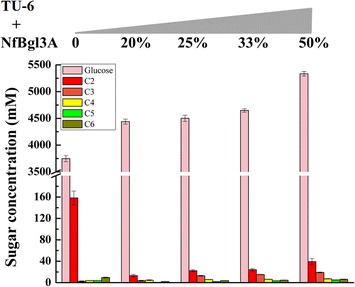
Fig. 1
Fig. 1
Supplementing with the P. pastoris-expressed NfBgl3A into the T. reesei cellulase enhanced release of glucose from crystalline cellulose. NfBgl3A was expressed in P. pastoris, purified, and added to TU-6 cellulase with increasing concentrations (0, 20, 25, 33, and 50 %, w/w). The enzymes were reacted with 20 mg/mL Avicel at 50 °C for 24 h. The released glucose and cellooligosaccharides were analyzed using HPAEC-PAD. C2-C6 represent cellobiose to cellohexaose, respectively
Fig. 2
Fig. 2
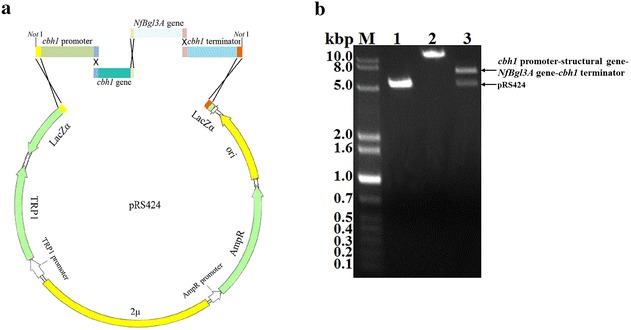
Construction of pRS-NfBgl3A using DNA assembler. a Schematic diagram showing one-step assembly of pRS-NfBgl3A. b Restriction digestion analysis of pRS-NfBgl3A by NotI. Lane M DNA molecular weight marker; lane 1 KpnI-linearized pRS424; lane 2 undigested pRS-NfBgl3A; lane 3 NotI-digested pRS-NfBgl3A
Fig. 3
Fig. 3
Transformation and expression of NfBgl3A in T. reesei. a Determination of NfBgl3A integration in the genome of T. reesei transformants by PCR using the primers Yz-Trchb1F/Yz-NfBgl3AR. The expected size is 445 bp, corresponding to a fragment spanning the joint region of cbh1 structural gene and NfBgl3A. Lane M DNA molecular mass marker; lane T1–T9, the transformants of T1–T9. b The β-glucosidase activities in the fermentation broth of TU-6 and six transformants
Fig. 4
Fig. 4
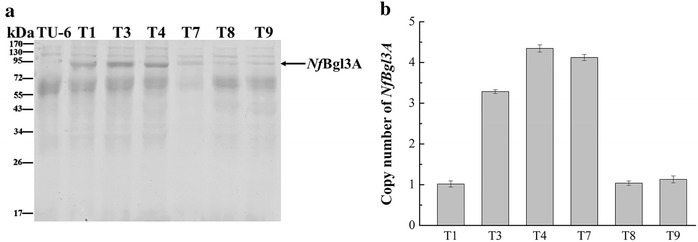
SDS-PAGE analysis of NfBgl3A expression and its copy numbers in the transformants. a SDS-PAGE analysis of the crude enzymes of TU-6 and the NfBgl3A transformants. The culture supernatants on day 5 post induction were used. b Determination of the NfBgl3A copy numbers by qPCR analysis
Fig. 5
Fig. 5
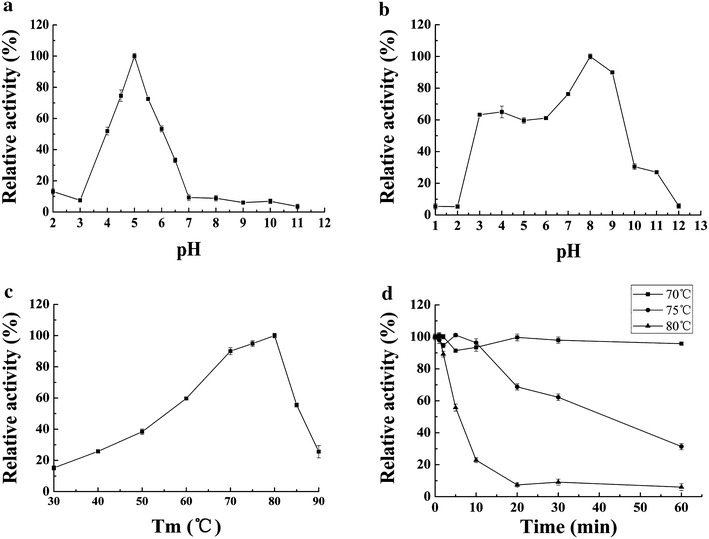
Biochemical characterization of NfBgl3A expressed in T. reesei. a Effect of pH on β-glucosidase activity. The enzyme assays were performed at 80 °C for 10 min. b pH stability. The crude NfBgl3A was pre-incubated without substrate at 37 °C for 1 h and then subjected to assay of the residual activity under standard conditions (pH 5.0, 80 °C, 10 min). c Effect of temperature on NfBgl3A activity. The assays were carried out at pH 5.0 for 10 min. d Thermostability. The crude NfBgl3A was pre-incubated in the McIlvaine buffer (pH 5.0) at 70, 75, or 80 °C and the residual β-glucosidase activities were measured
Fig. 6
Fig. 6
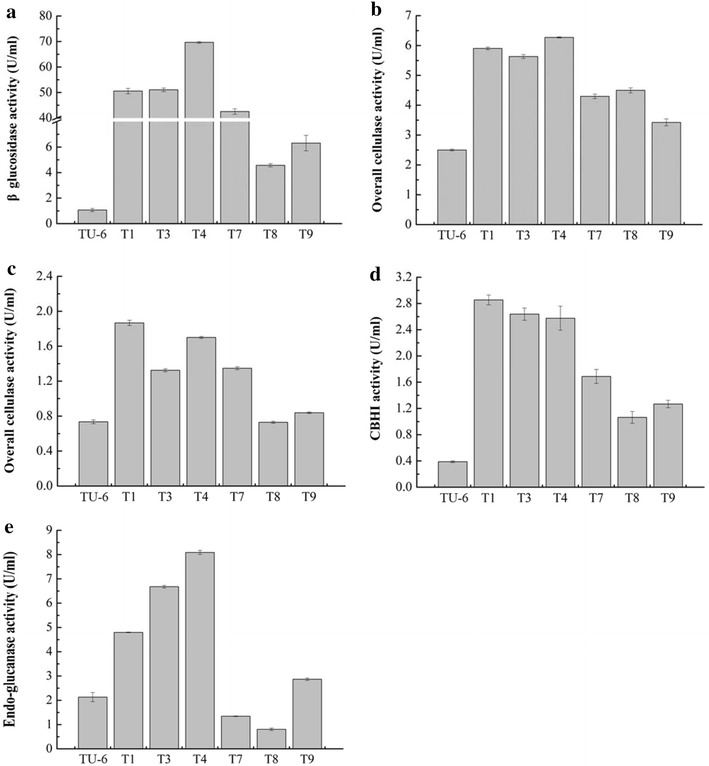
Overall and individual cellulase activities of TU-6 and the transformants. a The β-glucosidase activity. b, c The overall cellulase activities on Avicel (b) and filter paper (c), respectively. d CBHI activity as determined using MUC as the substrate. e The endo-glucanase activity using CMC-Na as the substrate
Fig. 7
Fig. 7
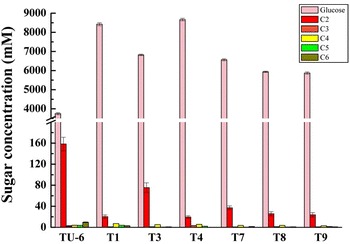
Hydrolysis of Avicel by TU-6 and its transformants as analyzed by HPAEC-PAD. The fermentation broth of strain TU-6 and its transformants harboring Nfbgl3A on day 6 post the induction was used to hydrolyze 20 mg/mL of Avicel. The reactions were carried out at 50 °C for 24 h. The released glucose and cellooligosaccharides were analyzed using HPAEC-PAD. C2C6 represent cellobiose to cellohexaose, respectively
Fig. 8
Fig. 8
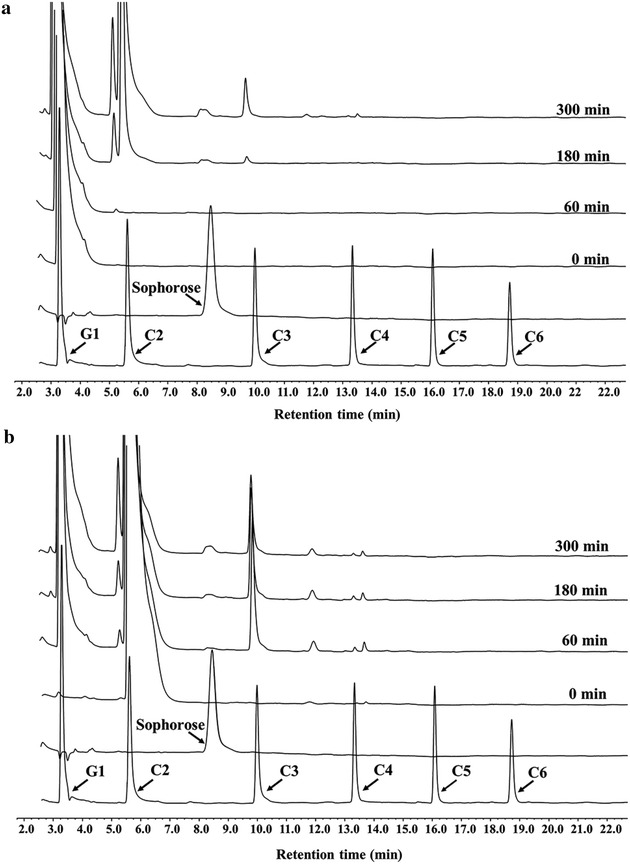
NfBgl3A displayed transglycosylation activity. NfBgl3A was incubated with 150 mM of glucose (a) or 250 mM of cellobiose (b) at pH 5.0 and 70 °C. Samples were taken out periodically and analyzed by HPAEC-PAD. G1 glucose; C2C6 cellobiose to cellohexaose

References

    1. Cherry JR, Fidantsef AL. Directed evolution of industrial enzymes: an update. Curr Opin Biotech. 2003;14:438–443. doi: 10.1016/S0958-1669(03)00099-5. - DOI - PubMed
    1. Martinez D, Berka RM, Henrissat B, Saloheimo M, Arvas M, Baker SE, Chapman J, Chertkov O, Coutinho PM, Cullen D, et al. Genome sequencing and analysis of the biomass-degrading fungus Trichoderma reesei (syn. Hypocrea jecorina) Nat Biotechnol. 2008;26:553–560. doi: 10.1038/nbt1403. - DOI - PubMed
    1. Sipos B, Benko Z, Dienes D, Reczey K, Viikari L, Siika-aho M. Characterisation of specific activities and hydrolytic properties of cell-wall-degrading enzymes produced by Trichoderma reesei Rut C30 on different carbon sources. Appl Biochem Biotechnol. 2010;161:347–364. doi: 10.1007/s12010-009-8824-4. - DOI - PubMed
    1. Miettinen-Oinonen A, Paloheimo M, Lantto R, Suominen P. Enhanced production of cellobiohydrolases in Trichoderma reesei and evaluation of the new preparations in biofinishing of cotton. J Biotechnol. 2005;116:305–317. doi: 10.1016/j.jbiotec.2004.10.017. - DOI - PubMed
    1. Koivula A, Reinikainen T, Ruohonen L, Valkeajarvi A, Claeyssens M, Teleman O, Kleywegt GJ, Szardenings M, Rouvinen J, Jones TA, Teeri TT. The active site of Trichoderma reesei cellobiohydrolase II: the role of tyrosine 169. Protein Eng. 1996;9:691–699. doi: 10.1093/protein/9.8.691. - DOI - PubMed

MeSH terms

LinkOut - more resources