


T Cells Going Innate
- PMID: 27402226
- PMCID: PMC5633931
- DOI: 10.1016/j.it.2016.06.004
T Cells Going Innate
Abstract
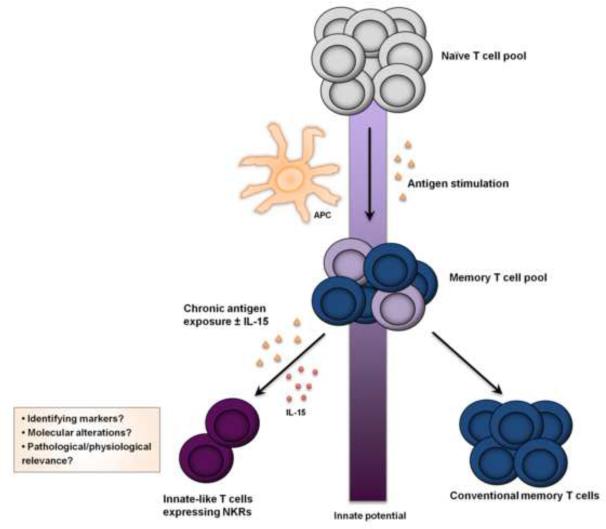
Natural killer (NK) cell receptors (NKRs) play a crucial role in the homeostasis of antigen-experienced T cells. Indeed, prolonged antigen stimulation may induce changes in the receptor repertoire of T cells to a profile that features NKRs. Chronic antigen exposure, at the same time, has been shown to trigger the loss of costimulatory CD28 molecules with recently reported intensified antigen thresholds of antigen-experienced CD8(+) T cells. In transplantation, NKRs have been shown to assist allograft rejection in a CD28-independent fashion. We discuss here a role for CD28-negative T cells that have acquired the competency of the NKR machinery, potentially promoting allorecognition either through T cell receptor (TCR) crossreactivity or independently from TCR recognition. Collectively, NKRs can bring about innate-like T cells by providing alternative costimulatory pathways that gain relevance in chronic inflammation, potentially leading to resistance to CD28-targeting immunosuppressants.
Keywords: NK cell receptors; T cells; adaptive immunity; innate immunity; transplantation.
Copyright © 2016 Elsevier Ltd. All rights reserved.
Figures

References
-
- Ljunggren HG, Kärre K. In search of the “missing self”: MHC molecules and NK cell recognition. Immunol Today. 1990;11:237–44. - PubMed
-
- Bauer S, et al. Activation of NK cells and T cells by NKG2D, a receptor for stress-inducible MICA. Science. 1999;285:727–9. - PubMed
-
- Janeway CA. Approaching the Asymptote? Evolution and Revolution in Immunology. Cold Spring Harb Symp Quant Biol. 1989;54:1–13. - PubMed
-
- O’Leary JG, et al. T cell- and B cell-independent adaptive immunity mediated by natural killer cells. Nat Immunol. 2006;7:507–16. - PubMed
Publication types
MeSH terms
Substances
Grants and funding
LinkOut - more resources
Full Text Sources
Other Literature Sources
Research Materials
