


Primary peritoneal cancer in BRCA carriers after prophylactic bilateral salpingo-oophorectomy
- PMID: 27403072
- PMCID: PMC4922728
- DOI: 10.5152/jtgga.2016.15223
Primary peritoneal cancer in BRCA carriers after prophylactic bilateral salpingo-oophorectomy
Abstract
Objective: The presence of deleterious mutations in breast cancer (BRCA)-1 or BRCA-2 gene has a decisive influence on the development of various types of neoplasms, such as breast, ovarian, tubal, and peritoneal cancers. Primary peritoneal cancer is an aggressive malignancy which, due to the absence of a specific screening test, cannot be diagnosed in its early stages. As a risk-reducing option, prophylactic bilateral salpingo-oophorectomy and mastectomy are often proposed in BRCA gene carriers. The effectiveness of a preventive surgical treatment is, however, unclear in the development of peritoneal cancer.
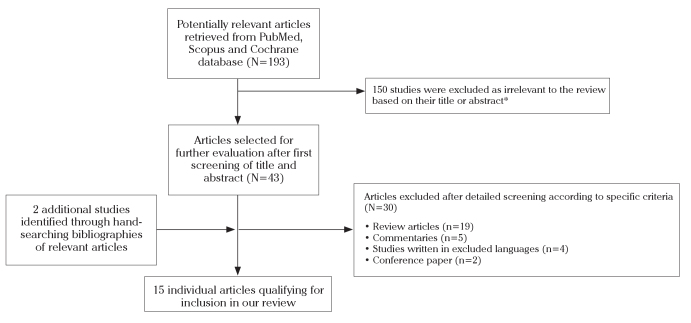
Material and methods: An extensive electronic search was performed in PubMed, Scopus, and Cochrane databases.
Results: The total number of patients who underwent prophylactic bilateral salpingo-oophorectomy was 1,830, of whom 28 presented with peritoneal cancer (1.53%). The age of the included patients ranged from 48 to 61 years. BRCA-1 was present in 9 out of 28 patients and BRCA-2 in 2 patients, while the type of BRCA was unclear in 17 patients. Salpingo-oophorectomy was performed in 23 out of 28 patients, while oophorectomy was carried out in 5 patients. The interval from initial risk-reducing surgical treatment to the presentation of peritoneal cancer ranged from 12 to 84 months.
Conclusion: Modification of the follow-up guidelines and increase in healthcare providers' awareness may reduce the risk of peritoneal cancer.
Keywords: BRCA gene; etiology; management; peritoneal carcinoma; prophylaxis.
Figures
References
-
- Finch A, Beiner M, Lubinski J, Lynch HT, Moller P, Rosen B, et al. Salpingo-oophorectomy and the risk of ovarian, fallopian tube, and peritoneal cancers in women with a BRCA1 or BRCA2 Mutation. JAMA. 2006;296:185–92. http://dx.doi.org/10.1001/jama.296.2.185. - DOI - PubMed
-
- Reitsma W, de Bock GH, Oosterwijk JC, Bart J, Hollema H, Mourits MJ. Support of the ‘fallopian tube hypothesis’ in a prospective series of risk-reducing salpingo-oophorectomy specimens. Eur J Cancer. 2013;49:132–41. http://dx.doi.org/10.1016/j.ejca.2012.07.021. - DOI - PubMed
-
- Pölcher M, Hauptmann S, Fotopoulou C, Schmalfeldt B, Meinhold-Heerlein I, Mustea A, et al. Opportunistic salpingectomies for the prevention of a high-grade serous carcinoma: a statement by the Kommission Ovar of the AGO. Arch Gynecol Obstet. 2015;292:231–4. http://dx.doi.org/10.1007/s00404-015-3697-y. - DOI - PubMed
-
- Bacha OM, Gregoire J, Grondin K, Edelweiss MI, Laframboise R, Simard J, et al. Effectiveness of risk-reducing salpingo-oophorectomy in preventing ovarian cancer in a high-risk French Canadian population. Int J Gynecol Cancer. 2012;22:974–8. http://dx.doi.org/10.1097/IGC.0b013e318257b936. - DOI - PubMed
-
- Iavazzo C, Vorgias G, Katsoulis M, Kalinoglou N, Dertimas V, Akrivos T. Primary peritoneal serous papillary carcinoma: clinical and laboratory characteristics. Arch Gynecol Obstet. 2008;278:53–6. http://dx.doi.org/10.1007/s00404-008-0678-4. - DOI - PubMed
LinkOut - more resources
Full Text Sources
Other Literature Sources
Research Materials
Miscellaneous
