


Rifabutin-based 10-day and 14-day triple therapy as a third-line and fourth-line regimen for Helicobacter pylori eradication: A pilot study
- PMID: 27403304
- PMCID: PMC4924440
- DOI: 10.1177/2050640615618043
Rifabutin-based 10-day and 14-day triple therapy as a third-line and fourth-line regimen for Helicobacter pylori eradication: A pilot study
Abstract
Background and aim: This prospective randomized study was designed to assess the efficacy of 10-day and 14-day rifabutin-based triple therapy as a third- or fourth-line rescue therapy.
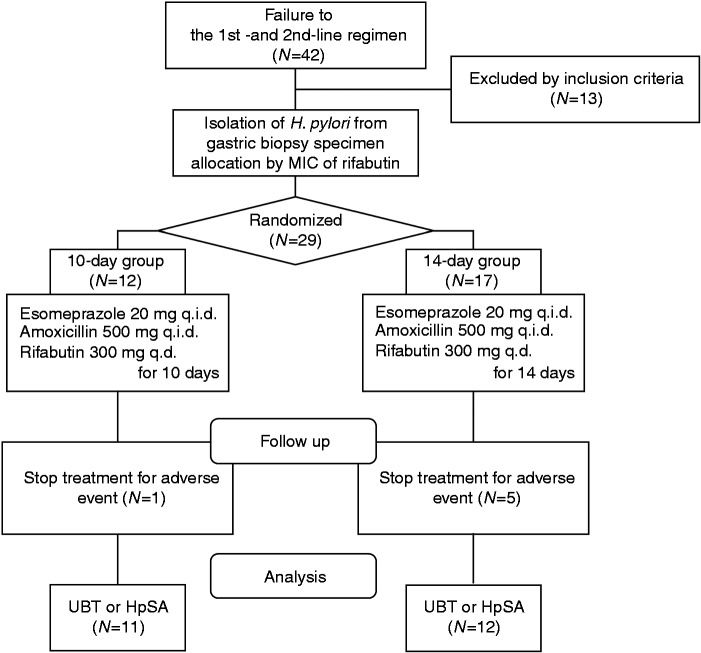
Methods: Patients who failed first- and second-line eradication therapy were enrolled. H. pylori was isolated from gastric biopsy specimens and the rpoB mutation status, a factor of resistance to rifamycins, and minimum inhibitory concentrations (MICs) of rifabutin and amoxicillin were determined. Enrolled patients were randomly assigned to receive 10-day or 14-day eradication therapy with esomeprazole (20 mg, 4 times a day (q.i.d.)), amoxicillin (500 mg, q.i.d.), and rifabutin (300 mg, once a day (q.d.s.)). Poor compliance was defined as intake of <80% of study drugs. Successful H. pylori eradication was confirmed using a [13C] urea breath test or a stool antigen test, 12 weeks after the end of therapy.
Results: Twelve patients were assigned to the 10-day group, and 17, to the 14-day group. Intention-to-treat and per-protocol analyses of eradication rates were 83.3% and 81.8% for the 10-day group and 94.1% and 91.7% for the 14-day group, respectively. All patients with rpoB mutation-positive strains (n = 3) showed successful eradication, irrespective of the regimen received. Therapy was stopped due to adverse events in 8.3% and 29.3% of patients in the 10-day and 14-day groups, respectively.
Conclusion: Both the 10-day and 14-day therapies were effective as rescue regimens. In particular, the 14-day therapy resulted in successful eradication in over 90% of patients, but the 10-day treatment may be enough to obtain a successful eradication rate, considering the tolerability of therapy.
Keywords: Rifabutin; amoxicillin; rpoB.
Figures
References
-
- Miwa H, Sakaki N, Sugano K, et al. Recurrent peptic ulcers in patients following successful Helicobacter pylori eradication: A multicenter study of 4940 patients. Helicobacter 2004; 9: 9–16. - PubMed
-
- Fukase K, Kato M, Kikuchi S, et al. Effect of eradication of Helicobacter pylori on incidence of metachronous gastric carcinoma after endoscopic resection of early gastric cancer: An open-label, randomised controlled trial. Lancet 2008; 372: 392–397. - PubMed
-
- Nakamura S, Sugiyama T, Matsumoto T, et al. Long-term clinical outcome of gastric MALT lymphoma after eradication of Helicobacter pylori: A multicentre cohort follow-up study of 420 patients in Japan. Gut 2012; 61: 507–513. - PubMed
-
- Asaka M, Sugiyama T, Kato M, et al. A multicenter, double-blind study on triple therapy with lansoprazole, amoxicillin and clarithromycin for eradication of Helicobacter pylori in Japanese peptic ulcer patients. Helicobacter 2001; 6: 254–261. - PubMed
-
- Murakami K, Sato R, Okimoto T, et al. Efficacy of triple therapy comprising rabeprazole, amoxicillin and metronidazole for second-line Helicobacter pylori eradication in Japan, and the influence of metronidazole resistance. Aliment Pharmacol Ther 2003; 17: 119–123. - PubMed
LinkOut - more resources
Full Text Sources
Other Literature Sources
