


Common and Divergent Mechanisms in Developmental Neuronal Remodeling and Dying Back Neurodegeneration
- PMID: 27404258
- PMCID: PMC5086086
- DOI: 10.1016/j.cub.2016.05.025
Common and Divergent Mechanisms in Developmental Neuronal Remodeling and Dying Back Neurodegeneration
Abstract
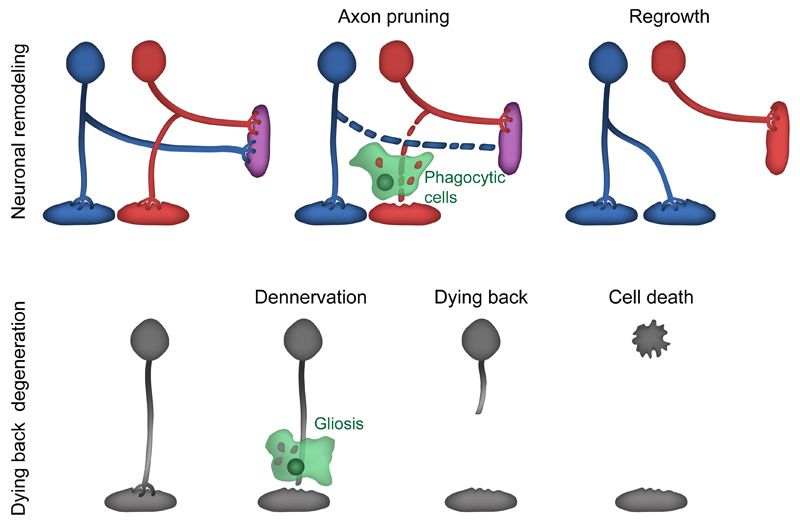
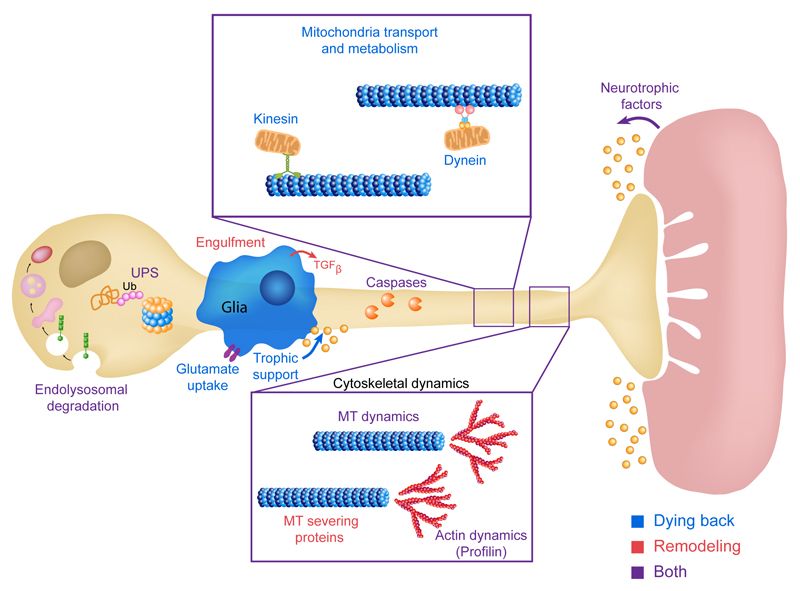
Cell death is an inherent process that is required for the proper wiring of the nervous system. Studies over the last four decades have shown that, in a parallel developmental pathway, axons and dendrites are eliminated without the death of the neuron. This developmentally regulated 'axonal death' results in neuronal remodeling, which is an essential mechanism to sculpt neuronal networks in both vertebrates and invertebrates. Studies across various organisms have demonstrated that a conserved strategy in the formation of adult neuronal circuitry often involves generating too many connections, most of which are later eliminated with high temporal and spatial resolution. Can neuronal remodeling be regarded as developmentally and spatially regulated neurodegeneration? It has been previously speculated that injury-induced degeneration (Wallerian degeneration) shares some molecular features with 'dying back' neurodegenerative diseases. In this opinion piece, we examine the similarities and differences between the mechanisms regulating neuronal remodeling and those being perturbed in dying back neurodegenerative diseases. We focus primarily on amyotrophic lateral sclerosis and peripheral neuropathies and highlight possible shared pathways and mechanisms. While mechanistic data are only just beginning to emerge, and despite the inherent differences between disease-oriented and developmental processes, we believe that some of the similarities between these developmental and disease-initiated degeneration processes warrant closer collaborations and crosstalk between these different fields.
Copyright © 2016 Elsevier Ltd. All rights reserved.
Figures
References
-
- Yamaguchi Y, Miura M. Programmed Cell Death in Neurodevelopment. Dev Cell. 2015;32:478–490. - PubMed
-
- Cowan WM, Fawcett JW, O'Leary DD, Stanfield BB. Regressive events in neurogenesis. Science. 1984;225:1258–1265. - PubMed
-
- Truman JW. Metamorphosis of the central nervous system of Drosophila. J Neurobiol. 1990;21:1072–1084. - PubMed
-
- Truman JW, Reiss SE. Dendritic reorganization of an identified motoneuron during metamorphosis of the tobacco hornworm moth. Science. 1976;192:477–479. - PubMed
-
- Purves D, Lichtman JW. Elimination of synapses in the developing nervous system. Science. 1980;210:153–157. - PubMed
Publication types
MeSH terms
Grants and funding
LinkOut - more resources
Full Text Sources
Other Literature Sources
Medical
